

What Is a Startup Company? Swiss Founders' Guide
A startup co is a young company built to find a repeatable, scalable business model, usually around a new product or technology, with growth that outpaces its costs. Unlike a traditional small business, a startup co aims to serve a large market quickly and typically funds that growth with outside capital rather than only its own revenue.
For founders in Switzerland, the label carries practical weight. It shapes which legal entity you choose, which investors will take your call and how much dilution you accept along the way. This guide explains what a startup company is, how it works, where it differs from a small business and what the Swiss funding picture looks like in 2026.
What Defines a Startup Company?
A startup company is defined by three traits: it tests an unproven model, it is designed to scale, and it operates under high uncertainty with limited resources. Age and headcount matter less than intent. A ten-year-old company that has stopped searching for a new model is no longer a startup, while a six-month-old venture with a scalable product and a plan to enter several markets clearly is.
The core characteristics are consistent across most definitions:
- Scalable model: revenue can grow much faster than costs, as with software, platforms or licensed hardware designs.
- Innovation: the product, process or business model solves a problem in a new way.
- Uncertainty: the market, pricing and customer base are still being validated.
- Growth orientation: the founders aim for rapid expansion instead of steady, local income.
- External capital: founders usually raise money from angels, syndicates or venture funds to move faster than revenue allows.
Founders often use "entrepreneur" and "startup" interchangeably, but they describe different things. Swisspreneur's breakdown of the difference between an entrepreneur and a startup covers that distinction in more depth.
How a Startup Co Differs From a Small Business
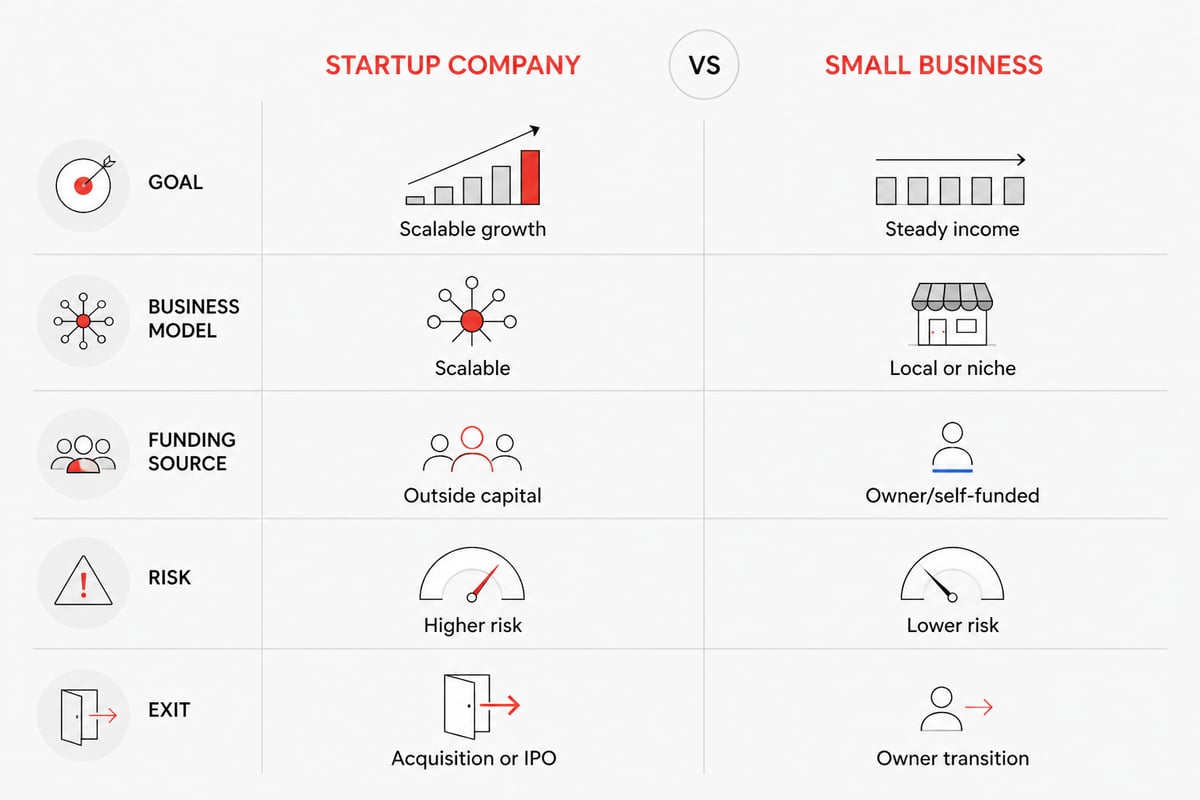
A startup co differs from a small business mainly in its goal: the small business aims for stable profit within a defined market, while the startup aims for rapid growth in a large one. Both can be legitimate, profitable and well run. They simply optimize for different outcomes.
| Attribute | Small business | Startup company |
|---|---|---|
| Primary goal | Steady profit and local presence | Fast growth and market share |
| Business model | Proven and repeatable | Being tested and refined |
| Funding | Owner capital, bank loans, revenue | Angels, syndicates, venture capital |
| Risk profile | Moderate | High, with outsized upside |
| Exit expectation | Rarely planned | Acquisition or IPO often anticipated |
| Time to scale | Gradual | Compressed, often within a few years |
A bakery with three locations and a software company serving customers across Europe may both employ twenty people. The bakery grows by adding branches. The software company grows by adding customers at almost no additional cost per customer. That difference in marginal cost is why investors treat the two so differently.
How a Startup Company Works: The Typical Life Cycle
A startup company moves through stages, each defined by what the founders must prove before the next round of capital or commitment becomes reasonable. The labels vary, but the logic is consistent.
- Idea and validation. Founders test whether a real problem exists and whether customers will pay for a solution. Interviews, landing pages and prototypes are common tools.
- Early traction. A first version reaches real users. Revenue, pilots or growing usage show that demand is more than a hypothesis.
- Pre-seed. Small amounts of capital fund the team and the first product iterations, often from angels or a syndicate.
- Seed. With traction in hand, founders raise a larger round to refine the model, hire and build repeatable sales or growth channels.
- Series A and beyond. Funds back a model that already works, to scale it across markets.
- Exit or sustainability. The company is acquired, lists publicly or grows into a long-term independent business.
Most startups never complete every stage. Many fail at validation or traction, which is why disciplined idea testing matters. The Swisspreneur article on the dos and don'ts of startup idea testing is a practical starting point for the first stage, and the page on startup lessons collects hard-won experience from the road after it.
Common Types of Startups With Examples
Startups cluster into a handful of recognizable categories, and the type affects how much capital is needed and how long it takes to reach revenue. The Swiss ecosystem is strong in several of them.
- Software and SaaS: low capital needs, fast iteration, subscription revenue. Many early-stage Swiss founders start here.
- Deep tech and robotics: longer development cycles and heavier funding needs, often tied to ETH Zurich and EPFL research. Swisspreneur's podcast episode on Realbot Engineering shows what a hardware-oriented startup looks like in practice.
- Biotech and medtech: regulated, capital-intensive and slow to reach market, but attractive to specialist investors. Biotech startups attracted strong investment growth in 2024, according to Venturelab.
- AI-driven businesses: the fastest-growing category by deal count. EY Switzerland found that AI-related business models accounted for a significant share of Swiss startup funding rounds in 2024.
- Service and marketplace startups: these connect supply and demand or productize a service. See Swisspreneur's overview of the service startup model.
Corporate-backed ventures are a separate case, covered in the guide to the corporate startup.
Legal Structure: GmbH or AG for a Swiss Startup Co
A Swiss startup co is usually incorporated as a GmbH (limited liability company) or an AG (stock corporation), and the choice mainly depends on capital requirements and investor expectations. Both give founders limited liability, which separates personal assets from company debts.
According to the Canton of Schwyz, an AG requires share capital of at least CHF 100,000, of which at least CHF 50,000 must be contributed at formation. A GmbH requires minimum share capital of CHF 20,000, which may be contributed in cash or in kind.
That lower threshold makes the GmbH attractive for first-time founders. The AG, however, has traditionally been the preferred form for companies expecting multiple funding rounds, since shares are easier to issue and transfer. Many founders start as a GmbH and convert later, though conversion carries notary and administrative costs, so it is worth discussing with a lawyer before the first round.
Founders weighing the international side of company setup, such as cross-border residency or investor relocation, may find a specialist resource useful. For questions about cross-border immigration and citizenship by investment, JS Privé offers a private practice with expert advisers in that area.

The Swiss Startup Landscape in 2026
Switzerland combines a high rate of company formation with a funding market that has cooled from its peak but remains active. The Swiss Federal SME Portal reports that the number of companies founded in 2025 was 34.7% higher than in 2015, which signals sustained founder activity across the country.
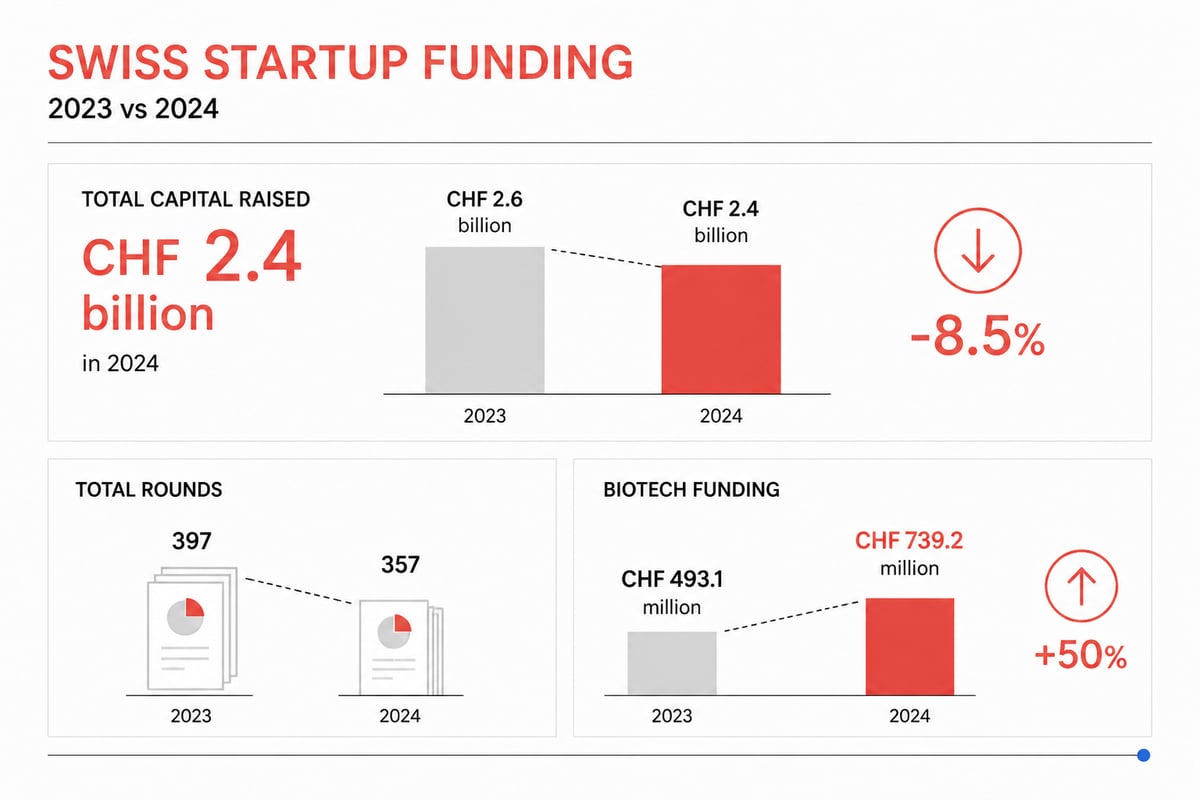
Funding tells a more cautious story. Greater Geneva Bern area data shows Swiss startups raised CHF 2.4 billion in venture capital in 2024, an 8.5% decline from 2023, while financing rounds fell from 397 to 357. EY counts rounds differently and recorded 513 in 2024, down 6.7% from 550 the year before. The EY Swiss Startup Barometer breaks these figures down by region, gender and industry.
The practical reading for founders: capital is available, but investors ask for more evidence before writing a check. Traction, clear unit economics and a credible team carry more weight than a polished deck alone.
How Startup Funding Works
Startup funding works by trading equity for capital, with each round priced on the evidence the company has produced so far. The earlier the stage, the more the price rests on the team and the market, and the less on financial results.
Common sources for a Swiss startup co include:
- Founders and family: personal savings or early support from people who know the founders.
- Business angels: individuals investing their own money, often with relevant industry experience.
- Syndicates: groups of investors who pool capital behind a single lead, so the startup deals with one coordinated party.
- Venture capital funds: institutional investors that typically enter at seed or Series A.
- Grants and innovation funding: non-dilutive support, often tied to research or technical milestones.
Pre-seed and seed rounds are where most Swiss founders feel the pressure, because the amounts are too small for large funds and too large for savings. Swisspreneur Investments for startups addresses that gap through its syndicate. Founders decide which investors and founders join each deal, and the syndicate takes a 15% carried interest with no management fee. Swiss startup founders can close a pre-seed round in about 2-3 weeks through the syndicate, and investors can join with as little as CHF 5,000 per deal. The syndicate has raised over CHF 3M in investments to date, and its database includes more than 1,000 investors.
Founders should also understand their own financial footing before approaching investors.
Why Understanding the Startup Model Matters
Understanding what a startup company is shapes decisions that are expensive to reverse, from legal form to the investors you accept. A founder who treats a growth venture like a lifestyle business may undercapitalize it. A founder who forces a stable local business into the venture model may give up equity for money the business never needed.
Several practical consequences follow:
- Fundraising expectations. Investors back startups because they can return many times their money. If your realistic ceiling is a profitable regional company, venture funding is the wrong tool.
- Hiring and culture. Startups hire ahead of revenue and rely on small teams with broad responsibilities. Swisspreneur's guide to building culture in a Swiss startup and the piece on what makes startup teams successful address this directly.
- Business model choice. Revenue logic should be settled early. The overview of business models for startups lays out the common options.
- Community access. Founders who connect with peers early learn faster and avoid repeated mistakes. Swisspreneur offers free masterclasses, over 550 podcast episodes and a Slack community of founders at no cost to startups.
Common Challenges Startups Face
Startups fail more often from running out of runway and misreading the market than from bad ideas alone. The main pressures are predictable, which means they can be planned for.
- Cash runway. Burn rate against remaining capital determines how many experiments the team gets. Raising before cash is critical gives more negotiating power.
- Product-market fit. Building something customers say they like is different from building something they pay for and keep using.
- Team conflict. Disagreements between co-founders about roles, equity or direction are a frequent cause of early collapse.
- Hiring under constraints. Limited budgets make it hard to compete for talent, especially in the Swiss labor market.
- Fundraising conditions. With round counts down year over year, preparation matters more. A clear story backed by traction data shortens the process.
- Pace of learning. Startups that talk to customers weekly adjust faster than those that plan for months before testing.
Founders benefit from hearing how others handled these problems. Swisspreneur's candid podcast conversations, including how to hire and manage your startup team, give an unfiltered view of the trade-offs, and the startup journey page maps the typical path from first idea to growth.
Related Terms Founders Should Know
Founders meet a consistent vocabulary once they begin raising money, and knowing it prevents confusion in early conversations.
- Scale-up: a company that has proven its model and is now expanding it quickly, usually after Series A.
- MVP (minimum viable product): the simplest version of a product that lets you test demand.
- Pre-seed and seed: the earliest funding rounds, typically used to build the first product and find early customers.
- Cap table: the record of who owns what percentage of the company.
- Dilution: the reduction in existing owners' percentage when new shares are issued.
- Carried interest: the share of profits a syndicate lead or fund manager keeps after investors are repaid.
- Runway: the number of months a company can operate before cash runs out.
- Traction: measurable evidence of demand, such as revenue, users or signed pilots.
If you are a Swiss startup with a GmbH or AG and early traction, start by writing down your current runway, your monthly growth and the amount you realistically need for the next 12 to 18 months, since every investor conversation begins with those three numbers. Swisspreneur's pre-seed and seed funding for Swiss startups can take it from there through its syndicate. If you invest in early-stage companies yourself, you can start with small tickets and back founders directly, so sign up for deals on Switzerland's leading platform for entrepreneurs.