

Difference Between Entrepreneur and Startup Explained
The difference between entrepreneur and startup is that an entrepreneur is a person who identifies an opportunity and builds a venture around it, while a startup is the young, high-growth company that person creates. One describes an individual with a mindset and a role; the other describes an organization with a business model and a growth plan. Confusing the two leads to muddled pitches, wrong funding choices and unrealistic expectations.
This article separates the terms, shows where they overlap, and explains what the distinction means in practice for founders raising early-stage capital in Switzerland and for individuals who want to back them.
What is an entrepreneur?
An entrepreneur is a person who creates, organizes and takes on the risk of a new business in pursuit of an opportunity. The role is defined by behavior: spotting a gap, committing resources and accepting uncertainty.
The Congressional Research Service describes entrepreneurship as the creation and growth of a new business enterprise, and notes that it can also occur inside an existing firm through a new product, service or process. That second point matters. Entrepreneurship is an activity, and it is not limited to people who run their own company. If you want to explore that angle, Swisspreneur has a useful overview of entrepreneurship inside established organizations.
Entrepreneurs come in many forms:
- Solo operators who build a consultancy, a shop or a freelance practice
- Serial founders who start several ventures over a career
- Corporate entrepreneurs who launch new units within a larger company
- Social entrepreneurs who prioritize impact alongside revenue
None of these people necessarily builds a startup. A baker who opens a second location is an entrepreneur. So is a founder who raises CHF 1.5 million to scale a software platform across Europe. Only the second is running a startup in the usual sense.
What is a startup?
A startup is a young company built to find a repeatable, scalable business model under conditions of high uncertainty. Its defining feature is the intent to grow quickly, often by serving a large market with a product or service that can be replicated at low marginal cost.
Several traits separate a startup from an ordinary new business:
- Scalability. Revenue can grow much faster than costs.
- Innovation. The product, technology or model is new or meaningfully better than existing options.
- Search for a model. The company is still testing what customers will pay for and how to reach them.
- External capital. Growth is often financed by angels, syndicates or venture investors rather than by profit alone.
- Time pressure. Runway is finite, so progress must be demonstrated within months.
A startup is a temporary state. Once the business model is proven and growth settles into a predictable pattern, the company graduates into a scale-up or a mature firm. For a deeper look at how the term has been used, see Swisspreneur's piece on the difference between startup and entrepreneurship.
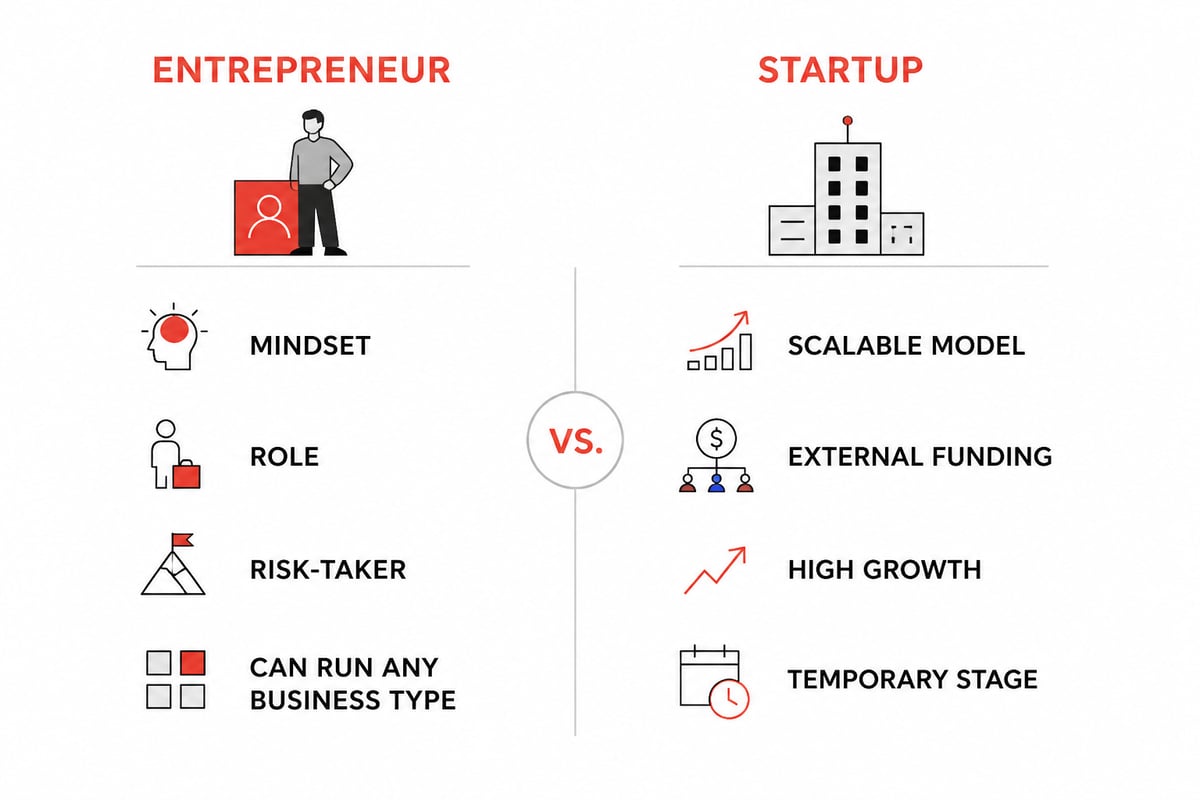
Difference between entrepreneur and startup: a side-by-side view
The most useful way to see the difference between entrepreneur and startup is to compare them on the same attributes. The table below summarizes the core contrasts.
| Attribute | Entrepreneur | Startup |
|---|---|---|
| Nature | A person | A company |
| Defined by | Mindset, initiative, risk-taking | Scalable model, growth intent |
| Lifespan | Can span a whole career | A stage, usually a few years |
| Can exist without the other? | Yes, many run non-startup businesses | Yes, though someone must found it |
| Typical funding | Savings, bank loans, revenue | Angels, syndicates, venture capital |
| Success measure | Value created, personal goals | Growth rate, traction, exit or scale |
| Legal form in Switzerland | Sole proprietorship, GmbH, AG | Usually GmbH or AG |
The relationship is one of containment. Every startup has at least one entrepreneur behind it, but only a fraction of entrepreneurs ever found a startup. Swisspreneur explores the person-versus-concept side of this in its article on the entrepreneur and entrepreneurship distinction.
Is entrepreneurship the same as being an entrepreneur?
No. Entrepreneurship is the process of creating and growing a venture, while an entrepreneur is the person who carries out that process. Think of entrepreneurship as the activity and the entrepreneur as the actor.
A concrete example makes this clear. Consider a Zurich-based founder who spots inefficiencies in how hospitals schedule staff:
- The entrepreneur is the founder who recognizes the problem and commits to solving it.
- Entrepreneurship is everything the founder does: validating demand, assembling a team, pricing the product, closing the first pilot customer.
- The startup is the company that results, with its codebase, contracts and cap table.
Three terms, three different things. The same founder could later step back, hire a CEO and remain an investor, no longer acting as an entrepreneur in day-to-day terms while the startup continues to operate.
Different types of entrepreneurship and startups
Entrepreneurship takes several recognized forms, and startups represent only one of them. Understanding the categories helps founders describe themselves accurately to investors.
Types of entrepreneurship
- Small business entrepreneurship: local, stable ventures such as restaurants, trades and agencies, built for steady income rather than rapid scale.
- Scalable startup entrepreneurship: high-growth ventures that seek outside capital and aim for large markets.
- Large company entrepreneurship: innovation launched within established firms, sometimes called corporate entrepreneurship.
- Social entrepreneurship: ventures designed to address a social or environmental problem, with profit as a means rather than the sole goal.
Types of startups
Startups themselves vary by approach. Some are product-led software companies, others are deep-tech spin-outs from universities such as ETH Zurich or EPFL, and others are marketplace or hardware ventures. What unites them is the pursuit of scale under uncertainty.
A useful rule: if the plan is to serve a defined local market profitably and grow at a measured pace, you are running a small business, and that is a perfectly respectable outcome. If the plan is to capture a large market quickly with outside capital, you are building a startup.
How funding and risk differ
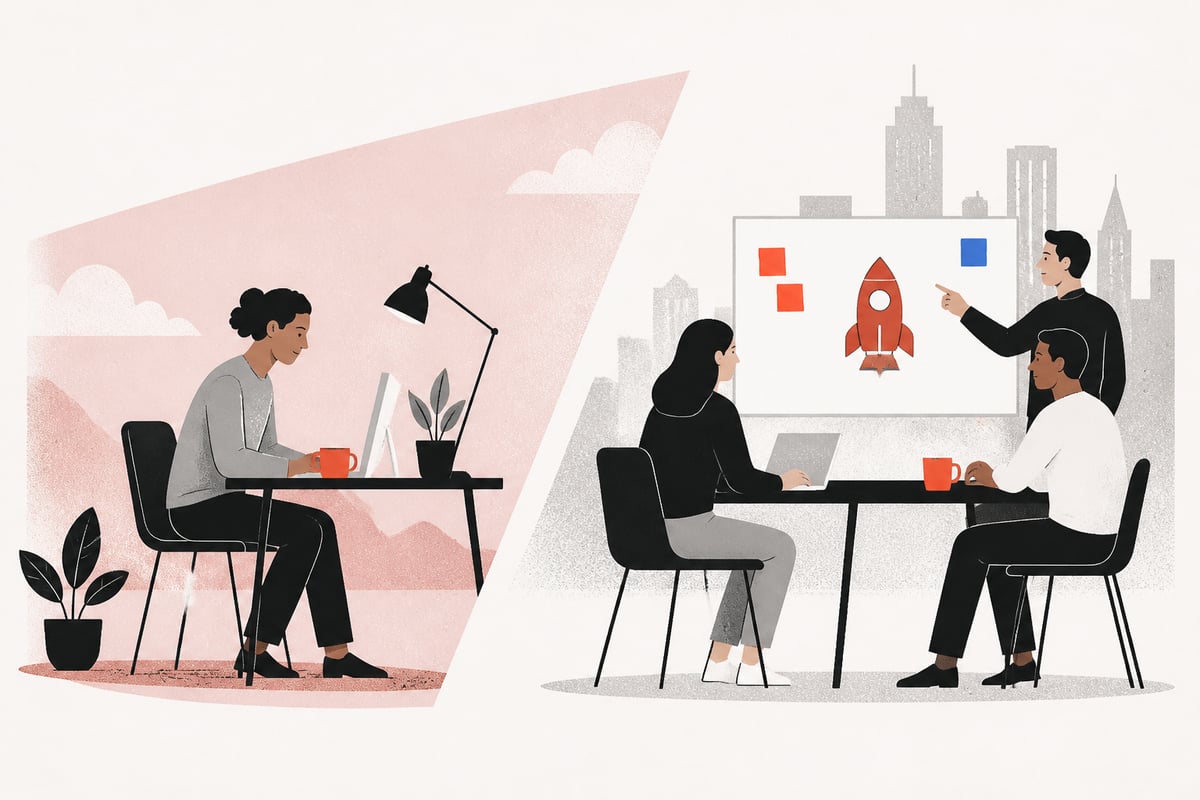
Funding is where the distinction becomes most practical. An entrepreneur running a conventional business typically finances it through personal savings, customer revenue or a bank loan, and keeps full ownership. A startup founder usually sells equity to investors in exchange for capital to grow faster than revenue alone would allow.
Risk behaves differently too. A small business owner risks savings and time, with a moderate and fairly predictable downside. A startup founder takes on a wider spread of outcomes: most ventures return little, while a few return a great deal.
For perspective on baseline survival, the U.S. Bureau of Labor Statistics publishes one-year survival rates for new business establishments by year and location, which vary by region. Those figures cover all new establishments, not only high-growth startups, which tend to face steeper odds. Founders should read such numbers as context for planning runway, not as a forecast for their own company.
In Switzerland, early-stage funding often comes from a mix of angel investors, regional programs and syndicates. A Swiss startup with a GmbH or AG and early traction can open conversations with professional investors well before a large venture round. Those looking for an organized route can look at Swisspreneur Investments for startups, where founders choose which investors and founders join each deal, and the Syndicate takes a 15% carried interest with no management fee. The Syndicate has facilitated over CHF 3M in investments to date.
Is it true that 90% of startups fail?
The often-quoted figure that 90% of startups fail is a rough rule of thumb, and the true rate depends on how failure and startup are defined. Broad data on new businesses paints a less severe picture in the first year, though long-term survival is lower.
The one-year survival figures above, in the mid-70% range, show that most new establishments do not close within twelve months. Failure accumulates over time and is heavily concentrated among ventures that never found a repeatable customer base. Definitions matter: a company that is acquired, pivots or winds down voluntarily is counted differently depending on the study.
For founders, the practical lesson is to reduce the odds of a preventable failure by testing demand early.
Are entrepreneurs born or made?
Entrepreneurs are largely made. Personality traits such as tolerance for uncertainty and persistence may give some people a head start, but the skills that determine outcomes, including selling, hiring, pricing and managing cash, are learned through practice and feedback.
This is reinforced by how many people try. The Congressional Research Service reports that the United States starts an average of 4.1 million businesses annually, a volume that could not be explained by a rare inborn type. Switzerland is smaller, but the pattern holds: founders come from engineering labs, consultancies, corporates and universities, with very different starting profiles.
Learning from others who have already made the mistakes shortens the curve. Swisspreneur's 550+ freely available podcast episodes include candid conversations such as an entrepreneur's secrets to selling two startups, and there is free masterclass content for founders building their first company.
Why the distinction matters for Swiss founders and investors
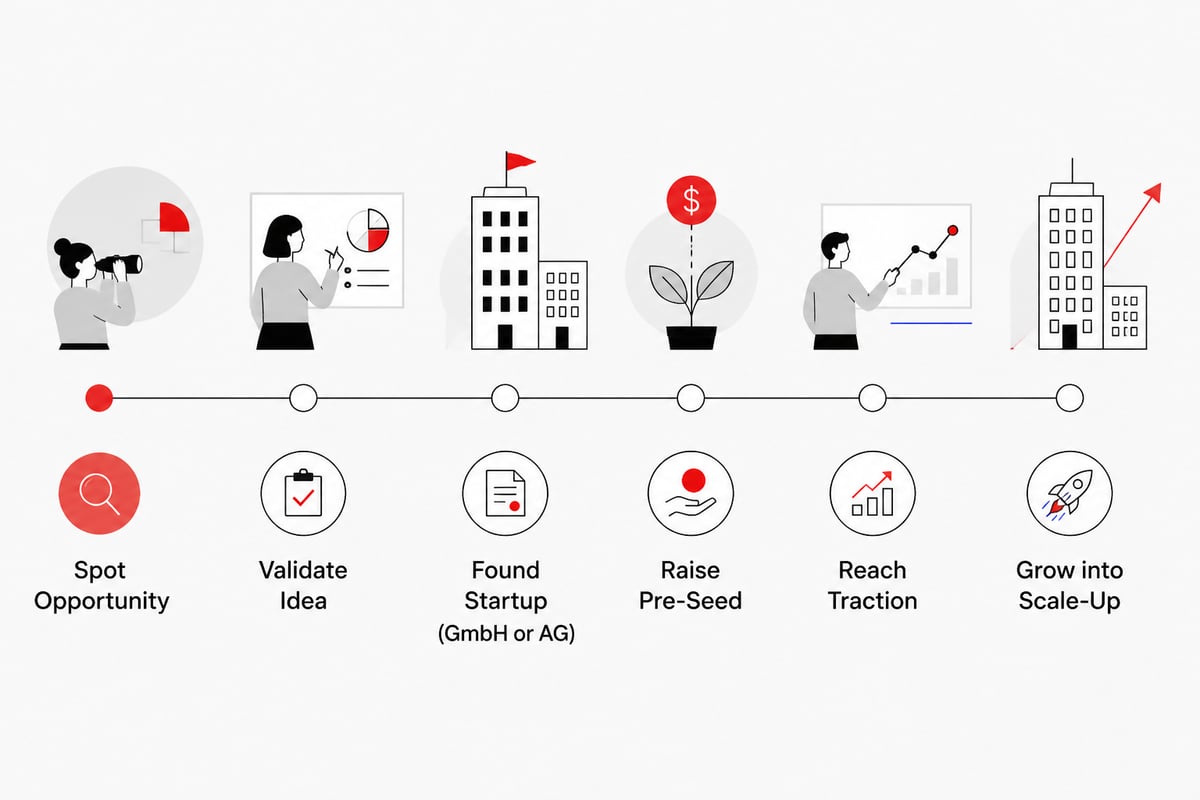
Getting the terms right changes how you pitch, who you approach and what you promise. A founder who describes the venture as a startup is signaling scalability, outside capital and a growth path, and investors will test those claims. A founder running a steady, profitable small business should say so, and seek bank financing or reinvest profits instead of chasing venture-style rounds.
For founders, the practical checklist looks like this:
- Confirm the model scales. Can revenue grow far faster than costs?
- Check your legal entity. Investors expect a Swiss GmbH or AG for a formal equity round.
- Show traction, not just an idea. Early customers or pilots matter more than a polished deck.
- Match funding to ambition. Equity suits high-growth plans; loans and revenue suit steadier ones.
For individual investors, the distinction defines the risk you are taking. Backing a startup means accepting a wide range of outcomes in exchange for the chance of outsized returns, so tickets should be sized accordingly and spread across several companies. There are over 1,000 investors in Swisspreneur's database.
International comparisons can also sharpen your view of how new ventures start. Eurostat publishes statistical indicators on entrepreneurship, including the share of new businesses launched by self-employed people and by small teams, which shows how many ventures begin as one-person efforts long before they become startups. For the Swiss context specifically, Swisspreneur's overview of startups in Switzerland is a useful companion.
Community matters as much as capital at this stage. Swisspreneur connects over 700 founders through its Slack channel and runs 10+ startup events per year, giving founders peers to compare notes with while they work out whether they are building a startup or a different kind of business.
FAQ
What is the difference between entrepreneurship and entrepreneur with examples?
Entrepreneurship is the process of creating and growing a venture, while an entrepreneur is the person who does it. For example, a founder who builds a fintech company is the entrepreneur, and the work of validating the idea, hiring and raising funds is entrepreneurship.
Can someone be an entrepreneur without running a startup?
Yes. Many entrepreneurs run small businesses, consultancies or family firms that grow steadily without outside investment or rapid-scale ambitions. Others practice entrepreneurship inside larger companies by launching new products or units.
Does every startup need an entrepreneur?
Every startup begins with at least one founder acting as an entrepreneur, since someone must spot the opportunity and commit resources. Over time the company may hire executives who run operations, but the venture still originates with entrepreneurial action.
Your next step is to write down, in one sentence, whether you are building a scalable startup or a steady business, and match your funding plan to that answer. If it is a startup with a Swiss legal entity and early traction, Swisspreneur Investments for startups outlines how founders raise pre-seed and seed rounds through the Syndicate. Swisspreneur is Switzerland's leading platform for entrepreneurs, with podcasts, free masterclasses and events that connect founders with business leaders and innovators across the Swiss ecosystem. If you want to back early-stage companies with small tickets, Swisspreneur is where you can sign up for deals and see what is currently open.