

Difference Between Startup and Entrepreneurship
The terms "startup" and "entrepreneurship" are frequently used interchangeably in business conversations, yet they represent fundamentally different concepts with distinct characteristics, goals, and methodologies. Understanding the difference between startup and entrepreneurship is crucial for anyone entering the business world, especially in Switzerland's dynamic ecosystem where both traditional business ventures and high-growth ventures coexist. This distinction affects everything from funding strategies to operational approaches, making it essential knowledge for aspiring business founders in 2026.
Understanding Entrepreneurship: The Foundation of Business Creation
Entrepreneurship represents the broader concept of creating and managing a business venture while taking on financial risks in pursuit of profit. The fundamental nature of entrepreneurship encompasses a wide range of business activities, from opening a local bakery to launching a consulting firm.
An entrepreneur focuses on building a sustainable business that generates consistent revenue and serves a specific market need. This approach prioritizes stability, profitability, and long-term growth over rapid expansion.
Core Characteristics of Traditional Entrepreneurship
Traditional entrepreneurship manifests in several distinct ways:
- Self-funding or traditional loans as primary capital sources
- Steady growth trajectory aligned with market demand
- Immediate profitability focus rather than deferred returns
- Established business models with proven market validation
- Local or regional market focus before considering expansion
The entrepreneurial mindset emphasizes creating value through solving existing problems with known solutions. Swiss entrepreneurs, for instance, might establish manufacturing firms, retail operations, or service businesses that serve their communities while building wealth over decades.

The Entrepreneurial Ecosystem in Switzerland
Switzerland's entrepreneurial landscape supports diverse business ventures across multiple sectors. Many Swiss entrepreneurs build companies that prioritize quality, precision, and incremental innovation rather than disruptive technology.
| Aspect | Traditional Entrepreneurship |
|---|---|
| Funding Source | Personal savings, bank loans, family |
| Growth Rate | 10-25% annually |
| Market Approach | Local/regional first |
| Profitability Timeline | 6-18 months |
| Exit Strategy | Lifestyle business or succession |
These businesses form the backbone of the Swiss economy, contributing to employment and regional development while maintaining sustainable growth patterns.
Defining Startups: The High-Growth Business Model
A startup represents a temporary organization designed to search for a repeatable and scalable business model. This definition, popularized by entrepreneur Steve Blank, highlights the difference between startup and entrepreneurship in fundamental ways.
Startups operate under conditions of extreme uncertainty, experimenting with innovative solutions to problems that may not have established markets yet. The goal isn't simply profitability but rather discovering a business model that can scale rapidly.
Key Characteristics of Startup Ventures
Startups distinguish themselves through several critical attributes:
- Scalability potential that allows 10x or 100x growth
- Innovation-driven approach creating new markets or disrupting existing ones
- Technology enablement as a core growth lever
- Venture capital compatibility seeking external investment
- Exit-oriented strategy planning for acquisition or IPO
The distinction between startup founders and traditional entrepreneurs becomes evident in their risk tolerance and growth expectations. Startup founders accept years of losses in pursuit of exponential returns, while traditional entrepreneurs seek profitability from early stages.
The Startup Methodology in Practice
Swiss startups in 2026 leverage unique advantages including strong intellectual property protection, access to European markets, and world-class research institutions. These ventures typically follow a distinct lifecycle:
- Ideation phase: Identifying problems worth solving at scale
- Validation stage: Testing assumptions with minimum viable products
- Growth phase: Achieving product-market fit and scaling operations
- Maturity stage: Becoming established companies or successful exits
Many Swiss founders navigate this journey through Swisspreneur's network, connecting with experienced entrepreneurs who've built successful ventures.
Critical Differences in Business Philosophy
The difference between startup and entrepreneurship extends beyond operational details into fundamental philosophical approaches to business building. Understanding these distinctions helps founders choose the right path for their vision and circumstances.
Risk Tolerance and Capital Requirements
Startups embrace risk as an inherent part of discovering scalable models. Founders often raise significant capital before achieving profitability, betting on future growth potential. Traditional entrepreneurs, conversely, minimize risk by starting small and growing organically.
Capital Structure Comparison:
| Element | Startups | Traditional Entrepreneurship |
|---|---|---|
| Initial Investment | $100K - $5M+ | $10K - $100K |
| Funding Source | VCs, angels, grants | Personal, loans, bootstrapping |
| Burn Rate | High (18-36 months runway) | Low (cash-flow positive focus) |
| Dilution | Significant equity given to investors | Minimal to none |
This fundamental difference shapes every subsequent decision, from hiring strategies to market positioning.
Growth Trajectory and Scalability
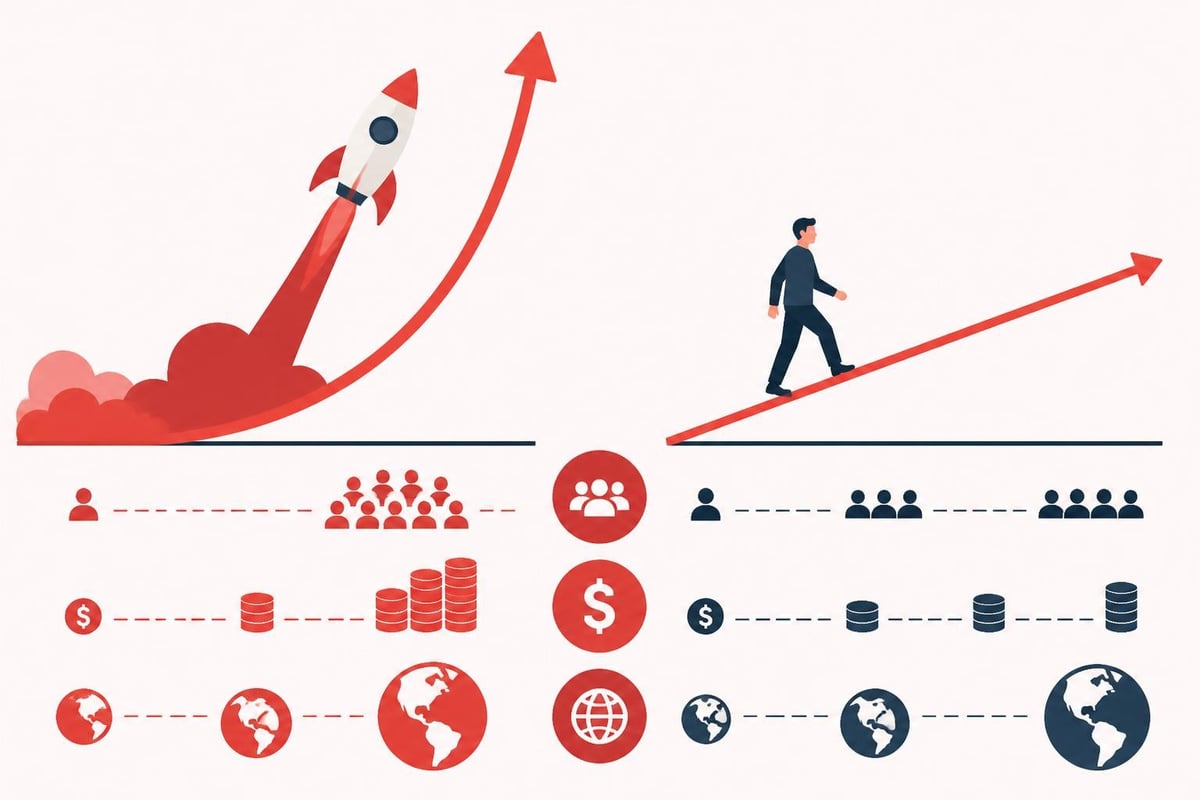
Perhaps the most visible difference between startup and entrepreneurship lies in growth expectations. As outlined in analyses of startups versus traditional businesses, startups target exponential growth curves while traditional businesses pursue linear expansion.
A Swiss e-commerce startup might aim to reach 100,000 customers within two years, while a traditional retail entrepreneur might build toward 500 loyal customers over the same period. Neither approach is superior-they serve different objectives and market opportunities.
Innovation Versus Optimization
Startups focus on innovation-creating new products, services, or business models that didn't exist before. Traditional entrepreneurship emphasizes optimization-doing existing things better, cheaper, or more efficiently.
Consider Switzerland's thriving business landscape:
- Startup approach: Developing AI-powered financial platforms that reimagine banking
- Entrepreneurial approach: Opening a boutique wealth management firm with personalized service
Both create value, but through fundamentally different mechanisms. The difference between startup and entrepreneurship here reflects whether you're creating new categories or excelling within existing ones.
Operational Differences in Daily Execution
The theoretical distinctions between startups and traditional entrepreneurship manifest in concrete operational differences that affect how founders spend their time and resources.
Team Building and Organizational Structure
Startups typically hire specialists early-software engineers, growth marketers, product managers-even before achieving product-market fit. They build teams anticipating rapid scaling, often offering equity compensation to attract talent beyond their current cash resources.
Traditional entrepreneurs hire generalists who can handle multiple functions, expanding their team only as revenue directly supports new positions. This approach maintains financial discipline while building sustainable operations.
Many Swiss founders benefit from connecting with peers through founder-focused events to understand which hiring model suits their vision.
Market Strategy and Customer Acquisition
The approach to markets reveals another crucial difference:
Startup Market Strategy:
- Target large, often global markets from inception
- Accept high customer acquisition costs for rapid growth
- Focus on viral growth loops and network effects
- Prioritize market share over immediate profitability
Traditional Entrepreneurship Market Strategy:
- Build strong local or regional presence first
- Maintain low customer acquisition costs
- Rely on word-of-mouth and relationship building
- Prioritize profitability per customer from day one
Communities like Talk Shop demonstrate how entrepreneurs in specific niches (like Shopify merchants) can build sustainable businesses through community-driven growth rather than venture-backed scaling.
Funding Mechanisms and Financial Structures
Perhaps no area illustrates the difference between startup and entrepreneurship more clearly than funding approaches. These financial strategies fundamentally shape what becomes possible for each business type.
Startup Funding Landscape
Swiss startups in 2026 access diverse funding sources:
- Angel investors providing initial capital (CHF 50K - 500K)
- Venture capital firms supporting growth stages (CHF 1M - 50M+)
- Government grants for innovation and R&D
- Accelerator programs offering capital and mentorship
- Crowdfunding platforms validating market demand
These funding mechanisms, explored through resources like Swisspreneur's investment syndicate, enable startups to pursue rapid growth strategies before achieving profitability.
Traditional Entrepreneurship Funding
Traditional entrepreneurs typically rely on:
- Personal savings built over years of employment
- Bank loans secured against assets or business plans
- Revenue reinvestment plowing profits back into growth
- Family and friends providing modest initial capital
This self-sufficiency creates different constraints and opportunities. Without external pressure from investors, traditional entrepreneurs maintain complete control but also bear full financial risk personally.
Measuring Success: Different Metrics for Different Models
The difference between startup and entrepreneurship extends to how success is measured and evaluated. These distinct metrics reflect fundamentally different objectives.
Startup Success Indicators
| Metric | Why It Matters | Typical Target |
|---|---|---|
| Monthly Recurring Revenue (MRR) | Predictable scaling potential | 20%+ monthly growth |
| Customer Acquisition Cost (CAC) | Unit economics viability | < 1/3 of Lifetime Value |
| Burn Rate | Runway management | 18-24 months cash |
| User Growth Rate | Market validation | 15%+ monthly active users |
| Product-Market Fit Score | Readiness to scale | 40%+ "very disappointed" |
These metrics focus on growth potential and scalability rather than immediate profitability.
Traditional Entrepreneurship Success Metrics
Traditional entrepreneurs track different indicators:
- Profit margins showing business health
- Cash flow ensuring operational sustainability
- Customer retention rates indicating service quality
- Personal income drawn from the business
- Asset accumulation building long-term wealth
A successful Swiss entrepreneur might build a CHF 2 million annual revenue business with 20% profit margins, providing excellent lifestyle returns without requiring venture capital or planning exits.

Exit Strategies and Long-Term Vision
The intended endpoint represents a fundamental difference between startup and entrepreneurship that influences every strategic decision along the journey.
Startup Exit Scenarios
Startups are built for eventual liquidity events:
- Acquisition by larger companies seeking innovation (most common)
- Initial Public Offering (IPO) for exceptional growth stories
- Secondary sales allowing early investors to exit
- Strategic mergers combining complementary technologies
According to Forbes' analysis of founders versus entrepreneurs, startup founders often build with exit multiples in mind-how much can investors return on their capital?
Entrepreneurship's Enduring Vision
Traditional entrepreneurs frequently build legacy businesses intended to:
- Provide long-term income streams
- Pass to family members across generations
- Serve communities for decades
- Build personal wealth through ownership
Many Swiss entrepreneurial ventures become multi-generational family businesses, contributing to Switzerland's stable economic foundation.
Choosing Your Path: Startup or Traditional Entrepreneurship
Understanding the difference between startup and entrepreneurship empowers founders to choose the path aligned with their goals, skills, and circumstances. Neither approach is universally superior-each suits different situations and objectives.
When the Startup Path Makes Sense
Consider the startup route when:
- You've identified a problem requiring innovative technology solutions
- Your business model can scale without proportional cost increases
- You're comfortable with high risk and potential failure
- You can articulate a path to serving millions of customers
- You're willing to raise external capital and accept dilution
Switzerland's strong technology sector and access to European markets make it particularly attractive for certain startup categories.
When Traditional Entrepreneurship Fits Better
Choose traditional entrepreneurship when:
- You're solving local problems with proven solutions
- You prefer maintaining complete ownership and control
- You need income from your business within months, not years
- You're building on existing expertise and relationships
- You value work-life balance and sustainable growth
The beauty of entrepreneurship lies in its flexibility-you can start traditionally and pivot toward startup methodologies if opportunities emerge, or vice versa.
Hybrid Models: Blending Both Approaches
The difference between startup and entrepreneurship doesn't require choosing one exclusively. Many successful founders blend elements from both models, creating hybrid approaches suited to their unique contexts.
Portfolio Entrepreneurship
Some founders build portfolios combining both types:
- Operating stable, cash-flowing businesses that fund living expenses
- Simultaneously building higher-risk startup ventures with growth potential
- Leveraging synergies between traditional and innovative ventures
This portfolio entrepreneurship approach reduces risk while maintaining upside potential.
Evolution from Entrepreneurship to Startup
Many startups begin as traditional businesses that discover scalable models. A Swiss software consultancy might develop a proprietary tool that becomes a SaaS product, transforming from services to scalable software.
This evolution allows founders to:
- Validate markets with paying customers before raising capital
- Build domain expertise that informs product development
- Maintain profitability while exploring growth opportunities
- Reduce risk compared to pure startup approaches
Regulatory and Structural Considerations in Switzerland
Switzerland's business environment affects how the difference between startup and entrepreneurship manifests practically. The Swiss legal and regulatory framework provides advantages for both models.
Legal Structures for Different Business Types
Common Startup Structures:
- AG (Aktiengesellschaft): Preferred for VC-backed ventures
- GmbH (Gesellschaft mit beschränkter Haftung): Flexible for growing businesses
Traditional Entrepreneurship Structures:
- Einzelfirma (Sole proprietorship): Simple for individual entrepreneurs
- GmbH: Liability protection for small businesses
The choice of legal structure reflects growth intentions, funding sources, and risk management approaches. Resources like founders' agreements become particularly crucial for startups with multiple co-founders and investors.
Swiss Advantages for Both Models
Switzerland offers unique benefits:
- Political stability reducing business uncertainty
- Strong IP protection crucial for innovative startups
- Access to talent from world-class universities
- Central European location facilitating market access
- Favorable tax environment for business operations
These advantages support both rapid-scaling startups and sustainable traditional businesses, making Switzerland an attractive location regardless of which path founders choose.
Real-World Examples from the Swiss Ecosystem
Examining concrete examples helps clarify the difference between startup and entrepreneurship in practice. Switzerland hosts both successful startups and thriving traditional businesses.
Swiss Startup Success Stories
Switzerland has produced notable startup successes across sectors:
- Technology startups leveraging Swiss engineering excellence
- Biotech ventures commercializing research from ETH and EPFL
- Fintech companies innovating in Switzerland's financial hub
These ventures typically raised significant venture capital, scaled rapidly, and targeted global markets from inception. Many founders share their journeys through platforms like the Swisspreneur podcast, offering insights into the startup path.
Traditional Entrepreneurship Excellence
Alongside startups, Switzerland hosts countless successful traditional businesses:
- Precision manufacturing firms serving specialized B2B markets
- Hospitality ventures building on Swiss service excellence
- Consulting practices leveraging professional expertise
- Retail operations serving local communities
These businesses generate substantial wealth for their owners while contributing to Switzerland's economic stability without venture capital or exit strategies.
Educational Resources and Support Systems
Both startups and traditional entrepreneurs benefit from Switzerland's robust support ecosystem. Understanding available resources helps founders navigate whichever path they choose.
Startup-Focused Resources
Startups access specialized support:
- Accelerator programs providing mentorship and initial funding
- Venture capital networks connecting founders with investors
- Technology transfer offices commercializing university research
- Startup events facilitating networking and learning
Platforms like Swisspreneur's masterclasses offer targeted education for founders pursuing high-growth ventures.
Traditional Entrepreneurship Support
Traditional entrepreneurs leverage different resources:
- Chamber of Commerce programs offering business fundamentals
- Industry associations providing sector-specific guidance
- Banking relationships facilitating traditional financing
- Local business networks enabling peer learning
The difference between startup and entrepreneurship means requiring different support systems, though some resources serve both audiences effectively.
Understanding the difference between startup and entrepreneurship empowers founders to choose the path that aligns with their vision, resources, and circumstances. Whether you're building a scalable technology venture or a sustainable traditional business, success requires clarity about your goals and approach. Swisspreneur supports Swiss founders across both paths, offering podcast insights, masterclasses, networking events, and investment opportunities tailored to your entrepreneurial journey. Connect with Switzerland's thriving founder community and access the resources you need to build your venture successfully.