

Starting a Startup Business: A Swiss Founder's Guide
A startup in business is a young company built to find a repeatable, scalable business model, and in Switzerland it usually becomes real the moment you register a legal entity, win your first paying customers and begin raising capital. The path is well defined: validate the problem, choose a legal form, handle taxes and social insurance correctly, build a minimum viable product, and fund growth with the right investors. This guide walks through each step with Swiss specifics, so you can move from idea to a fundable company with fewer false starts.
What Makes a Startup Different From a Small Business
A startup is a company designed to grow fast by repeating one scalable model, while a small business typically aims for stable local income. A bakery that serves one neighborhood is a small business. A software company that can serve customers in Zurich, Munich and Singapore with the same product is a startup.
That distinction matters because it shapes your legal setup, your funding options and your hiring plan. Founders who treat a startup like a lifestyle business often under-invest in growth. Founders who treat a lifestyle business like a startup burn cash chasing venture capital that was never a fit.
Switzerland has no shortage of new companies. According to the SECO SME Portal, 52,978 new companies were registered in 2024, up 2.6% from 2023 and 13.8% above the decade average. The leading sectors were craftsmanship, consulting, real estate and retail. Most of these are small businesses. A much smaller group sets out to scale, and that group is the audience for this guide. For a deeper look at the distinction, see Swisspreneur's piece on the difference between a startup and entrepreneurship.
What Are the 7 Stages of a Startup?
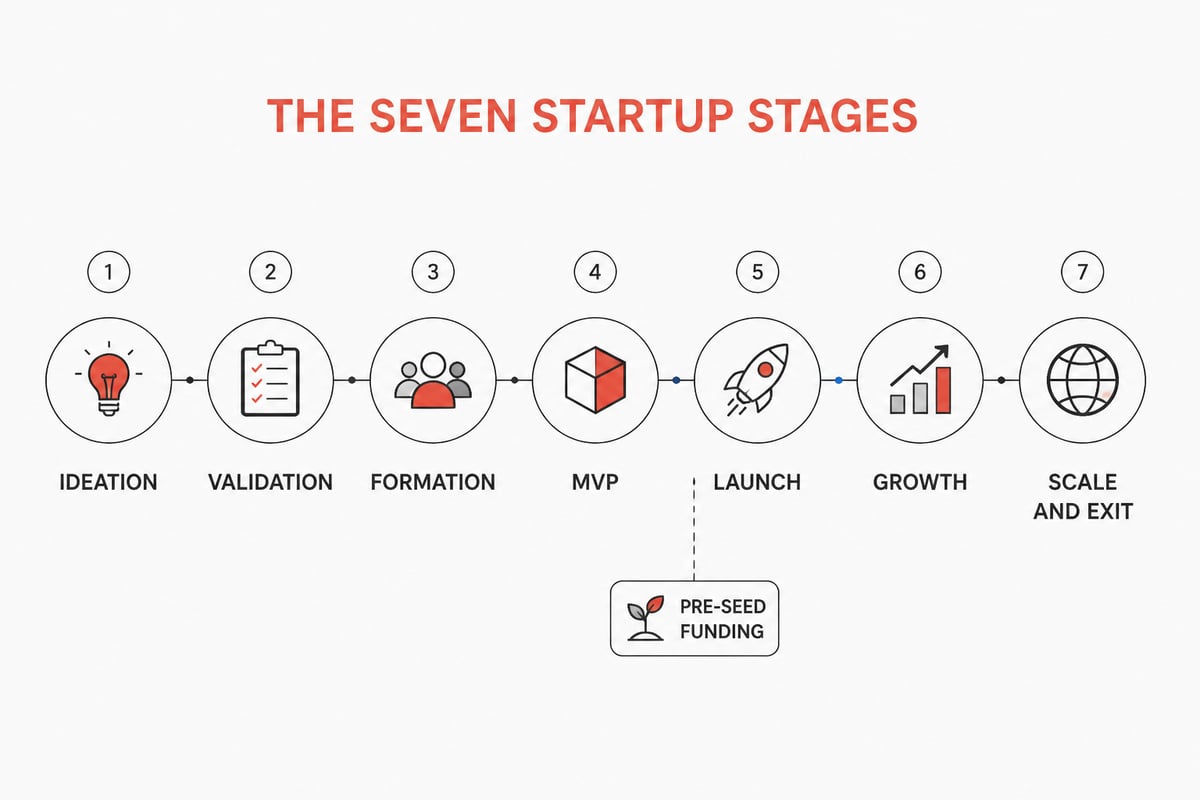
The seven stages of a startup are ideation, validation, formation, building the minimum viable product, launch, growth and scale, and exit or maturity. Naming them helps you judge where you stand and which investors suit your stage.
- Ideation: You identify a problem worth solving and form a first hypothesis about who has it.
- Validation: You test the problem with real people before building anything substantial.
- Formation: You register a legal entity, split equity and sign the basic agreements.
- MVP: You build the smallest product that delivers real value to a first customer group.
- Launch: You put the product in front of paying users and measure what they actually do.
- Growth: You refine the model, expand channels and raise outside capital.
- Scale and exit: You build systems, expand markets and move toward acquisition, IPO or long-term profitability.
Most Swiss founders seeking pre-seed funding sit between stages four and six. That is the point where investors want evidence of traction rather than a slide deck.
Validate the Problem Before You Build
Validation means proving that a specific group of people has a painful problem and will pay to solve it, before you invest in a product. Skipping this step is the most common reason early-stage ventures stall.
Start with conversations, not code. Interview at least 20 potential customers and ask about their current workaround, what it costs them and what they have already tried. Look for repeated pain, not polite interest. A founder who hears "that sounds nice" has learned nothing. A founder who hears "I spend six hours a week on this and would pay to stop" has found a signal.
Then test willingness to pay. A landing page with a pre-order button, a paid pilot with one customer or a letter of intent from a business buyer all count as stronger evidence than survey answers. Swisspreneur's guide to the dos and don'ts of startup idea testing covers practical methods for this stage.
Keep the market research focused on three questions:
- Who exactly has this problem, and how many of them can you reach?
- What do they use today, and why is it inadequate?
- What would they realistically pay, and how often?
Choose the Right Business Model
Your business model describes who pays you, for what and how often, and it should be settled early enough to guide product decisions. Common models for early-stage ventures include subscriptions, transaction fees, marketplaces, licensing and hardware plus service.
Investors read the model before they read the product. A clear model shows how revenue grows without cost growing at the same rate. If every new customer requires proportional manual work, you have a services firm, which is a fine business but a different one.
Write the model on one page: customer segments, value proposition, revenue streams, main costs and acquisition channels. Revisit it every quarter. The model you launch with is rarely the one you scale with. Swisspreneur's explainers on business models for startups and how to create a business model give structured templates for this work.
Should a Startup Be an LLC? Choosing a Legal Form in Switzerland
In Switzerland, the closest equivalent to an LLC is the GmbH, and for most venture-backed startups the choice is between a GmbH and an AG (stock corporation). Both limit your personal liability, and both are what investors expect when they fund a company.
| Legal form | Minimum capital | Typical fit |
|---|---|---|
| Sole proprietorship | None | Solo founders testing an idea at low cost |
| GmbH | CHF 20,000 | Small teams, simple cap tables, bootstrapped or angel-funded |
| AG | CHF 100,000 (CHF 50,000 paid in) | Startups planning multiple funding rounds and employee equity |
A sole proprietorship is fast and cheap, and the Canton of Zurich explains the responsibilities of a sole proprietor, including social-insurance recognition, AHV contributions and VAT obligations. The drawback is unlimited personal liability, and most institutional and syndicate investors will not invest in a sole proprietorship.
If you plan to raise outside capital, incorporate as a GmbH or AG early. Swisspreneur's own funding pathway is built for startups with a Swiss legal entity, so having one in place is a practical prerequisite. Our guides to starting a business in Switzerland and opening a business in Switzerland cover the notary, commercial register and bank steps in sequence.
Taxes, VAT and Social Insurance Basics
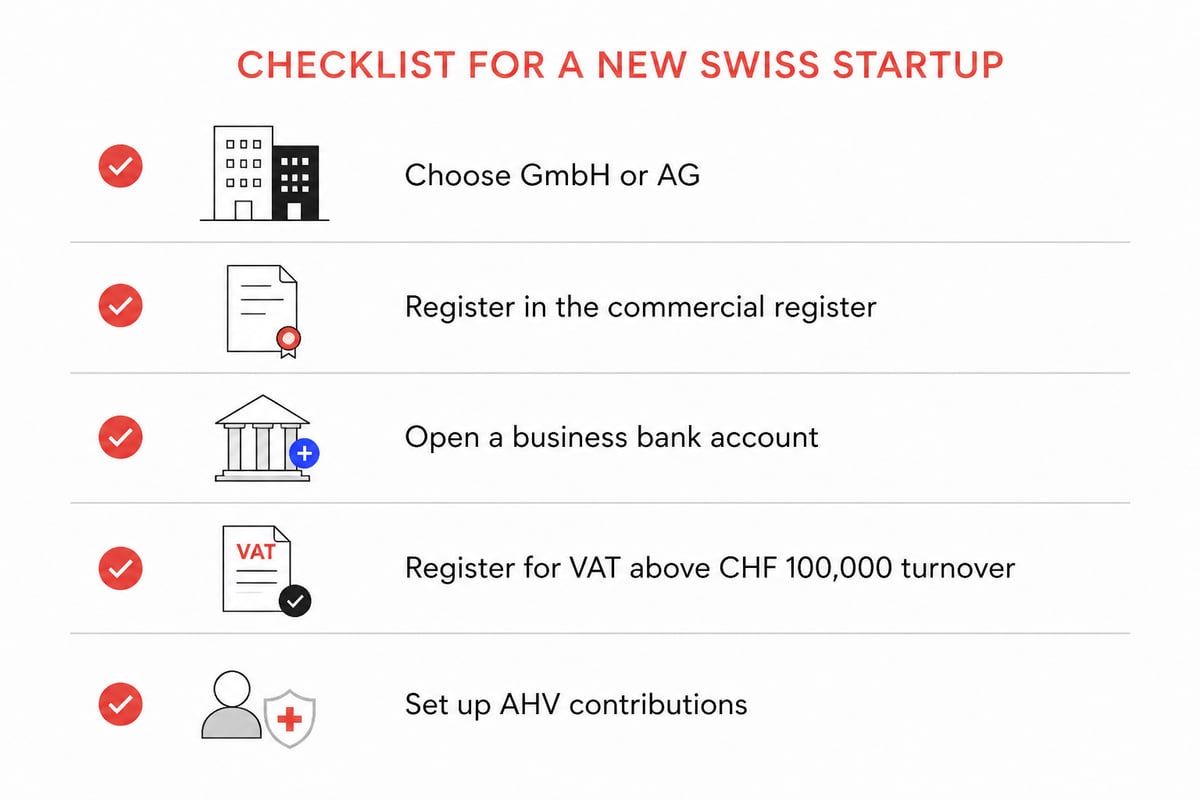
Swiss founders must register for VAT once annual turnover passes CHF 100,000 and must pay AHV contributions on self-employment income. Getting these wrong early creates avoidable penalties.
According to the Canton of Zurich, VAT liability generally begins at annual turnover of CHF 100,000, and registration with the Federal Tax Administration is required within 30 days after exceeding the threshold. The same source notes that founders running a side business while employed may owe additional AHV contributions when side-business net profit exceeds CHF 2,500 per year, provided they already pay the statutory minimum through their main job.
Two habits save trouble later:
- Open a dedicated business bank account from day one and never mix personal and company funds.
- Engage an accountant before your first invoice, not after your first tax deadline.
Swisspreneur's finance essentials for startups covers bookkeeping, runway and burn rate in plain terms.
Build the MVP and Find Your First Customers
An MVP is the smallest version of your product that lets a real customer complete the core job, and its purpose is learning rather than polish. Build only what is needed to test your riskiest assumption.
Set a hard time limit, often six to twelve weeks, and a single success metric such as paid pilots signed or weekly active users. Use no-code tools, existing platforms or hired developers where speed matters more than elegance. Founders without a technical co-founder can find specialists through services like FreelanceDEV, a platform that connects freelance developers with startups for web, app and software projects.
Your first ten customers should come from direct outreach, not advertising. Talk to them weekly, watch how they use the product and charge from the start, even a small amount. Paying customers give you honest feedback and the revenue proof investors weigh most heavily.
Early culture also forms during this phase. The habits you set with your first three hires will outlast your pitch deck, and Swisspreneur's guide on building a culture in a Swiss startup is a useful reference.
The State of Startup Funding in Switzerland
Capital is available in Switzerland, but investors have become more selective and expect clearer traction. The EY Startup Barometer reports that Swiss startups completed 513 funding rounds in 2024, down 6.7% from 550 in 2023, and raised CHF 2.3 billion, 15% less than the CHF 2.71 billion recorded in 2023. EY's Swiss Startup Barometer overview adds further context on financing activity.
What this means for a founder is simple. Fewer, larger rounds go to companies with evidence of demand. A pre-seed raise now rewards a working product, early revenue or signed pilots, and a founding team that has already shown it can execute.
The usual early-stage sources are:
- Founder savings and friends and family, useful for the first prototype.
- Business angels, who contribute capital and introductions.
- Grants and innovation programs, which are non-dilutive but slow.
- Syndicates, where many small investors back a company together under one structure.
For Swiss founders with a GmbH or AG and early traction, the Swisspreneur Investments for startups pathway offers pre-seed and seed funding through its syndicate. Founders choose which investors and founders join each deal, and the syndicate takes a 15% carried interest on investor profits, with founders paying nothing. The syndicate has facilitated over CHF 3M in investments and draws on a database of more than 1,000 investors.
Build Your Network and Find Mentors
Founders who build a peer network early raise capital faster and avoid expensive mistakes, because advice from someone one step ahead is worth more than any template. Mentoring and community are working tools, not social extras.
Swiss founders have several routes. Local meetups and conferences produce introductions, and Swisspreneur's overview of startup networking events lists what to look for. The Swisspreneur community includes over 700 founders connected through its Slack channel, more than 550 free podcast episodes with candid founder conversations, free masterclass content and regular startup events. None of these cost startups anything.
Use mentors with a specific question in mind. "Can you help me?" gets polite silence. "We are choosing between a GmbH and an AG before a CHF 500,000 round; what would you do?" gets a real answer. If you want structured guidance, read about startup business coaching to judge when paid help is worth it.
Founders sometimes need practical services that have nothing to do with software. When you move into your first office or workshop, a platform like Offertenheld lets you compare fixed-price quotes from vetted tradespeople in Switzerland, which saves time during a hectic launch month.

What Business Makes $10,000 a Month?
No single business type guarantees $10,000 a month, because income depends on pricing, cost structure and how many customers you can serve, not on the industry label. Several models can reach that level with the right inputs.
Consulting and specialized services can reach it fastest, since a few clients paying well each month can cover it. Subscription software reaches it more slowly but more durably, once enough customers pay a recurring fee. E-commerce can get there through volume, although margins are thinner and advertising costs rise with scale. If you are weighing service options, Swisspreneur has a short list of good service business ideas to start.
Work backward from the target. Divide the monthly goal by your price to find the customer count, then ask whether you can realistically find and keep that many. If the answer depends on luck, change the model.
FAQ
What are the top startups founders should study?
Rather than copying a list of famous names, study companies at your stage and in your market. Swisspreneur's startups in Switzerland overview and its podcast feature founders who describe real decisions, mistakes and numbers, which teach more than headline valuations do.
How much money do I need to start a startup in Switzerland?
It depends on the legal form and the product. A GmbH requires CHF 20,000 in share capital and an AG requires CHF 100,000 with at least CHF 50,000 paid in, plus notary and registration fees. Software ventures can launch on very little beyond that, while hardware and healthcare ventures need considerably more.
Do I need traction before approaching investors?
Yes, for most pre-seed rounds. Investors want evidence such as paying customers, signed pilots or strong usage, because ideas alone are cheap. A startup in business with even modest revenue is a far easier conversation than a concept on a slide.
Your next step is to write down your riskiest assumption and test it with ten potential customers this month, before you spend on incorporation or development. Once you have a Swiss GmbH or AG and early traction, you can explore the Swisspreneur Investments for startups pathway to raise pre-seed capital alongside investors who understand the Swiss ecosystem. If you would rather back early-stage founders yourself, you can start with small tickets and sign up for deals through Swisspreneur's syndicate.