

How Business Owners Can Find the Right Business Partner in Switzerland
Business owners looking for partners in Switzerland should start with a clear picture of what the business lacks, then search inside the networks where trust already exists: former colleagues, founder communities, industry events and mentors. The strongest partnerships combine complementary skills, aligned ambition and a written agreement signed before the first franc is spent. This guide covers how to decide whether you need a partner, what to look for, where to find candidates in Switzerland, and how to formalize the relationship.
Do You Actually Need a Business Partner?
You need a partner when a specific gap, such as technical skill, sales capacity or capital, is slowing the business and cannot be closed by hiring or outsourcing. If the gap is only a lack of time or a wish for company, a partner is usually the wrong fix.
Start by writing down what the company needs over the next 18 months. Then sort each need into one of three categories:
- Can be hired: bookkeeping, administration, junior development, design
- Can be bought or contracted: legal review, fractional finance, specialist consulting
- Requires an owner: product leadership, a core sales relationship, deep technical ownership, a credibility that investors expect
Only the third category justifies sharing equity. A partner receives a permanent claim on your upside, so the role should be one that no salary could fill.
The benefits are real when the fit is right. Shared decision-making reduces blind spots, two founders can cover more ground in the first year, and many Swiss investors prefer teams over solo founders because the workload and risk are spread. The cost is control, and a poorly matched partner can stall the company faster than a missing one.
What to Look for in a Business Partner
The right partner shares your direction, complements your skills and communicates in a way you can sustain under pressure. Evaluate each candidate against the same checklist so that enthusiasm does not replace judgment.
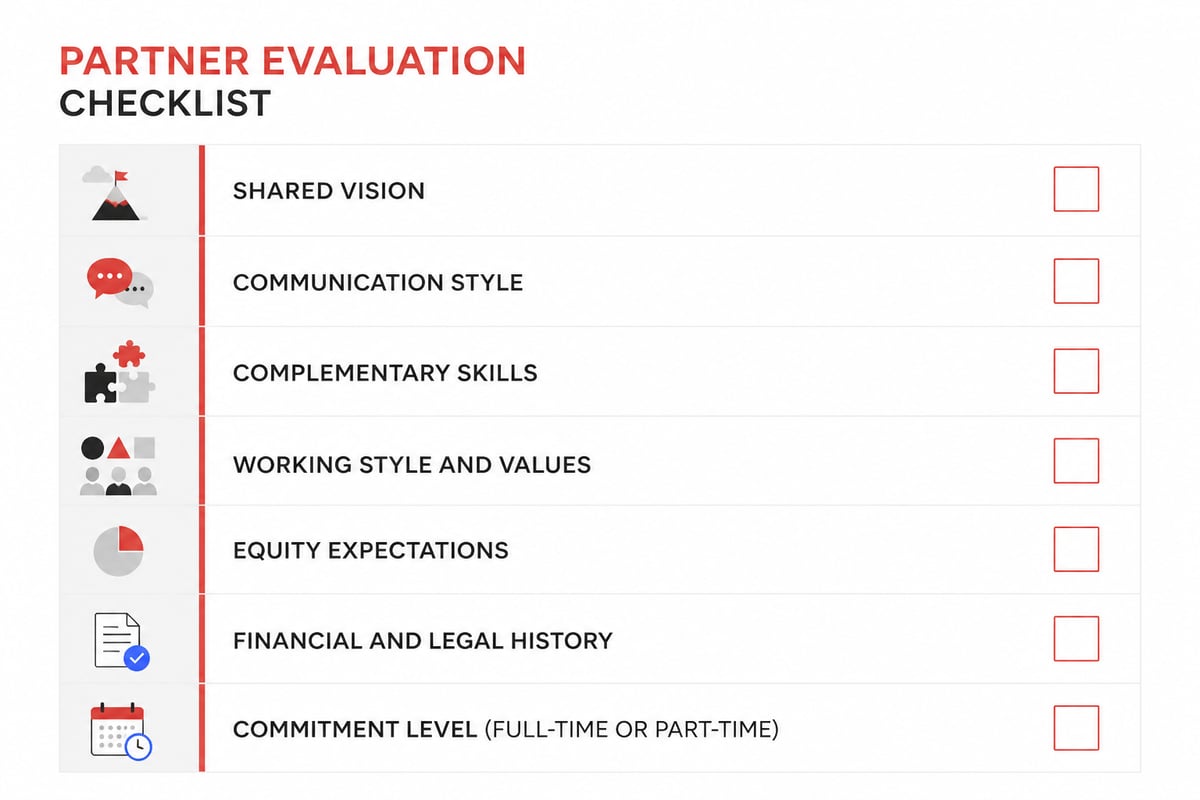
Shared vision and ambition
Ask each other plain questions. Do you want to build a company to sell in five years, or a business to run for thirty? Is a CHF 2 million revenue business a success or a stepping stone? Founders who answer these differently tend to discover it during the first difficult decision.
Complementary skills
Two engineers rarely build a company faster than an engineer and a seller. Map each person's strengths honestly. Overlap creates friction over who decides, while a clean split of ownership (product versus commercial, for example) creates speed.
Communication and conflict style
Test how the person behaves when something goes wrong. Do they raise problems early or hide them? Do they prefer weekly check-ins or long silences? A short project together, even two or three months of paid collaboration, reveals more than a dozen coffees.
Commitment and equity expectations
Clarify whether each partner is full-time, what they can invest, and what share they expect. Unequal commitment paired with equal equity is one of the most common causes of partner disputes, so settle it explicitly.
Financial and legal history
Run basic due diligence. Check the commercial register for prior companies, ask about outstanding debts, and request references from former colleagues or co-founders. This is ordinary professional practice in Switzerland, not an insult.
Where Business Owners Looking for Partners Can Search in Switzerland
Business owners looking for partners in Switzerland have the best results in warm networks, where a mutual contact has already vouched for the person. Cold outreach works, but it takes longer and carries more risk.
- Your own professional circle. Former colleagues, clients and suppliers know how you work and how they work. Many successful Swiss startups began as a spin-out between two people who had already shipped something together.
- University and research networks. ETH Zurich, EPFL and the other Swiss universities and applied-science institutions produce technical talent and active entrepreneurship communities. Alumni groups and spin-off programs are natural places to meet a technical co-founder.
- Founder communities. A moderated peer community lets you observe how people think and collaborate over time before any commitment. Swisspreneur's Slack channel connects founders, and its conversations show who is generous with advice and who follows through.
- Startup events and meetups. Face-to-face contact filters quickly. The networking events for startups in Switzerland range from large conferences to small founder dinners, and the smaller formats usually produce deeper conversations. Swisspreneur itself runs 10+ startup events per year.
- Mentors and advisors. Experienced operators often know a capable person who is looking for the right company to join. Ask a mentor for introductions rather than for a partner directly.
- Podcasts and content. Listening to how a founder discusses setbacks reveals character. The Swisspreneur podcast archive includes founders describing how they chose, and sometimes parted with, their co-founders.
For a broader view of how local groups form and operate, see this overview of the online business community landscape.
The Swiss market also has a structural feature that favors partnerships. According to the SECO SME Portal, companies with fewer than 250 employees account for over 99% of commercial companies and two-thirds of jobs in Switzerland (figures for 2023). Small teams are the norm, so finding a partner who understands the realities of a small company is easier than in markets dominated by large employers.
Choosing the Right Legal Structure for the Partnership
The legal form determines liability, capital requirements and how partners can exit, so choose it before you sign anything else. For most Swiss startups with more than one founder, a GmbH (Sàrl) or an AG (SA) is the practical choice.
The capital thresholds differ meaningfully. Invest Vaud notes that a Swiss Sàrl requires at least CHF 20,000 in equity, fully paid up at formation, while an SA requires CHF 100,000 in capital, with at least CHF 50,000 paid up. The federal SME portal also provides a useful explanation of how Swiss legal structures differ in liability and suitability, including the options for entrepreneurs starting with colleagues.
| Structure | Typical minimum capital | Partner liability | Common use |
|---|---|---|---|
| General partnership (Kollektivgesellschaft) | None required | Personal and unlimited | Small professional ventures |
| GmbH / Sàrl | CHF 20,000, fully paid up | Limited to capital | Early-stage startups, closely held firms |
| AG / SA | CHF 100,000, at least CHF 50,000 paid up | Limited to capital | Companies planning outside investment |
A general partnership is simple to set up but exposes each partner personally to the company's debts, which is rarely wise for a venture that may raise money. Online registration through EasyGov supports several forms, including sole proprietorships, limited liability companies, corporations and general partnerships, according to the SECO SME Portal. For an LLC or corporation, it helps prepare documents for notarial certification. For a deeper walkthrough of the process, the guide to setting up a business in Switzerland covers each step.

What a Founder Agreement Should Contain
A founder agreement should record who owns what, who does what, and what happens if someone leaves. Write it while the relationship is warm, because disagreements about exits are far harder to resolve once they are real.
A solid agreement addresses:
- Equity split and vesting. A four-year vesting schedule with a one-year cliff protects the company if a partner departs early.
- Roles and decision rights. Define who has the final say on product, hiring, spending limits and fundraising.
- Time and exclusivity. State whether each partner works full-time and whether outside projects are allowed.
- Intellectual property. Confirm that all work related to the company belongs to the company.
- Exit and buy-out terms. Include good-leaver and bad-leaver provisions and a valuation method for buying out a departing partner.
- Deadlock resolution. Name a mediator or an escalation process for decisions where partners disagree.
Engage a Swiss lawyer familiar with startup structures. The legal advice for early-stage startups episode is a useful preparation before that first meeting, because it helps you arrive with the right questions.
Partners Who Bring Capital: Working With Investors
Some business owners looking for partners are actually looking for capital, and an investor partner is a different relationship from a co-founder. An investor brings money and network but not daily labor, so the agreement should reflect that distinction.
Before approaching investors, make sure the company has traction and a Swiss legal entity, since most Swiss angel and syndicate investors expect a registered GmbH or AG and early evidence that customers want the product. The article on four steps for fundraising in Switzerland lays out a sequence founders can follow.
For founders at that stage who want a community alongside capital, the Swisspreneur Scaleup Circle offers an operator-led community with podcasts, curated events and selective capital access for Swiss scaleups. Founders in the Swisspreneur Syndicate also have a say in which investors and founders join each deal. That structure matters because it keeps founders in control of who sits on the cap table, which is itself a partnership decision. Over CHF 3M has been invested through the Syndicate. The Swisspreneur database holds 1,000+ investors.
A Step-by-Step Process for Finding and Vetting a Partner
A structured process reduces the risk of choosing on chemistry alone. Follow these steps in order and do not skip the trial period.
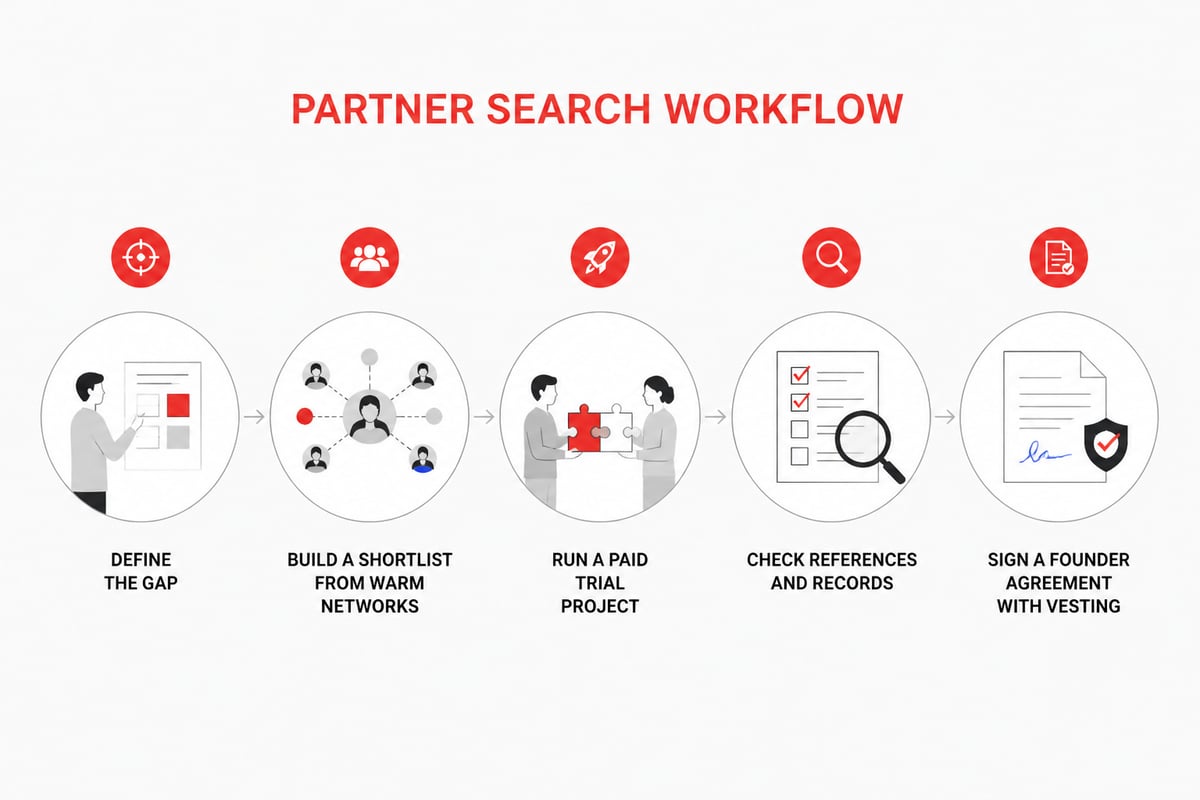
- Define the gap. Write a one-page description of the role, the time commitment and the equity range you can offer.
- Build a shortlist. Draw candidates from warm introductions first, then from events and communities. Aim for three to five serious conversations.
- Hold structured conversations. Use the same questions about vision, risk tolerance, finances and working style for each candidate so you can compare answers.
- Run a trial collaboration. Work on a defined deliverable for six to twelve weeks, with a written scope and fair compensation. Observe reliability, quality and tone under deadlines.
- Verify background and references. Check the commercial register, speak with at least two former collaborators, and confirm any claims about past results.
- Formalize. Sign the founder agreement, register the company in the form you chose, and set up vesting before the partner begins full-time work.
Allow a few months for the whole process. Founders who rush it often spend far longer, and far more money, unwinding a bad match.
Common Mistakes to Avoid
Most failed partnerships trace back to a small set of avoidable decisions.
- Choosing a friend because of the friendship. Friendship is valuable, but it does not replace complementary skills or aligned ambition. Protect the friendship by being more formal about the business, not less.
- Splitting equity 50/50 by default. An even split can be right, but it should be the result of a discussion about contribution, not an avoidance of one.
- Skipping vesting. Without it, a partner who leaves after three months can walk away with a large share of the company.
- Ignoring culture. Values shape every hiring and customer decision. The piece on culture before the cart explains why founders should settle cultural questions early.
- Waiting too long to address friction. Small disagreements about effort or priorities compound. Schedule a regular partner review, quarterly at minimum, where each person states what is working and what is not.
Hiring in the Swiss labor market is competitive, which makes a committed partner who can take on a core function more valuable than it might appear on paper.
Your next step is to write the one-page role description for the partner you need and send it to three people in your network who might know the right person. If your company has a Swiss GmbH or AG and early traction, Swisspreneur can then help you meet founders and investors who back Swiss startups; you can sign up for deals to see opportunities and connect with the community, and the Swisspreneur Scaleup Circle is worth a look if you are growing past the first stage.