

How to Become a Startup Founder: Essential Qualities and First Steps
A start up founder is the person who spots a problem, builds a company around solving it, and carries the responsibility for its early decisions, funding and team. Becoming one requires a specific set of personal qualities and a clear sequence of first steps: test demand, find co-founders, set up a legal entity and secure early capital. This article covers each in order, with a focus on founders building in Switzerland.
What Does a Start Up Founder Actually Do?
A founder's job is to turn an unproven idea into a company that customers pay for, and the daily work shifts as the company grows.
In the first months, the role is mostly practical. You talk to potential customers, build or commission a first version, recruit your first collaborators and keep the company alive financially. There is rarely a division between strategy and execution, because you handle both. As the team grows, you move from doing the work to setting direction, hiring people who are better than you at specific tasks, and managing investor relations.
Many founders come from employment rather than from a lifelong entrepreneurial identity. Swisspreneur's podcast episode on moving from startup employee to startup founder explores that path in candid conversation.
It also helps to separate the founder role from the broader idea of entrepreneurship. Not every business owner builds a company designed to scale quickly, and the difference between a startup and entrepreneurship matters when you decide how you will fund and structure the venture.
Qualities That Define a Successful Start Up Founder
The founders who survive the early years tend to share a handful of traits, and most of them can be developed rather than being fixed at birth.
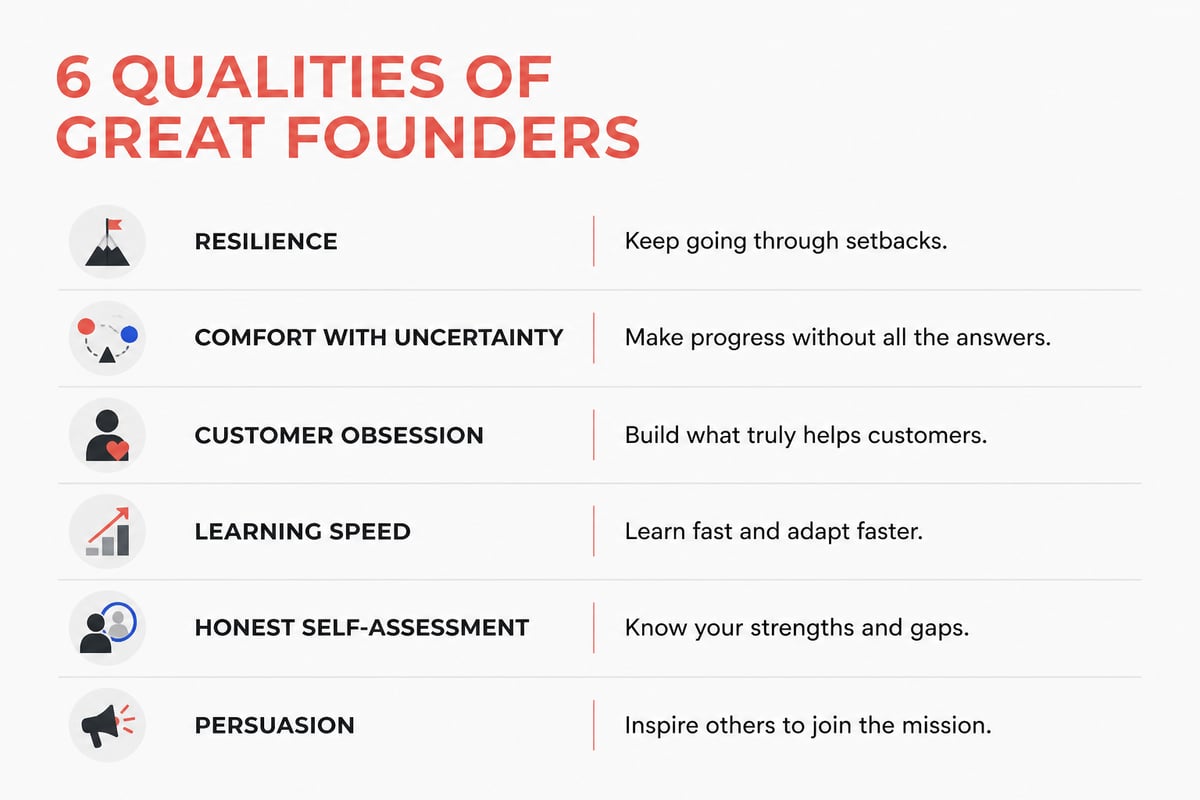
- Resilience. Early-stage companies fail often at the task level: a pilot falls through, a hire leaves, a product launch underperforms. Founders who treat these as information, not verdicts, keep moving.
- Comfort with uncertainty. You will make decisions with incomplete data. The skill lies in deciding quickly, then adjusting when new evidence appears.
- Customer obsession. The strongest founders stay close to the people they serve long after the first sale.
- Learning speed. You will need to understand finance, hiring, sales and product within a few years, often with no formal training in any of them.
- Honest self-assessment. Knowing your gaps is what allows you to fill them with the right co-founder or advisor.
- Persuasion. You must convince customers, employees and investors to take a chance on something that does not yet fully exist.
Experience in a related industry strengthens several of these qualities. A founder who has worked for years in logistics, health care or financial services understands the customer's pain in a way an outsider rarely can. Age is not a barrier in either direction, and the broader lessons founders collect along the way are worth studying, such as the ones gathered in Swisspreneur's collection of startup lessons.
Validate the Problem Before You Build Anything
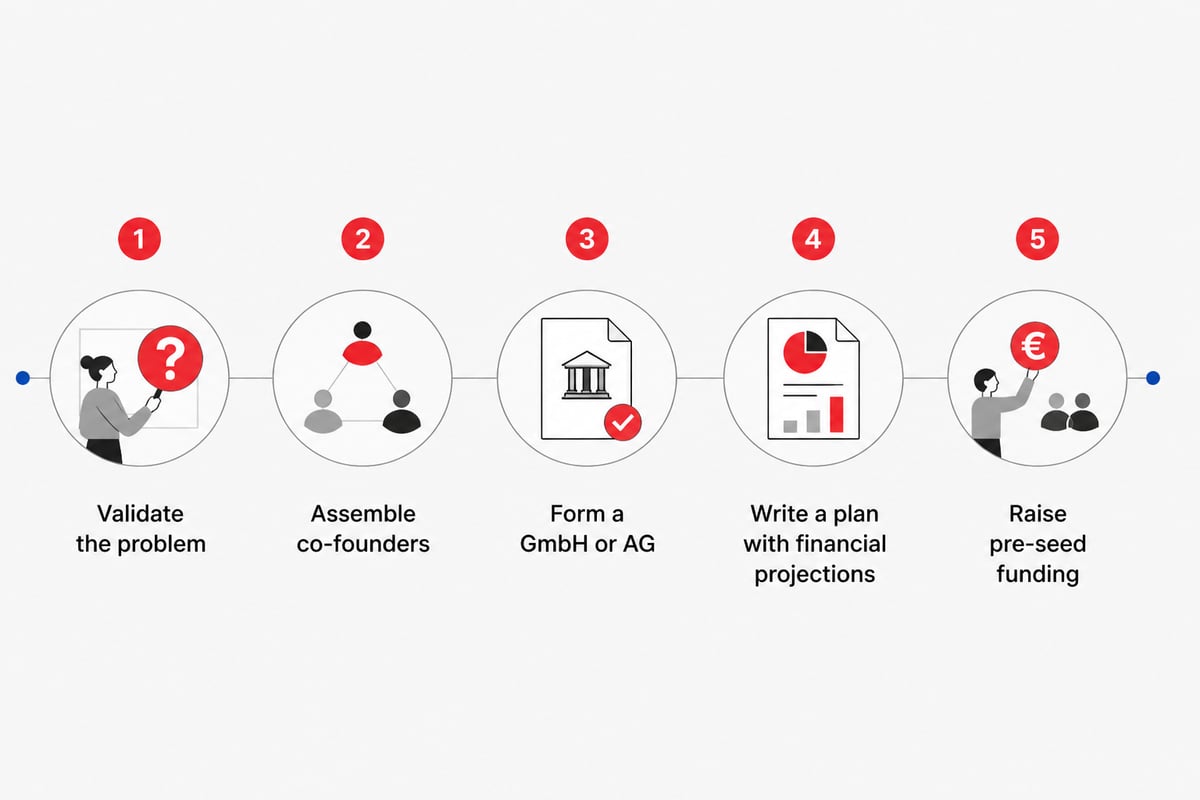
The first practical step is to confirm that a real group of people has a problem worth paying to solve, and to do so before you invest in a product.
Market research gives you a structured way to do this. According to the U.S. Small Business Administration, market research can assess demand, market size, customer location, market saturation and competitor pricing. The same source identifies surveys, questionnaires, focus groups and in-depth interviews as ways to conduct direct market research.
For an early-stage founder, interviews tend to deliver the most value per hour. A practical approach:
- Write down the specific problem and the specific customer you believe has it.
- Book 15 to 20 conversations with people who match that description.
- Ask about their current workaround and what it costs them, rather than pitching your idea.
- Look for patterns. If the same pain appears repeatedly and people already spend money or time on poor alternatives, you have a signal.
- Test a simple version, such as a landing page, a prototype or a paid pilot, to see whether interest turns into commitment.
In Switzerland, add a market-size check early. A product that works for a Swiss audience may need a plan for German, French and Italian-speaking regions, and possibly for neighboring markets, before the numbers support venture-scale growth.
Build a Founding Team and Agree on the Rules
Most investors prefer to back teams rather than individuals, so choosing co-founders is one of the highest-stakes decisions you will make.
Look for complementary skills. A common pairing is one person who builds the product and one who sells it, with a third person covering operations or finance once the company grows. Shared values and compatible working styles matter as much as skills, because disagreements about direction will arise under pressure.
Before you incorporate or take on any outside money, put agreements in writing. Roles, equity split, vesting, decision rights and exit scenarios should be settled while everyone is still friendly. Swisspreneur has published practical material on co-founders and on the founders agreement, both useful starting points before you speak to a lawyer.
Solo founders do succeed, but they carry the entire load and have to compensate through advisors, early hires and a strong peer network. If you are going alone, build that support structure on purpose rather than waiting for it to appear.
Choose a Legal Structure and Handle the Paperwork
Forming a company gives you legal protection, a vehicle for investors and a clear ownership record, and it is a step you should complete before accepting funding.
In Switzerland, the two standard choices for a venture-backed company are the GmbH (limited liability company) and the AG (stock corporation). The AG is often favored when you expect to issue shares to several investors, while the GmbH can be simpler and cheaper to set up. A lawyer or notary can help you weigh the options.
The administrative checklist in any country follows a similar pattern. The IRS lists sole proprietorships, partnerships, corporations, S corporations and limited liability companies among common business structures, and notes that most businesses need an Employer Identification Number even when they have no employees. These are US rules, but they illustrate the types of decisions every founder faces: which entity to form, how it will be taxed and which identifiers and licenses it requires.
Keep your finances organized from the first day. Separate business and personal accounts, track every expense and understand your runway.
Write a Plan That Works as a Roadmap
A business plan does not need to be long, but it must show that you understand your market, your model and your numbers.
A traditional plan commonly includes an executive summary, market analysis, marketing and sales plans and financial projections, according to the SBA. The agency also recommends projections covering five years, with first-year figures built in more detail through quarterly or monthly estimates. Its guide to writing a business plan explains how the document works as a roadmap.
For a seed-stage company, investors usually care less about a polished document and more about the thinking behind it. Be ready to answer these questions clearly:
- Who is the customer, and how will you reach them?
- How does the company make money, and what does one customer cost to acquire?
- What milestones will the funding allow you to reach?
- What could go wrong, and how would you respond?
Your revenue approach deserves particular attention. Swisspreneur's article on business models for startups outlines the main options, from subscriptions to marketplaces, so you can choose one that fits your customer.
Raise Early-Stage Funding the Right Way
Pre-seed funding pays for the first product, the first hires and the evidence that your idea works, and in Switzerland you have several routes to it.
Common sources include your own savings, friends and family, grants and innovation programs, angel investors and syndicates. Each carries trade-offs in speed, control and expectations. Whichever route you choose, approach investors only after you have some proof of traction, such as paying pilots, signed letters of intent or a working prototype with active users.
One option built for Swiss founders is Swisspreneur Investments for startups, which provides pre-seed and seed funding through the Swisspreneur Syndicate. Founders pay nothing, and Swisspreneur takes a 15% carried interest on investor profits. The Syndicate has channeled over CHF 3M in investments so far. This route suits companies that already have a Swiss GmbH or AG and some early traction.
Before any investor meeting, prepare a short deck, a clear use-of-funds plan and a realistic view of how much ownership you are willing to give up. Speed matters, but so does choosing partners who add contacts and advice, not only capital.
Find Your Community and Keep Learning
No founder builds a company in isolation, and the people around you often determine how fast you learn.
Peer groups give you a place to test ideas, hear how others solved similar problems and find introductions to customers, talent and investors. Events are the fastest way to widen that circle. Swisspreneur's guides to founder communities and startup networking events are a good way to decide where to spend your limited time.
Swisspreneur itself offers a set of free resources aimed at Swiss founders:
- A podcast with 550+ episodes freely available and around 10k plays per month
- More than 150 minutes of free masterclass content
- A Slack community connecting over 700 founders
- 10+ startup events per year, with an overall NPS score of 84
Mentoring works best when you arrive with specific questions. Instead of asking a senior founder for general advice, bring a decision you face this month, such as pricing, a hiring choice or a term sheet clause, and ask how they would think about it.
Founders in Switzerland also benefit from taking the long view. The first year is rarely the hardest one. Staying power comes from keeping costs under control, protecting your own health and learning from each setback, a theme that runs through Swisspreneur's collection on the startup journey.
Common Mistakes First-Time Founders Make
Most early failures trace back to a short list of avoidable errors, and knowing them in advance saves months of effort.
- Building before listening. Spending a year on a product before talking to customers is the most common and most expensive mistake.
- Splitting equity without a plan. Handing out equal shares without vesting leaves the company exposed if a co-founder departs early.
- Hiring too soon. Extra salaries shorten your runway; wait until a specific bottleneck demands a hire.
- Raising money without a milestone plan. Investors back a path, so be ready to say what the funding will achieve and by when.
- Neglecting culture. Habits form in the first ten hires and are hard to change later. Swisspreneur's resource on building a culture in a Swiss startup is a useful reference.
- Going it alone for too long. Isolation slows learning and increases the odds of burnout.
Treat each of these as a checklist item at your quarterly review. A few minutes of honest assessment can prevent a problem that would otherwise cost you a year.

Your next step is to schedule five customer conversations this week and write down what each person says about the problem you want to solve. Once you have evidence of demand and a registered Swiss company, you can explore Swisspreneur Investments for startups to see how a pre-seed round could work for your company. If you want to follow the deals and back early-stage Swiss founders yourself, you can sign up for deals through Swisspreneur and get access to the next opportunities as they open.