

Entrepreneur and Enterprise: How Swiss Founders Start
An entrepreneur is a person who spots an opportunity and takes the financial risk of pursuing it, while an enterprise is the organized business that person builds to deliver it. The first term describes a human role; the second describes a legal and operational structure. For founders in Switzerland, the practical question is how and when the first becomes the second, and what needs to be true before a founder sets up an enterprise that investors will back.
What Is the Difference Between an Entrepreneur and an Enterprise?
The difference is that an entrepreneur is a person who initiates and drives a venture, whereas an enterprise is the organization that carries out the commercial activity. One is a role, the other is an entity.
An entrepreneur can exist without an enterprise. A founder who is testing a concept, interviewing customers and sketching a prototype is already acting as an entrepreneur, even before a company is registered. An enterprise, by contrast, can continue to operate after its founder steps away. It has contracts, employees, accounts, intellectual property and a legal identity.
Three contrasts make the distinction concrete:
- Nature: the entrepreneur is a person with a mindset; the enterprise is a structure with processes.
- Risk: the entrepreneur carries personal and financial risk; the enterprise carries legal obligations and, in a GmbH or AG, limited liability.
- Lifespan: the entrepreneur's involvement may end or change; the enterprise is designed to outlast any single individual.
For a deeper look at how these roles overlap, the Swisspreneur piece on the differences between a businessman and an entrepreneur covers the contrast from the founder's side.
What Is an Enterprise in Business?
In business, an enterprise is any organized undertaking that produces goods or services with the aim of earning revenue, regardless of its size or legal form. The word is broader than "startup" and broader than "corporation."
An enterprise can be a one-person consultancy, a family-owned manufacturer or a venture-backed software company. What unites them is organization: defined activities, resources committed to those activities, and an intention to operate commercially over time. In Switzerland, the enterprise landscape is dominated by small and medium-sized firms. According to the Swiss Statistics Portal, Swiss SMEs provided more than 3.2 million jobs in 2024, which shows how much of the economy rests on organized small businesses rather than on a handful of large employers.
The word also carries a second meaning: enterprise as a quality. "Enterprising" describes initiative, resourcefulness and a willingness to act on an idea. That is why the two terms are so often paired, and why they are so often confused.
Who Is an Entrepreneur? Examples From the Swiss Context
An entrepreneur is anyone who creates a new business or product and accepts the uncertainty that comes with it. The label depends on behavior, not on a job title or the size of the company.
Examples vary widely:
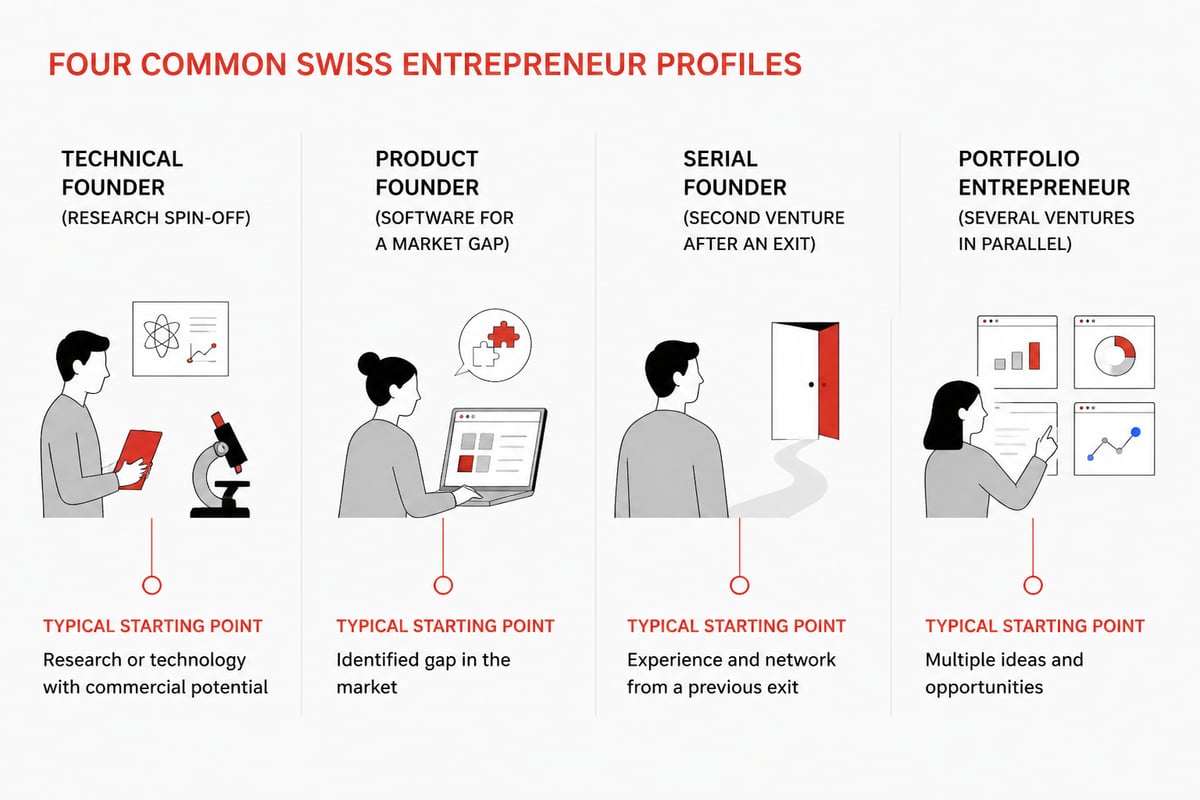
- The technical founder: an ETH or EPFL researcher who commercializes a lab discovery as a spin-off, typically in biotech, medtech or deep tech.
- The product founder: someone who identifies a gap in a market, builds software for it and sells to Swiss and European customers.
- The serial founder: a person who has built and exited one venture and starts another, applying what the first one taught.
- The portfolio entrepreneur: a founder who runs several smaller ventures in parallel. Swisspreneur has covered this model in its article on portfolio entrepreneurship.
Swiss founders also tend to operate in sectors where the country has a research advantage. EY's startup barometer reports that biotech startups attracted CHF 0.7 billion across 63 deals in 2024, the largest share of Swiss startup venture capital reported that year. Those biotech entrepreneurs are the same kind of person as a bootstrapped software founder: they see a problem, take a risk and organize a company around the solution.
Does Entrepreneur Mean CEO?
No, entrepreneur does not mean CEO. An entrepreneur is defined by the act of creating and risking, while CEO is a position inside an enterprise that carries responsibility for running it.
Many founders hold both titles at the start. In a company with two people and a prototype, the person who had the idea is usually also the person who signs contracts and answers to the board. As the enterprise grows, the roles often separate. A founder may stay on as CEO, move to chief product officer or chief technology officer, or step back to a board seat while a hired executive takes over operations.
This matters for funding conversations. Investors assess whether the person leading the enterprise has the skills the next stage requires, which is not always the same set of skills that got the company started. A founder who recognizes this early, and who is open to bringing in a co-founder or senior hire, is generally easier to back. The Swisspreneur article on co-founders and founders explains how those roles are commonly divided.
Entrepreneurship Versus Small Business Ownership
Entrepreneurship aims at building something scalable and new, while ordinary small business ownership aims at running a stable, established operation. Both create enterprises, but the intent behind them differs.
A bakery owner who opens a second location is running a growing small business. A founder who builds a logistics platform designed to serve thousands of customers across Europe is pursuing entrepreneurship in the venture sense. The first is no less valuable: Swiss SMEs of exactly this kind account for the employment figures cited above. The difference lies in growth ambition, in how risk is funded and in the exit horizon.
This distinction shapes the type of capital a founder seeks. Owner-operators usually rely on savings, bank loans or retained earnings. Scalable ventures often need external equity, which brings pre-seed and seed investors into the picture. If you are weighing which path fits you, the comparison between a startup and entrepreneurship offers a useful frame.

How a Swiss Entrepreneur Builds an Enterprise Step by Step
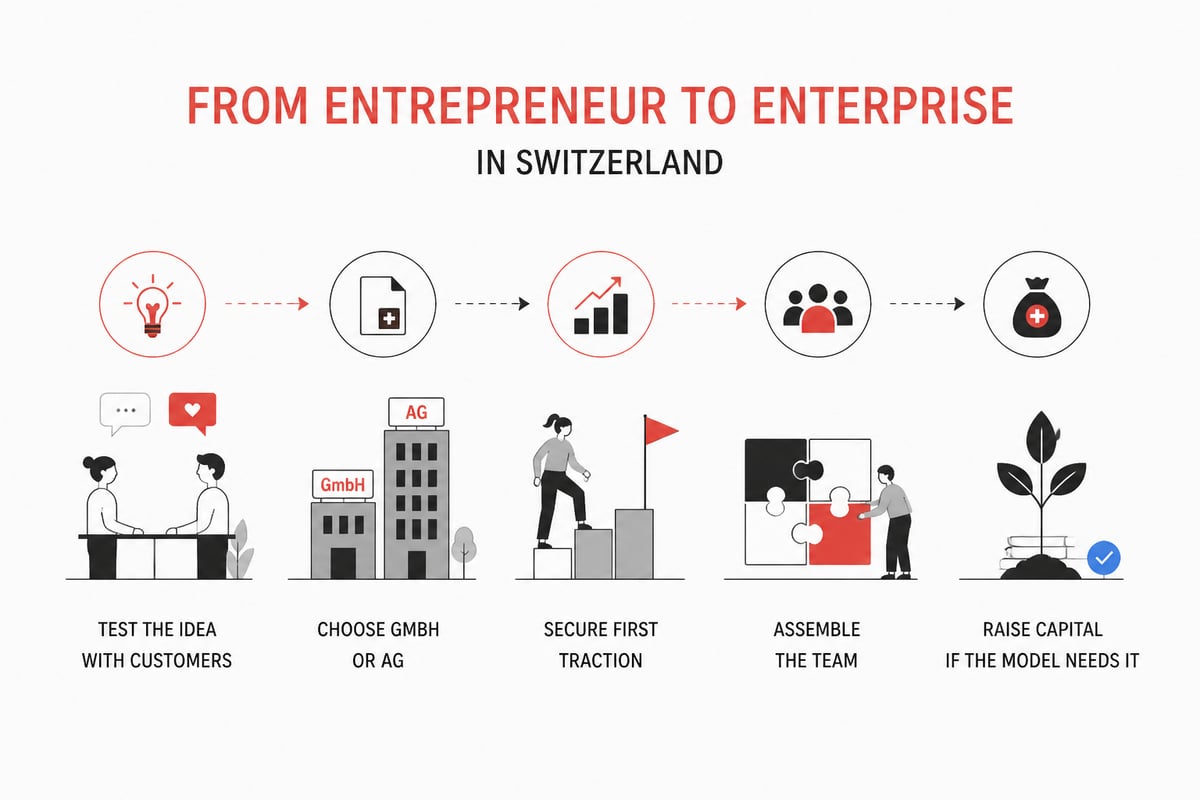
A Swiss founder turns an idea into an enterprise by validating demand first, then forming a legal entity, then building the team and financial base around it. The order matters because each step reduces risk before the next one adds cost.
- Test the idea against real customers. Before incorporating, confirm that people will pay. Swisspreneur's guide to the dos and don'ts of startup idea testing lays out practical methods.
- Choose the legal form. Most venture-oriented founders select a GmbH or an AG. The right choice depends on capital, liability and how you plan to raise money.
- Secure first traction. Early customers, pilot contracts or recurring revenue turn a concept into something investors can evaluate.
- Assemble the team. Early hires shape culture and speed. Employment law in Switzerland has its own rules, summarized in hiring, firing and everything in between.
- Raise capital if the model requires it. External funding is a tool, not a milestone to be celebrated for its own sake.
The sequence is not rigid, but skipping the first step is the most common cause of early failure. A company with a registered entity and no validated demand has only added administrative overhead to an unproven idea.
The Funding Landscape Facing Swiss Enterprises
Swiss startups raised CHF 2.3 billion across 513 funding rounds in 2024, according to the EY Startup Barometer Switzerland 2025, which also reported that total funding was 15% lower than in 2023. The market is active but more selective than it was at its peak.
Capital is also moving toward particular themes. The same EY report found that Swiss startups with an AI component raised CHF 345 million in 2024, up 134% from CHF 148 million in 2023. For founders, this means that investor attention is concentrated, and that a clear story about traction and market size carries more weight than it did in looser years.
Early-stage founders face a specific challenge: institutional venture funds often prefer later rounds, while friends and family capital is limited. Angel and syndicate structures fill that gap. Swisspreneur's investment platform for startups offers pre-seed and seed funding through its syndicate, where founders pay nothing and Swisspreneur takes a 15% carried interest on investor profits.
Raising money is also a question of fit. Investors in the Swisspreneur database, which lists more than 1,000 investors, back founders they can assess quickly, so a concise pitch and clear numbers shorten the process. The article on entrepreneur pitches is a good starting point for preparing one.
Why Peer Community Matters as Much as Capital
Founders who build an enterprise alone make slower decisions and repeat mistakes that others have already solved. A peer community shortens the learning curve in a way that money alone cannot.
The first years of a company involve decisions with no obvious right answer: when to hire, how to price, whether to enter a second market. Hearing how other Swiss founders handled the same choice is often more useful than any framework. This is the reason community formats exist around the ecosystem, from podcasts to live events to private channels.
Swisspreneur has built several of these into one place. The podcast has more than 550 episodes available free of charge and reaches 10k plays per month. Over 700 founders are connected through its Slack channel. The platform runs 10+ startup events per year and offers 150+ minutes of free masterclass content. None of this carries a cost to startups.
Mentoring works best when it is specific. A founder preparing for a first hire gets more from one candid conversation with someone who has just done it than from a generic course.
FAQ
Can a company be an entrepreneur?
Strictly speaking, no. An entrepreneur is a person, while a company is a legal entity. A company can behave entrepreneurially by launching new products or business units, which is often called corporate entrepreneurship or intrapreneurship, but the initiative still comes from individuals inside it.
Do you need to register an enterprise to be an entrepreneur?
No. You are acting as an entrepreneur from the moment you start testing an idea and taking risk on it. Registration becomes necessary when you want to sign contracts, hire staff, limit personal liability or accept investment, which in Switzerland usually means forming a GmbH or AG.
Is every enterprise the result of entrepreneurship?
Not always. Some enterprises are inherited, acquired or spun out of larger organizations, so the person running them did not necessarily create them. Entrepreneurship refers to the act of creating and driving something new, while an enterprise can be any organized business, new or old.
Your next step is to write down, in one page, the customer problem you solve and the evidence that people will pay for it, because that page is what both a mentor and an investor will ask for first. If you already have a Swiss GmbH or AG and early traction, you can explore pre-seed and seed funding through Swisspreneur Investments for startups. Swisspreneur is Switzerland's leading platform for entrepreneurs, combining candid podcast conversations, free masterclasses, regular startup events and a syndicate that connects founders with investors. To see current opportunities as they open, sign up for deals and follow what the Swiss startup ecosystem is backing next.