

How to Start a Business in Switzerland: Steps for Founders
To start that business in Switzerland, you need a validated idea, a legal form (usually a sole proprietorship, GmbH or AG), registration with the commercial register and social insurance authorities, and enough capital to operate until revenue arrives. The process is predictable and well documented, and a founder who prepares the steps in the right order can move from idea to a registered company in a matter of weeks.
This guide walks through those steps in the sequence you will actually do them. It is written for founders building a Swiss company with growth ambitions, so it also covers the point where most early-stage teams need outside capital. If you want the broader context first, Swisspreneur's overview of starting a business in Switzerland is a useful companion.
What You Need Before You Begin
Before you file anything, gather a short list of prerequisites so each later step goes faster.
- A defined customer problem. One sentence naming who has the problem and why they would pay to solve it.
- Evidence of demand. Conversations with prospective customers, a waitlist, a pilot or first paid orders.
- A rough budget. Formation costs, living costs for at least six months and the capital your chosen legal form requires.
- A Swiss address and a founding team. Decide who holds shares and who works in the company full time.
- Basic documents. Passport or residence permit, proof of address and, for a company, draft articles of association.
Founders who also need a premises search in France or a recruitment partner for hiring technical staff can find support through dedicated agencies. For example, Arundo Immobilier is a real estate agency in Reims covering buying, selling and renting, and Fullhouse is a Dutch recruitment agency serving technical sectors. Both are outside the Swiss formation process itself, but may be relevant if your plans extend across borders.
Step 1: Validate the Idea With Real Customers
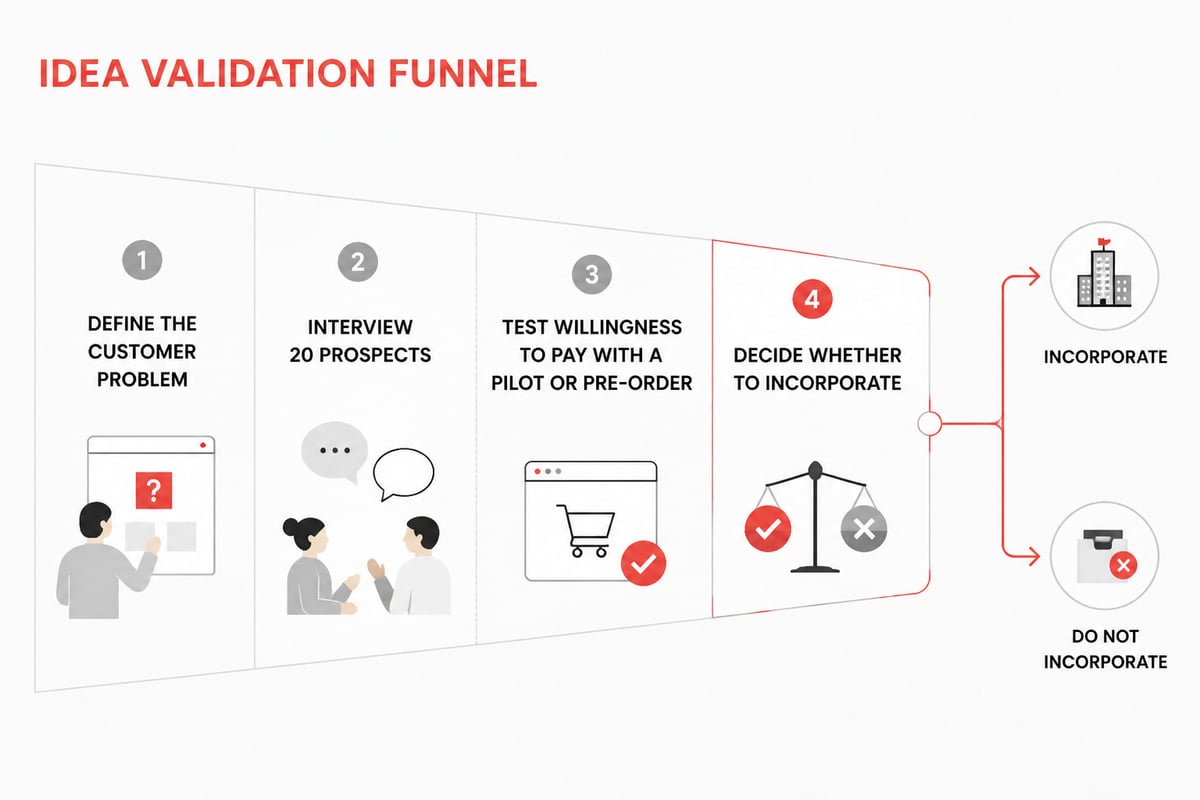
Validating an idea means proving that a specific group of people will pay for your solution before you invest in a company structure.
Speak to a good number of potential customers. Ask how they solve the problem today, what it costs them in time or money, and what they would pay for something better. Listen for urgency. A problem people mention unprompted and have already tried to fix is far more promising than one they politely agree is "interesting."
Then test willingness to pay. A pre-order, a signed letter of intent or a paid pilot says more than any survey. If you are building software or a technology product, the lessons in Swisspreneur's guide to starting a tech business apply directly.
Step 2: Choose the Right Kind of Business to Start
The right business to start is one that matches your skills, your available capital and the demand you found in Step 1.
Service businesses, such as consulting, design or development work, need little capital and can generate revenue within weeks. Product and technology businesses cost more and take longer but can scale beyond your own hours. Swisspreneur's article on a good service business to start compares the lower-capital route, and the primer on business models for startups helps you decide how the company will earn money.
If you plan to raise venture or angel funding, the choice narrows. Investors back companies with a clear path to scale, so a repeatable model with recurring revenue usually fits better than a one-person service practice.
Step 3: Write a Business Plan That Answers Investor and Bank Questions
A business plan is a short document that explains the problem, the customer, the product, the market, the team and the financial outlook, and it should be written to be read, not filed.
For an early-stage company, aim for a concise document or deck. Include these sections:
- Problem and solution. What hurts, and what you built.
- Market. Who buys, how many there are and how you will reach them.
- Business model. Pricing, margins and the unit economics of one customer.
- Go-to-market plan. Your first 100 customers and how you will win them.
- Team. Why these people can execute.
- Financial plan. Monthly cash flow for 18 to 24 months, with the key assumptions stated.
The financial plan is where weak plans fall apart. State your assumptions about customer acquisition cost, conversion and churn explicitly, and test the downside case. Swisspreneur's lesson on creating a business model gives a structured way to do this.
Step 4: Pick a Legal Form: Sole Proprietorship, GmbH or AG
The three common Swiss legal forms differ mainly in liability, capital requirements and how investors view them.
| Legal form | Minimum capital | Liability | Typical fit |
|---|---|---|---|
| Sole proprietorship | None | Personal and unlimited | Freelancers, solo service work |
| GmbH (LLC) | CHF 20,000, fully paid in | Limited to company assets | Small teams, closely held companies |
| AG (corporation) | CHF 100,000, at least CHF 50,000 paid in | Limited to company assets | Venture-backed startups |
A sole proprietorship is the simplest option, but you are personally liable for every debt. It must be entered in the Commercial Register once annual turnover reaches CHF 100,000, according to the Swiss Confederation SME Portal.
A GmbH requires at least CHF 20,000 in share capital, paid in full at incorporation, according to the Canton of Zurich. The formation must be notarized, and the capital must be deposited into a blocked bank account until the company is registered.
An AG requires share capital of at least CHF 100,000, of which at least CHF 50,000 must be contributed at formation, according to the Canton of Schwyz. Many startup founders choose an AG or a GmbH because investors expect a limited-liability company with a clean cap table.
One point matters for funding. Swisspreneur's syndicate works with startups that have a Swiss legal entity, either a GmbH or an AG. If you intend to raise a pre-seed round, incorporate before you pitch.
Step 5: Form the Company and Register It
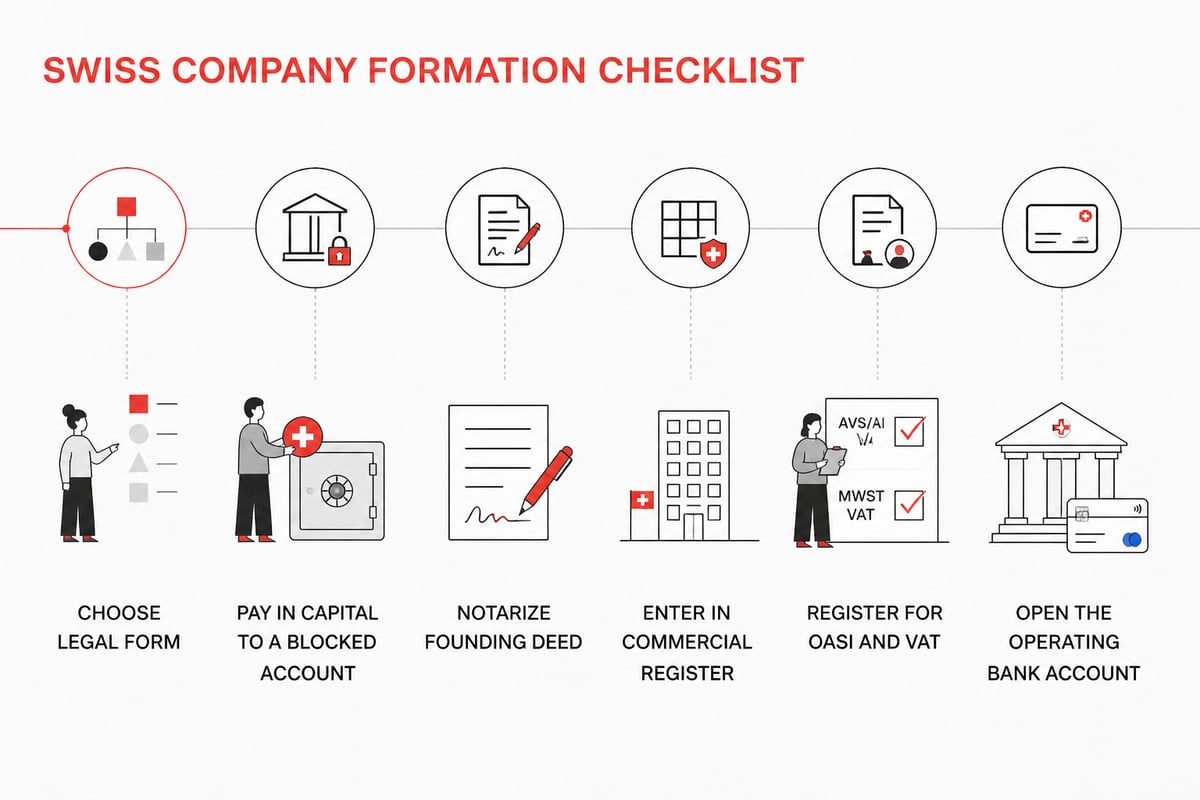
Forming a Swiss company means signing a notarized deed, paying in the capital and entering the company in the commercial register of its canton.
The sequence for a GmbH or AG runs like this:
- Draft the articles of association and agree on shareholders, directors and the company name.
- Open a blocked capital deposit account with a Swiss bank and pay in the required capital.
- Sign the notarized founding documents.
- File the application with the cantonal commercial register, along with the bank confirmation.
- Receive the register entry, which gives the company its legal existence and a company identification number (UID).
Check the company name for availability in the commercial register before you commit to branding. Costs vary by canton and by the notary you choose, so request quotes early. Swisspreneur's resource on opening a business in Switzerland adds practical context for this stage.
Step 6: Register for Social Insurance, VAT and Taxes
After the company exists, you must register with the authorities that handle social insurance, value added tax and income tax.
Social insurance. Founders must register with the competent OASI compensation office, which determines whether they qualify as self-employed, according to the Federal Social Insurance Office. Contributions follow a scale tied to income. Self-employed people with annual income of CHF 10,100 or less pay a minimum OASI/DI/IC contribution of CHF 530 per year, and those earning between CHF 10,100 and CHF 60,500 pay at a sliding-scale rate, according to the same office. Budget for these contributions from your first month of income.
VAT. Registration with the federal tax administration becomes mandatory once your taxable turnover passes the legal threshold, and you can register earlier if you want to reclaim input VAT on early purchases. Confirm the current threshold with the authority.
Direct taxes. Cantonal and municipal tax offices handle corporate and income tax, and rates differ widely between cantons. Compare locations before you fix your registered seat, because the difference can be significant over time.
Insurance. Accident insurance for employees is compulsory, and occupational pension requirements apply once salaries pass a set level. Add liability insurance appropriate to your business.

Step 7: Open a Business Bank Account and Set Up Accounting
A business bank account and a bookkeeping system should be running before your first invoice goes out.
Once the commercial register entry is issued, the blocked capital account converts into your operating account. Choose a bank or neobank that supports your payment needs, including multi-currency invoicing if you sell abroad. Connect an accounting tool from day one, and decide whether to hire a fiduciary. Most early-stage founders hand over annual accounts and tax filings to a fiduciary while keeping the monthly bookkeeping in-house or in software.
Keep personal and company money strictly separate. Mixed accounts complicate audits, due diligence and, in a limited-liability company, can weaken your liability protection.
Step 8: Fund the Business
Funding for a Swiss startup usually comes from a mix of founder savings, grants, loans and early-stage equity, and the right mix depends on how fast you intend to grow.
If you want to start that business with little outside money, bootstrapping is realistic for service and low-cost software models, and Swisspreneur explains how in its piece on starting a business with no investment. Bootstrapping keeps full ownership but caps your speed.
If your plan requires hiring engineers or buying inventory before revenue, you need equity. Swisspreneur Investments for startups offers pre-seed and seed funding through the syndicate. Founders decide which investors and founders join each deal, and the Syndicate takes only a 15% carried interest with no management fee. Swiss startup founders can close a pre-seed round in about 2 to 3 weeks through the Syndicate, and investors can join with as little as CHF 5,000 per deal. The platform has channeled over CHF 3M in investments and has more than 1,000 investors in its database. Note that the syndicate is built for companies with a Swiss GmbH or AG and some traction, not for pure idea-stage projects, so complete Steps 1 through 5 first.
Whatever route you take, prepare a short data room before approaching investors: your cap table, financial model, incorporation documents and a summary of traction.
Step 9: Build Your Team, Network and Support System
Early traction depends on the people around you, so build your team and your founder network deliberately rather than by accident.
Start with a founding team whose skills overlap as little as possible. Agree on roles, equity splits and vesting in writing before you incorporate. Swisspreneur's article on four things you need to know about successful startup teams is a good checklist for those conversations.
Then add peers and mentors. Founders who learn from others avoid expensive errors. Swisspreneur offers free masterclasses, podcast episodes, a Slack community of founders and regular startup events, with an overall event NPS of 84. These resources carry no cost to startups, which makes them a low-risk way to test your assumptions against people who have done it before.
Why Do 90% of Startups Fail?
Most startups fail because they run out of cash before they find a market that pays, and the root causes are usually avoidable.
The recurring causes include:
- No real market need. The team built something people did not urgently want.
- Cash runs out. Costs grow faster than revenue, and fundraising starts too late.
- Team conflict. Unclear roles or unresolved disagreements between co-founders.
- Weak go-to-market. A good product with no repeatable way to reach customers.
- Poor legal and financial hygiene. Missing registrations, unclear share structures or unpaid social insurance.
The defense is discipline in the early steps: validate demand, keep a long runway, document your founder agreement and treat compliance as part of the business. Swisspreneur's collection of startup lessons and its article on mistakes in business show what this looks like in practice.
Common Mistakes When You Start a Business in Switzerland
A handful of errors account for most of the delays and costs founders face during formation.
- Choosing the legal form by habit. A sole proprietorship feels easy, but it exposes your personal assets. Match the form to your risk and your funding plans.
- Underestimating the capital rules. A GmbH needs CHF 20,000 paid in and an AG needs at least CHF 50,000 paid in of CHF 100,000 total. Plan the cash before you book the notary.
- Skipping social insurance registration. Late registration can lead to back payments. Register with the compensation office as soon as you begin earning.
- Pitching investors without a legal entity. Funds and syndicates need a company to invest in, so incorporate first.
- Ignoring the cantonal tax difference. The same profit can be taxed very differently depending on your seat.
- Leaving the founder agreement undocumented. Equity, vesting and decision rights should be written down before the first customer arrives.
FAQ
How do you start a business and grow it?
Start by validating demand with paying customers, then reinvest early revenue into the one channel that brings customers most cheaply. Once the model is repeatable, add capital, hire against clear bottlenecks and track a small set of metrics such as customer acquisition cost and retention.
How long does it take to start a business in Switzerland?
A sole proprietorship can be operating within days, while a GmbH or AG typically takes a few weeks because of the notarization, the capital deposit and the commercial register entry. Preparing your documents and capital in advance is what shortens the timeline most.
Do I need a lot of money to start a business in Switzerland?
Not necessarily. A sole proprietorship has no minimum capital, and a GmbH requires CHF 20,000. The larger cost is usually your own runway, meaning the months of living and operating expenses before revenue covers them.
Your next step is to confirm your legal form and book a notary and a blocked-account appointment so your formation date is fixed. Once the company is registered and you have early traction, a funding conversation becomes realistic. Swisspreneur's Investments for startups is built for Swiss GmbH and AG founders preparing a pre-seed or seed round, and Swisspreneur is where you can follow the next deals and sign up for deals as they open.