

Founder Guide for Swiss Startup Founders Starting Out
An e founder is a person who starts a company, and for a Swiss founder in 2026 the early path comes down to four decisions: choose a legal form, put a founders agreement in writing, build traction, and line up the right mix of grants and private capital. This guide walks through each step with Swiss specifics, so you can move from first idea to first funding round without avoidable detours.
What Does It Mean to Be a Founder in Switzerland?
A founder is the person who creates a business and carries its earliest risk, which in Switzerland also means carrying personal legal and social-insurance obligations from the first franc of income. The title describes an act, not a job description. Founders set the vision, recruit the first team, and take the first financial decisions before any structure exists to share them.
Entrepreneurs and founders overlap heavily. An entrepreneur is anyone who builds or runs a business, including a freelancer or a shop owner. A founder is the specific person who brought a given company into existence. Every founder is an entrepreneur, but an entrepreneur who buys an existing business is not that company's founder. Our overview of company founders covers how the role differs across company types.
The Swiss environment is active. According to the Swiss SME Portal, company formations in 2025 were 34.7% higher than in 2015. More founders means more competition for talent and capital, which makes early preparation more valuable.
Founder or Co-Founder: Which Is Better?
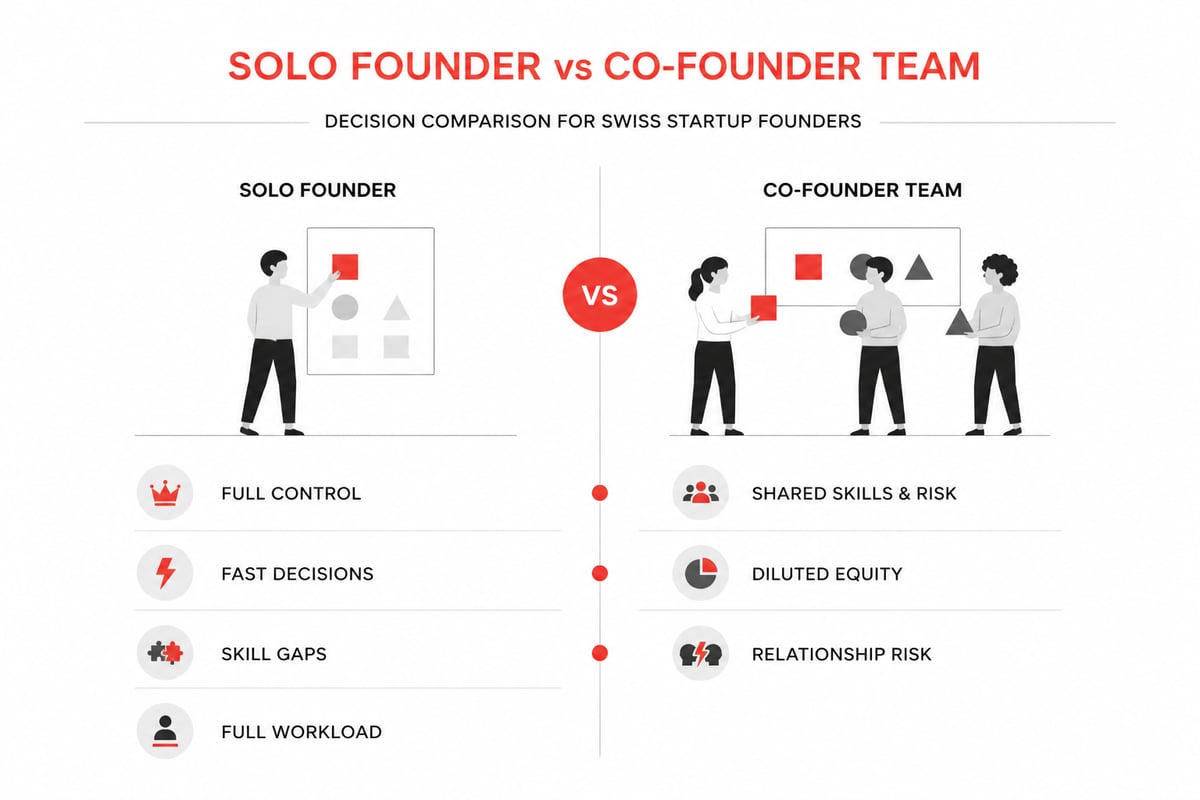
Neither title is better; the right structure depends on the skills, capital and risk you need to carry the company through its first two years. A solo founder keeps full control and decides quickly. A co-founder team adds complementary skills and shares the workload, but dilutes ownership and introduces a relationship that must survive stress.
Investors tend to scrutinize this choice. A solo technical founder who has never sold a product raises questions about go-to-market capacity. A team of three people with identical backgrounds raises questions about blind spots. Neither is disqualifying, yet each needs a clear answer.
If you are weighing the decision, these questions help:
- Which critical skill (product, engineering, sales, finance) is missing from your profile today?
- Can you fund the first 12 months without a second salary?
- Would you still want to work with this person after a disagreement over strategy?
- Are you prepared to split equity for skills you could hire later?
The article on co-founder and founder examines the distinction in more depth, and the piece on building a founder team covers how to assemble one deliberately.
Is an Entrepreneur a Founder?
An entrepreneur is a founder only if they created the company; the two terms overlap but are not identical. A person who acquires an existing business, takes over a family firm, or runs an operation started by others is an entrepreneur in practice but not its founder.
The distinction matters in practical settings. Investors ask who the founders are because they want to know who holds the original conviction and, usually, the largest share of early equity. Commercial-register entries, shareholder agreements and vesting schedules all depend on who counts as a founder.
For a deeper look at entrepreneurial roles across business types, see our guide to business entrepreneurship.
Legal and Administrative Basics Every Swiss Founder Needs
Swiss founders choose between an individual enterprise, a GmbH, or an AG, and the choice affects liability, credibility with investors, and administrative workload. Individual enterprises are the simplest to set up, but the owner is personally liable. GmbH and AG structures limit liability to company assets and are the standard vehicles for venture-backed startups.
A few thresholds are worth knowing:
- For an individual enterprise, commercial-register registration becomes mandatory when revenue exceeds CHF 100,000, according to the Swiss AHV/IV Information Centre.
- The same source states that the 2025 minimum AHV/IV/EO contribution for self-employed people is CHF 530 per year, with rates ranging from 5.371% to 10% of net annual income depending on income.
- Venture investors in Switzerland typically expect a GmbH or AG, so incorporating early removes friction later.
Social insurance, VAT registration and accounting obligations vary with your situation. Confirm details with a fiduciary or notary before committing. For a step-by-step view of the process, see our guide to founding in Switzerland and the walkthrough on how to start a business.
Put Your Founders Agreement in Writing Early
A founders agreement is a written contract that defines ownership, roles, decision rights and exit terms among the people who start a company together, and it should be signed before significant work or money enters the business. Verbal understandings hold up poorly once a company has value, and disputes between co-founders are among the most common reasons early-stage startups stall.
A solid agreement usually covers:
- Equity split and the reasoning behind it
- Vesting with a cliff, so a departing founder does not walk away with a full stake
- Roles and time commitment, including whether founders work full time
- Intellectual property assigned to the company
- Decision rules for deadlocks
- Leaver provisions for voluntary and involuntary departures
Investors request these documents during due diligence, and gaps slow or kill deals. Swisspreneur also offers a free founders agreement masterclass for those who prefer to learn the topic in video form.

How Swiss Founders Fund the Early Stage
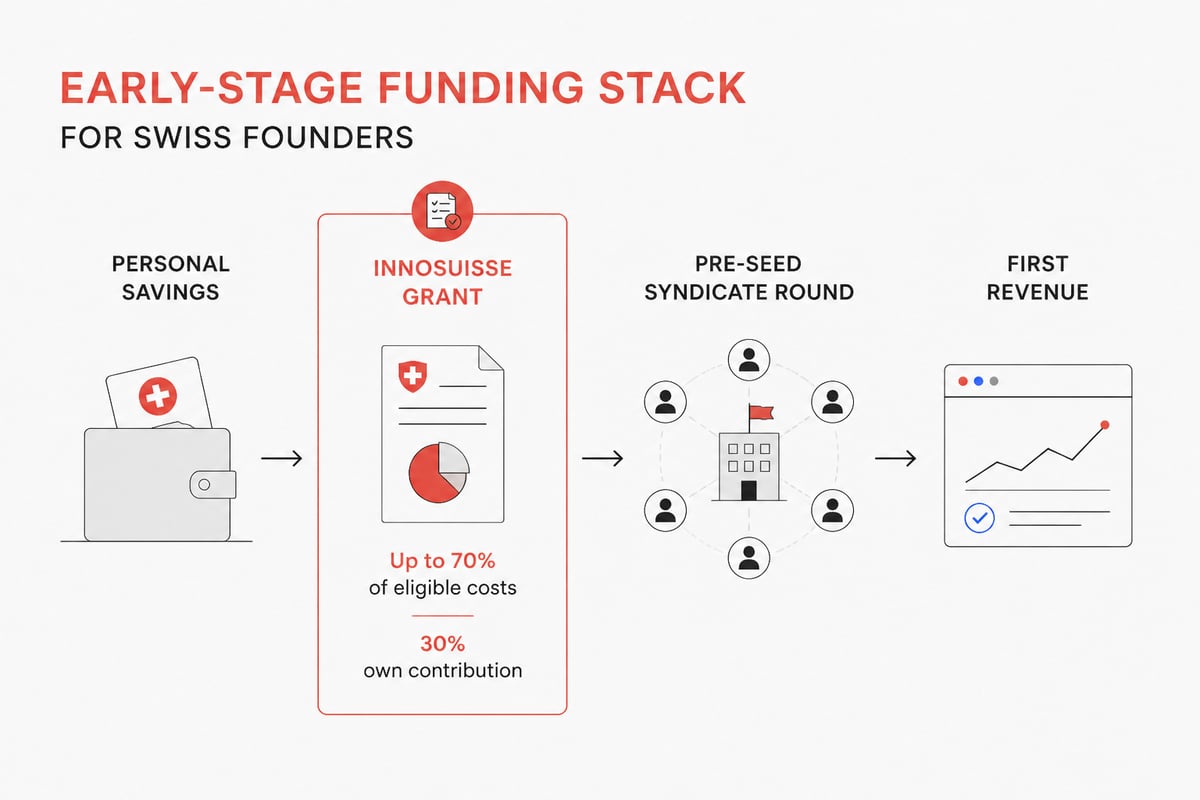
Swiss founders typically combine four sources in the early stage: personal savings, public innovation funding, angel or syndicate capital, and revenue. Each carries different expectations about timing, dilution and proof of progress, so sequencing them well matters more than chasing any single one.
Public Funding Through Innosuisse
The Swiss Innovation Agency Innosuisse supports startups with training, advice, international trade fairs and opportunities to test foreign markets. Its startup innovation-project funding is more specific. Per Innosuisse, eligible Swiss-based startups must generally be no more than five years old, have fewer than 50 FTE, and contribute at least 30% of project costs, with exceptions that may extend the age limit to 10 years. The agency covers up to 70% of eligible direct project costs for qualifying pre-market projects.
Grant funding is non-dilutive, which makes it attractive, but the application demands a clear innovation case and a realistic budget.
Angels, Syndicates and Pre-Seed Rounds
Private capital at pre-seed usually comes from angels and syndicates writing small tickets. Syndicates pool many investors behind one lead and one set of terms, which simplifies the cap table for the founder. If you already have a Swiss GmbH or AG and early traction, Swisspreneur Investments for startups offers pre-seed and seed funding through its syndicate. Founders decide which investors and founders join each deal, and the Syndicate takes only a 15% carried interest with no management fee. Swiss startup founders can close a pre-seed round in about 2-3 weeks through the Syndicate, and the Syndicate has facilitated over CHF 3M in investments to date.
The offer is for startups with a Swiss legal entity and some traction. It is not designed for companies still at the idea stage.
Building Traction Before You Raise
Traction is verifiable evidence that customers want what you build, and it is the single strongest lever a founder has in a fundraising conversation. At pre-seed, investors rarely expect large revenue. They expect signals: paying pilots, letters of intent, a growing waitlist with real conversion, or repeat usage among early customers.
A practical order of operations:
- Talk to at least 30 potential customers before writing significant code or buying inventory.
- Charge something early, even a symbolic amount, because payment separates interest from politeness.
- Track one or two metrics that match your model, such as weekly active users or monthly recurring revenue.
- Document what you learned, including what failed.
Our guide to building a product people want to buy and the business model guide help structure this work. A related episode, how long should founders keep selling, tackles a question many technical founders avoid.
Founder Mental Health and Community: The Overlooked Funding Asset
A founder's own resilience and network are assets that directly affect funding outcomes, because investors back people who can sustain pressure over several years. Isolation is a common feature of the early stage. Decisions arrive faster than advice, and many founders have no peer who has faced the same problem.
Practical ways Swiss founders build support:
- Join a founder community where people share real numbers and failures, such as the Swisspreneur Slack channel, which has connected over 700 founders.
- Attend in-person events. Swisspreneur runs 10+ startup events per year, and the founders dinner is one format built around candid peer conversation.
- Listen to founders discuss setbacks openly. The podcast library holds 550+ episodes, freely available, including a conversation on founders in love that addresses relationships and company building together.
Peers also become your best source of introductions to investors and customers. Our overview of founder communities compares formats and what to look for.
Common Early Mistakes and How to Avoid Them
Most early founder mistakes are predictable and avoidable with a few deliberate habits. The costliest tend to involve people and paperwork rather than product.
| Mistake | Consequence | Better practice |
|---|---|---|
| Splitting equity 50/50 without vesting | Departing co-founder keeps a full stake | Use vesting with a cliff |
| Delaying incorporation | IP ownership unclear, investor friction | Form a GmbH or AG before raising |
| Raising before any traction | Weak terms or no interest | Validate with paying customers first |
| Ignoring social insurance | Unexpected contribution bills | Register as self-employed and budget contributions |
| Working alone without peers | Slow learning, burnout | Join a founder community early |
Several of these connect to the points above. If you have not yet drafted a founders contract, treat it as the first item on your list.
FAQ
Who is the founder of Y Combinator?
Y Combinator was founded in 2005 by Paul Graham, Jessica Livingston, Trevor Blackwell and Robert Tappan Morris. It became one of the best-known startup accelerators and a reference point for how early-stage programs structure funding and mentoring.
Who is the founder or CEO?
The founder is the person who created the company, while the CEO is the executive who runs it day to day. In many startups the same person holds both roles at first. As the company grows or raises capital, a founder may hand the CEO role to someone else and stay on as a shareholder or board member.
Do I need a co-founder to raise money in Switzerland?
No. Solo founders do raise pre-seed funding, but investors will look closely at how you cover gaps in skills and workload. A clear plan for hiring or advisory support often matters more than the headcount of the founding team.
Your next step is to write down your equity split, vesting terms and roles in a draft founders agreement this week, before any further money or work enters the company. Once your Swiss GmbH or AG is in place and you have early traction, explore Swisspreneur Investments for startups for pre-seed and seed funding through the syndicate. Swisspreneur is Switzerland's leading platform for entrepreneurs, combining candid podcast conversations, free masterclasses, regular events and investment opportunities, and if you want to back early-stage Swiss startups with small tickets yourself, Swisspreneur lets you sign up for deals.