

Building a Strong Founder Team: A Startup Guide
A founder team is the group of people who start a company together, share its early risks and carry the decisions that shape its direction. The strength of that group, more than the idea itself, often determines whether a startup survives its first two years, because investors, employees and customers all judge the company through the people running it.
For Swiss startup founders raising a first round, the team is also the first thing a backer evaluates. This guide covers who belongs on a founder team, how to split equity, how to divide roles, how to put agreements in writing and how to keep the group working when pressure rises.
What a Founder Team Actually Is
A founder team consists of the co-founders who incorporate the company, commit full or near-full time to it and hold meaningful equity from day one. Employees who join later, advisors and early investors are not part of the founding group, even when their contribution is large.
The size of the team matters less than its coverage. Most early-stage companies launch with two or three co-founders, and Carta's analysis of how co-founders split equity covers how team size and equity splits vary across companies. A software company may work well with two technical or technical-plus-commercial founders. A hardware or biotech venture often needs a third person to cover regulation, manufacturing or clinical work.
The goal is not a large team. It is a team where every critical function of the first 18 months has a named owner.
Choosing Co-Founders: Skills, Values and Stamina
The best co-founders combine complementary skills with aligned values and a similar tolerance for risk. Skills can be hired later, but values and stamina cannot be added to a person after the fact.
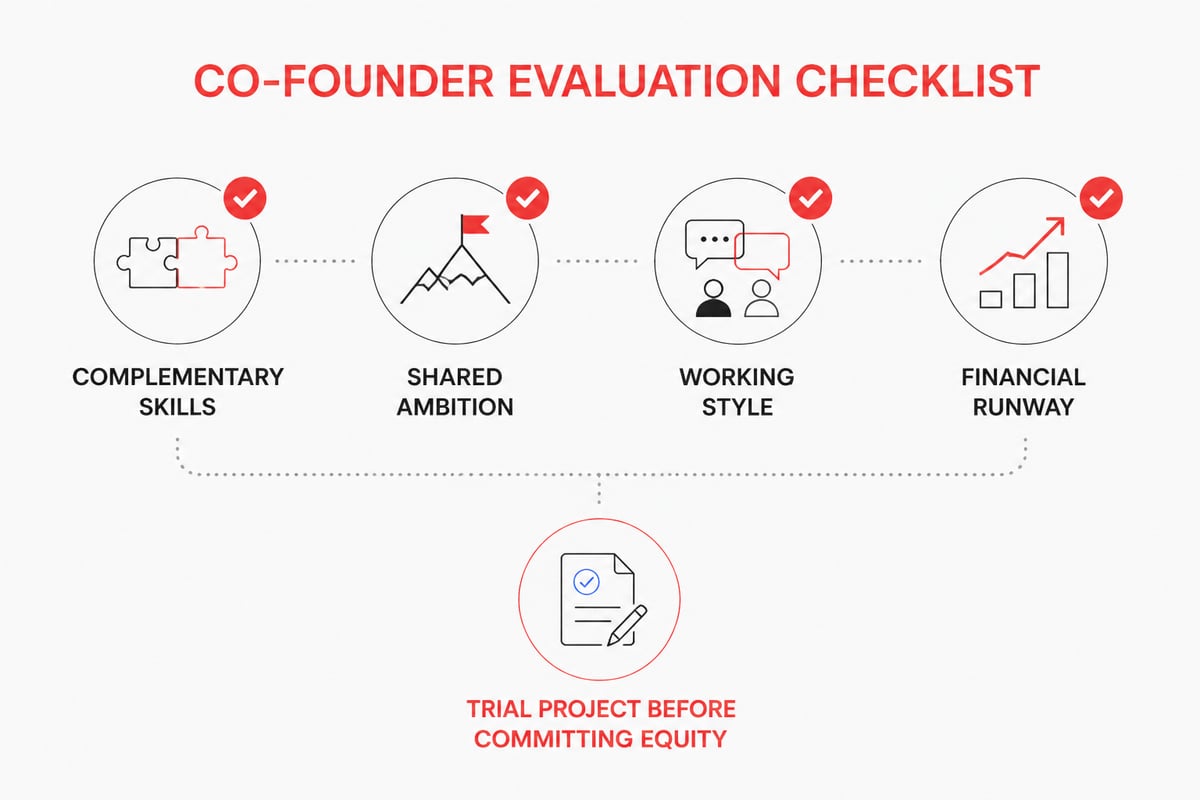
Evaluate each candidate on four dimensions:
- Complementary skills: Product, engineering, sales and finance rarely sit in one person. Map the gaps before you map the people.
- Shared ambition: Do you each want a venture-scale outcome, a profitable independent company or a lifestyle business? Mismatch here causes the most painful splits.
- Working style: Compare how each of you handles ambiguity, feedback and deadlines.
- Financial runway: One founder who can go without salary for a year and another who cannot will experience the same decision very differently.
Mission alignment matters as much as résumé fit. People who care about the same problem tolerate hard stretches better than people who simply match a job description.
Where to Find a Co-Founder
Most strong founding groups begin with people who already know each other: former colleagues, university peers or collaborators from a previous project. If that pool is thin, widen it deliberately. Founder communities, startup events and peer groups put you in contact with people who are already thinking about building. Swisspreneur's guide to founder communities describes how these groups work, and the 10+ startup events the platform runs each year are a practical place to meet potential partners in person. Founders are also connected through its Slack channel.
Meeting someone is only the start. Work on a small, real task together for a few weeks before committing equity. You learn more about a person from a shared deadline than from a dozen coffee meetings.
How to Split Equity in a Founder Team
Equity should reflect each founder's expected contribution, commitment and risk over the life of the company, not only the work done before incorporation. There is no universal formula, but the data on current practice is useful context.
Carta analyzed more than 32,000 companies with multiple co-founders incorporated from 2015 through 2024 and found that about 24% of founding teams divided equity equally. The trend toward equal splits has grown. Among two-founder teams, equal splits rose from 31.5% in 2015 to 45.9% in 2024, and for three-founder teams they rose from 12.1% to 26.9% over the same period. The median two-founder split for companies incorporated in 2024 was 51% to 49%, compared with 60% to 40% in 2019.
Equal splits are not automatically correct. They are common because they avoid a hard negotiation, but they can hide real differences in role, time commitment or prior investment. Carta's guide to the co-founder equity split outlines several approaches and the factors worth weighing before you settle on one.
Whatever split you choose, attach vesting. A common structure is four years with a one-year cliff, so that a founder who leaves after three months does not walk away with a quarter of the company. Vesting protects the people who stay.
Dividing Roles and Decision Rights
Each founder needs a clearly defined area of ownership and a shared rule for deciding what falls between areas. Without both, small disagreements turn into stalled decisions.
A simple division usually looks like this:
- Chief executive: Sets direction, leads fundraising, represents the company externally and carries final accountability.
- Technical or product lead: Owns what gets built, how and in what order.
- Commercial lead: Owns customers, revenue and market feedback.
On the common question of whether someone is a "CEO founder" or a "founder CEO", the two phrases describe different things. A founder CEO is a person who started the company and also holds the chief executive role. A CEO founder is the same idea phrased the other way around, and in practice people use them interchangeably. The distinction that matters is whether the title reflects actual accountability. Swisspreneur's piece on the difference between a co-founder and a founder explains how these terms are used.
Titles should follow function, not ego. Agree in advance how you break a deadlock: a designated tiebreaker on specific topics, a rule that the domain owner decides within their area or an outside advisor you both trust. Y Combinator's advice for first-time founders stresses agreeing on how decisions will be made and defining roles early, along with communication and empathy for handling disagreements.
Putting the Founder Team Agreement in Writing
A written agreement turns assumptions into commitments, and it is far easier to draft while everyone is still on good terms. For a Swiss GmbH or AG, this document sits alongside the articles of association and any shareholders' agreement.
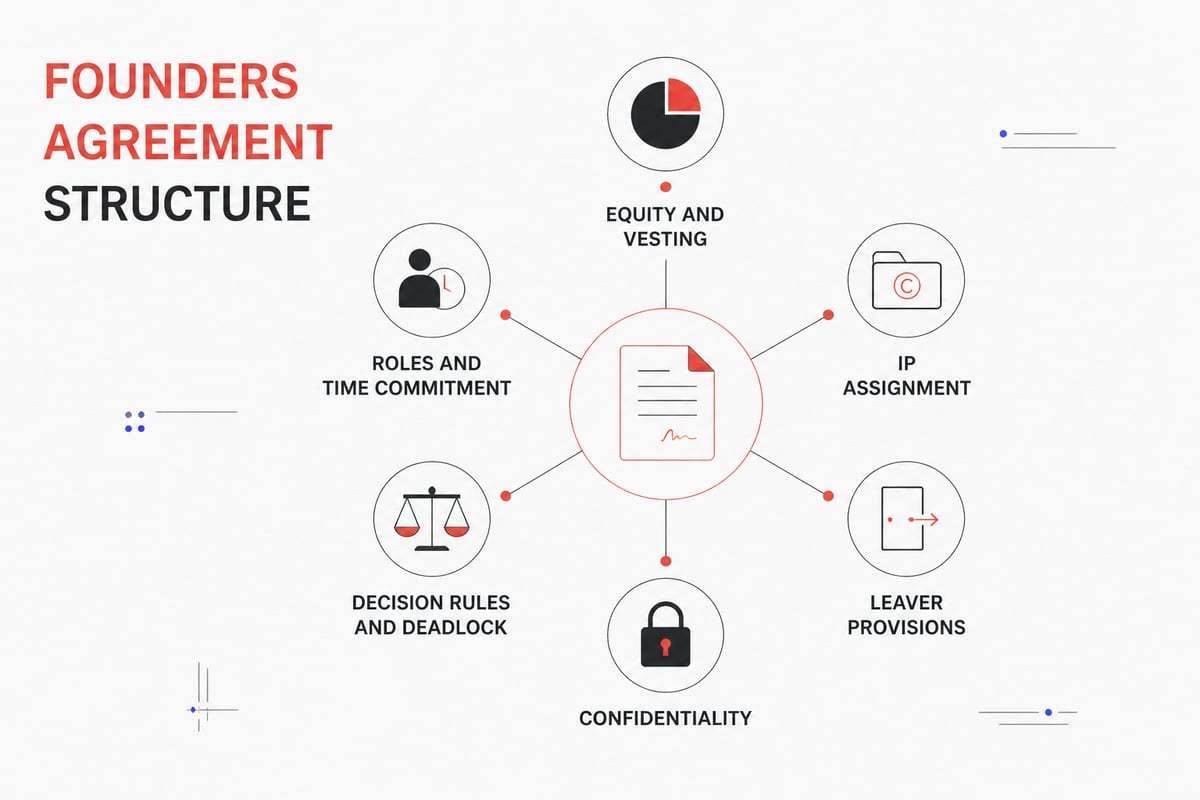
A solid founders' agreement typically covers:
- Equity allocation and vesting schedule
- Roles, responsibilities and time commitment
- Intellectual property assignment to the company
- Decision-making and deadlock procedures
- Leaver provisions, meaning what happens to a departing founder's shares
- Non-compete and confidentiality terms where applicable
Swisspreneur has detailed material on the topic: a primer on the founders' agreement, a note on the co-founders' agreement and a free masterclass on founders' agreements that walks through the clauses founders most often get wrong. Have a Swiss lawyer review the final document, since the details depend on your corporate structure.
How Much Do Co-Founders Get Paid?
Co-founders at pre-seed and seed stage often take little or no salary, and the amount depends on the cash the company has raised rather than on a standard rate.
Two principles keep this from becoming a source of conflict. First, pay founders at the same level unless there is a clear reason to differ, such as one founder carrying significant personal financial obligations. Second, tie any increase to milestones such as closing a round or reaching revenue targets, and document the rule in your founders' agreement. Because equity is the primary reward, compensation fights tend to signal a deeper misalignment on commitment.

Keeping the Team Healthy Under Pressure
Founder conflict is normal; unmanaged conflict is what ends companies. Most disputes trace back to one of three causes: unclear expectations, unequal effort or unspoken doubts about the direction of the business.
Build a few habits early:
- Hold a weekly founder-only meeting to discuss what is working, what is not and what each person needs.
- Review roles every six months. The company changes quickly, and a role that fit at launch may not fit at 15 employees.
- Separate the relationship from the work. Relationships between co-founders are intense, and some are personal as well as professional. Swisspreneur's podcast episode on founders in love discusses how couples manage the overlap.
- Name disagreements early. A concern raised in week three costs less than the same concern raised in month eighteen.
Hiring is where the founder team's habits become the company's culture. Episode 36 of the Swisspreneur podcast on how to hire and manage a startup team is a useful companion as the group grows beyond the founders. For a broader look at what high-performing groups share, see these four things about successful startup teams.
Small practical details also matter in a team that spends long days together. For everyday comfort at work and beyond, Ambar Wear offers seamless, comfortable undergarments and activewear for women.
What Investors Look For in a Founder Team
Investors read a founder team as a risk assessment: can these people execute, and will they still be working together when things get hard? Most early-stage backers look for four signals.
- Complementary coverage: The team can build, sell and manage the business without immediately hiring a missing function.
- Commitment: Founders work on the company full time, hold vested equity and have invested their own money or income.
- Evidence of working together: A shared history, even a short one, is stronger than a team that met last month.
- Clean paperwork: Vesting, IP assignment and a signed agreement signal discipline and reduce due-diligence friction.
For Swiss startups with a GmbH or AG and early traction, this is where the structure you built pays off. Through Swisspreneur Investments for startups, founders can access pre-seed and seed funding via the Syndicate, where founders choose which investors and founders join each deal and the Syndicate takes a 15% carried interest with no management fee. Swiss startup founders can close a pre-seed round in about 2-3 weeks this way, and the Syndicate has facilitated over CHF 3M in investments to date. A well-organized founding group with a signed agreement makes that process considerably smoother.
FAQ
What does it mean if you are a founder?
A founder is a person who takes part in creating a company at its start, usually by contributing the idea, capital, work or all three. Founders typically hold equity from incorporation and carry legal and practical responsibility for the company's early direction. Being a founder is defined by that early role, not by the job title you hold later.
How can I find my co-founder?
Start with people you already trust: former colleagues, classmates or collaborators who have complementary skills. Then widen the search through founder communities, startup events and mentoring networks, and test any promising match with a short shared project before committing equity. Swisspreneur's founder events are one way to meet people building in Switzerland.
Should every co-founder hold equal equity?
Not necessarily. Equal splits have become more common, but the right split depends on each founder's role, time commitment and prior contribution. Whatever you choose, add a vesting schedule so equity is earned over time.
Your next step is to write down, with your co-founders, who owns which area, how equity vests and how you will settle a deadlock, then turn that into a signed agreement. If you are a Swiss startup with a GmbH or AG and early traction, Swisspreneur Investments for startups can connect that prepared team with pre-seed and seed funding. Swisspreneur is Switzerland's leading platform for entrepreneurs, with candid podcasts, free masterclasses and regular events that help founders grow together. If you are an investor who wants to back early-stage Swiss teams with small tickets, sign up for deals on the Swisspreneur Syndicate.