

All About Starting a Business: A Swiss Founder's Guide
All about starting a business comes down to five moves: validate a real problem, choose a legal structure, register and budget properly, find early customers, and fund growth with the right partners. In Switzerland, each step has specific rules and resources, from cantonal commercial registries to VAT thresholds and an active early-stage investor community. This guide walks through the sequence a Swiss founder follows, with the practical details that apply to a GmbH or AG and a product that already shows early traction.
What Do You Need to Start a Business?
You need five things to start a business: a validated problem, a legal entity, a realistic budget, your first customers, and a funding plan. Everything else, from branding to hiring, builds on these.
- A validated problem. A clear customer pain that people will pay to solve.
- A legal entity. For most Swiss startups that seek investors, a GmbH or AG.
- A budget. Startup costs, runway and a buffer for slower-than-expected sales.
- First customers. Proof that the market responds before you scale.
- A funding plan. Bootstrapping, grants, angels or a syndicate round.
The sections below take each in turn.
Validate the Problem Before You Build
Validation means confirming that a specific group of customers has a painful problem and will pay for a solution before you invest heavily in building one.
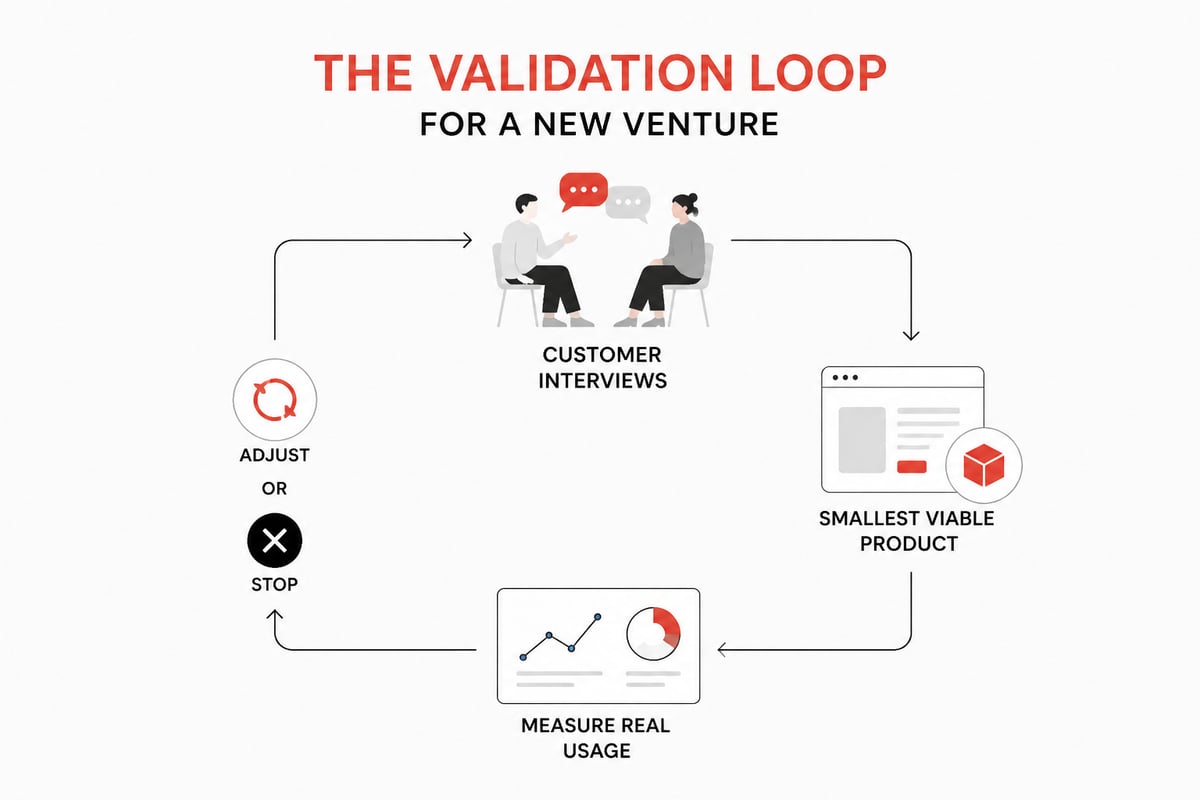
Start with conversations, not code. Interview at least 20 potential customers and ask how they handle the problem today, what it costs them and what they have already tried. If they have no workaround and no budget, the problem is probably not urgent enough.
Then size the market from the bottom up. Count how many reachable customers exist in Switzerland and nearby markets, multiply by a realistic price, and see whether the number supports a venture-scale business or a healthy small one. Both are legitimate, but they lead to different funding paths.
A lean first version helps here. Build the smallest product that delivers the core value, put it in front of real users and measure what they do rather than what they say. Swisspreneur's guide to how to start a business covers this early stage in more depth.
Choose the Right Legal Structure in Switzerland
The right legal structure depends on your liability, your funding plans and how many founders are involved, and for investor-backed startups it is usually a GmbH or an AG.
A sole proprietorship is the fastest route and needs no minimum capital, but you carry unlimited personal liability. A GmbH limits liability to the company's capital and suits small teams. An AG is the standard choice for companies planning to issue shares to multiple investors.
| Structure | Liability | Typical fit |
|---|---|---|
| Sole proprietorship | Unlimited, personal | Freelancers, very small service businesses |
| GmbH | Limited to company capital | Small teams, early-stage startups |
| AG | Limited to company capital | Startups planning to raise from investors |
Investors generally expect a clean cap table and a Swiss entity with proper articles of association. If you plan to raise a pre-seed round, set up the entity correctly from the start rather than converting later. A practical walkthrough is available in Swisspreneur's article on setting up a business in Switzerland.
Complete the Registration Steps and Understand VAT
Registering a Swiss company follows a defined checklist, and the federal SECO checklist is the most reliable reference for the order of steps.
According to the SECO SME Portal, you should budget for startup costs, clarify your business name with the cantonal commercial registry, register for social insurance and determine your VAT status. For companies other than sole proprietorships, the checklist also includes preparing a business contract and articles of association and registering with the commercial register.
A typical sequence looks like this:
- Choose and check the company name with the cantonal registry.
- Draft the articles of association and shareholder agreement.
- Deposit the share capital with a bank and obtain the confirmation.
- Have the founding documents notarized where required.
- Register with the commercial register.
- Register for social insurance and clarify VAT status.
On VAT, the standard Swiss rate is 8.1%, according to the Federal Tax Administration. Whether you must register depends on your turnover, so confirm your status early to avoid invoicing mistakes. For the canton-by-canton details, see Swisspreneur's guide to starting a business in Switzerland.
How Much Money Do You Need to Start a Business?
The amount you need depends on the business model, but a startup is better planned by months of runway than by a single headline figure.
Costs fall into one-off items (incorporation, notary fees, legal drafting, branding, initial development) and recurring ones (salaries, software, insurance, marketing, accounting). A service business with one or two founders can start on a few thousand francs. A software or hardware startup with a development team needs considerably more, and Swiss salaries make payroll the dominant cost.
A reasonable planning method:
- List every fixed monthly cost, including your own minimum salary.
- Multiply by 12 to 18 months to estimate the runway you should fund.
- Add a 20% buffer for delays and unplanned costs.
- Compare the total against what you can bootstrap, borrow or raise.
If a smaller sum covers a service business, bootstrapping may be enough. If your plan requires a product team, that is where outside capital enters the picture.
Build a Business Model That Can Sustain Itself
A business model explains who pays you, how much and why, and it should show that each customer returns more than they cost to acquire.
Define your customer segment, value proposition, pricing, sales channels and cost structure on a single page. Then test the weakest assumption first, which is usually willingness to pay or the cost of acquiring customers. Swisspreneur's guide on how to create a business model and the overview of business models for startups help you compare recurring revenue, transaction fees, licensing and service models.
Avoid pricing too low out of caution. Swiss customers tend to value reliability and quality, and a price that signals credibility often converts better than a discount.
Find Your First Customers
Your first customers come from direct outreach, your personal network and a narrow, well-defined niche rather than broad marketing.
Start with the people you already know and the communities where your customers gather. Offer a small group a pilot at a reduced price in exchange for detailed feedback and a reference. Ten paying customers who tell you exactly what to improve are worth more than a thousand passive sign-ups.
Track three numbers from the beginning: how many prospects you contact, how many convert, and how long the sale takes. These figures become the core of any investor conversation later. Traction is also what separates a promising company from an idea, and it is the standard most early-stage investors apply.
Understand the Swiss Funding Landscape
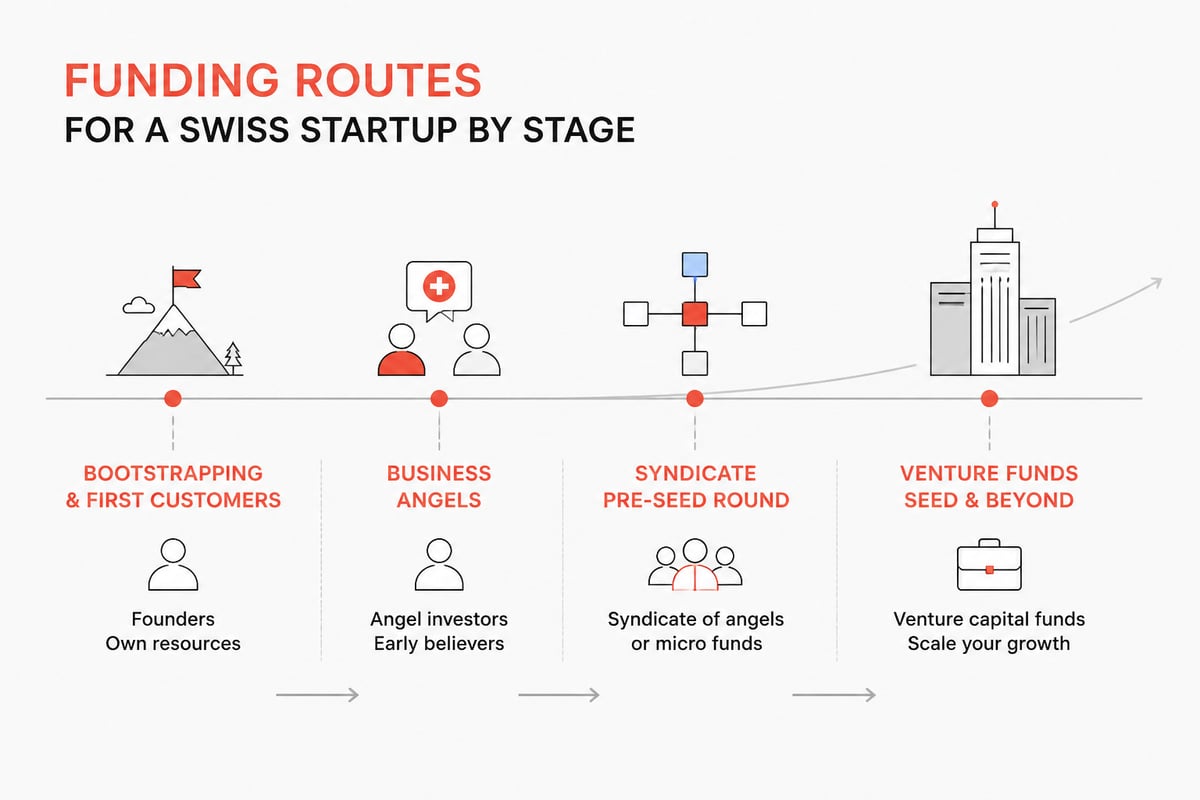
Swiss startups raise money from founders' savings, grants, business angels, venture funds and syndicates, and the market has been recovering after a slower period.
In 2024, investment in Swiss startups fell compared with 2023, according to EY Switzerland. Conditions improved the following year: Swiss startup investment rose in 2025, according to the Swiss Venture Capital Report as reported by SWI swissinfo.ch.
Sector focus matters too. Swiss startups with an AI component raised CHF 345 million in 2024, up 134% from CHF 148 million in 2023, according to EY Switzerland. If your product sits near an area of investor attention, say so clearly, but never stretch your story to fit a trend.
For a first external round, three routes are common:
- Business angels. Individuals who invest early and often add mentoring.
- Venture funds. Larger cheques, usually for companies with stronger traction.
- Syndicates. Groups of investors who pool capital behind a single round.
For a closer look at winning angels, the Swisspreneur episode Q&A on how to win business angels over as investors is a practical listen.
Raising a Pre-Seed Round Through a Syndicate
For Swiss founders with a GmbH or AG and early traction, a syndicate can close a pre-seed round far faster than a traditional roadshow.
Swisspreneur Investments for startups offers pre-seed and seed funding to Swiss startups through its syndicate. Founders decide which investors and founders join each deal, and the syndicate takes only a 15% carried interest with no management fee. Swiss startup founders can close a pre-seed round in about 2-3 weeks through the syndicate, and it has channelled over CHF 3M in investments so far. Its database holds more than 1,000 investors, and individual investors can join a deal from CHF 5,000.
This route is aimed at startups with a Swiss legal entity and visible traction. If you are still at the idea stage, concentrate on validation and first customers before approaching investors.
Build a Team and a Support Network
A strong founding team and a circle of peers shorten the learning curve more than almost any tool or tactic.
Choose co-founders whose skills complement yours, agree early on roles, equity and vesting, and put the arrangement in writing. Disputes over equity are among the most preventable causes of early failure. Swisspreneur's piece on four things you need to know about successful startup teams offers a useful framework.
Peer support matters just as much. Founders who talk regularly with others at a similar stage hear about suppliers, hiring options and pitfalls before they hit them. Swisspreneur connects founders through its Slack channel, runs startup events throughout the year, and publishes a large library of podcast episodes and free masterclass content. Its networking events for startups are a low-pressure place to meet other founders and investors.

A Practical First-90-Days Checklist
A focused 90-day plan keeps a new founder moving through the essentials in order instead of scattering effort across low-value tasks.
Days 1 to 30: validate and decide
- Complete at least 20 customer interviews.
- Define your target customer and core promise.
- Choose your legal structure and check the company name.
Days 31 to 60: register and build
- Draft the articles of association and founder agreement.
- Complete registration, social insurance and VAT clarification.
- Launch the smallest usable version of your product.
Days 61 to 90: sell and learn
- Sign your first paying customers or pilots.
- Record conversion rates and sales cycle length.
- Prepare a short deck with traction data for potential investors.
FAQ
What business makes $10,000 a month?
Businesses that reach $10,000 a month in revenue tend to be service, consulting, software or e-commerce models with strong margins and repeatable sales. The business type matters less than pricing, customer acquisition cost and how many clients you can serve. Test your numbers against your own cost structure before assuming any figure is realistic.
Is $10,000 enough to start a business?
It can be, for a lean service or online business with low overhead and a single founder. It is rarely enough for a product company with a development team, especially in Switzerland where salaries and legal setup costs are high. Plan by months of runway rather than one lump sum.
Is $5000 enough to start a business?
Yes, for a freelance, consulting or simple digital business that needs little more than registration, basic tools and a modest marketing budget. For anything involving staff, inventory or software development, it will cover only the first few weeks. Validate demand cheaply first, then decide how much more you need.
Your next step is to write down the three riskiest assumptions in your plan and test the first one with real customers this week. When your Swiss GmbH or AG has early traction and you are ready to raise, the syndicate route described above through Swisspreneur Investments for startups is worth a closer look. Swisspreneur is Switzerland's leading platform for entrepreneurs, with podcasts, free masterclasses, regular events and a syndicate that supports startup founders. Swisspreneur lets you sign up for deals so you can see which Swiss startups are raising next.