

Entrepreneur vs Entrepreneurship: What's the Difference
An entrepreneur is a person who starts and runs a venture, while entrepreneurship is the process, activity, and mindset through which opportunities are identified, resourced, and turned into value. That is the core difference of entrepreneur and entrepreneurship: one describes who acts, the other describes what is being done and how. The two terms are closely linked, but they are not interchangeable, and treating them as the same thing leads to muddled thinking about funding, hiring, and strategy.
This article defines each term, compares them side by side, and then moves to practical territory: how the distinction affects a Swiss founder raising a first round, building a team, and finding the right peers.
What Is an Entrepreneur?
An entrepreneur is an individual who identifies a market opportunity, organizes resources around it, and accepts the financial and personal risk of building a venture. In everyday language this is the answer to the question "What do we call a person who starts a business?" The most common word is founder, and entrepreneur is the broader label that covers founders, serial builders, and owner-operators.
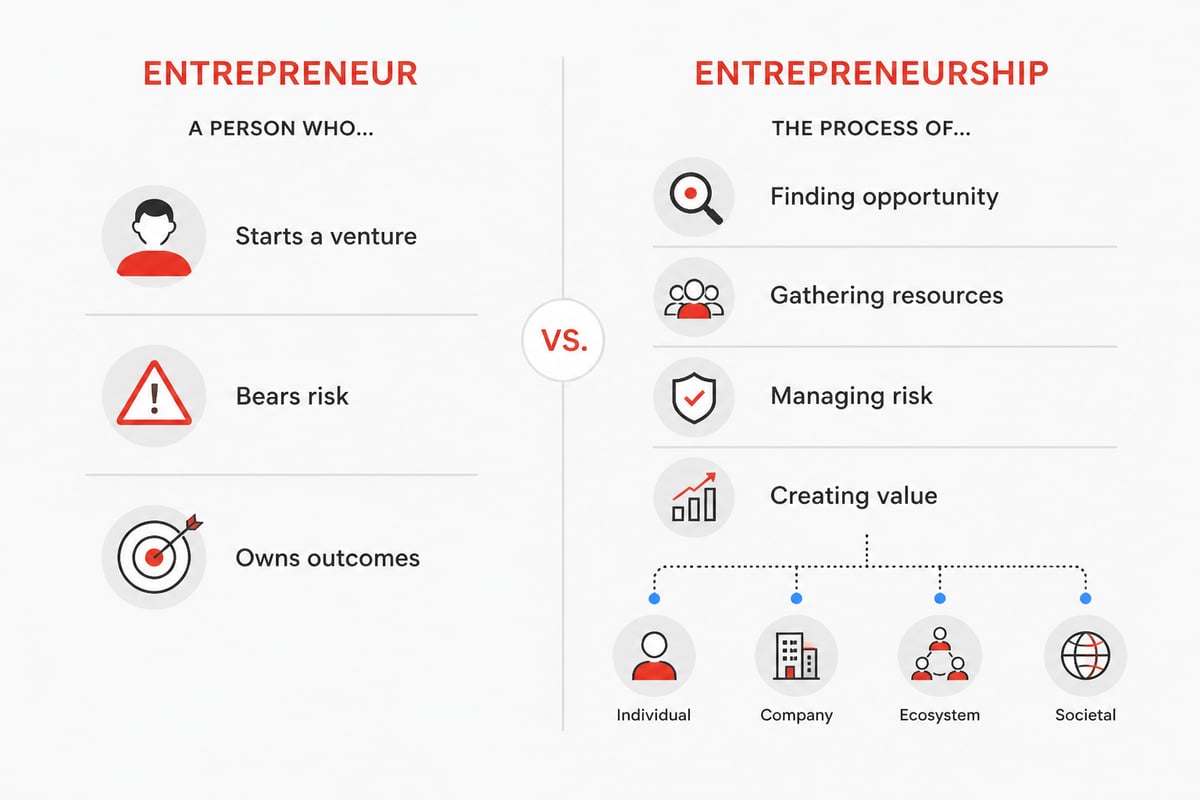
Entrepreneurs are generally understood as the people who pursue a venture, take on its associated risk, and may benefit from its success. Three traits recur in nearly every definition:
- Initiative: the entrepreneur acts before certainty exists.
- Risk-bearing: capital, time, and reputation are put at stake.
- Ownership of outcomes: results, good or bad, trace back to the person.
An entrepreneur is a role held by an individual or a small founding team. You can say "she is an entrepreneur," but you cannot say "she is an entrepreneurship." That grammatical test captures the distinction well. The first term is a noun for a person; the second is a noun for a field of activity.
Not every business owner fits the label either. A person who buys an established franchise and runs it as designed is managing a business. An entrepreneur is typically creating something new, whether a product, a service, or a way of delivering one. For a closer look at that line, see this breakdown of the differences between a businessman and an entrepreneur.
What Is Entrepreneurship?
Entrepreneurship is the process of spotting opportunities, innovating, mobilizing resources, managing risk, and creating value. This is the standard answer to "What is the definition of entrepreneurship?" and it matches how Bentley University describes it: a process of identifying opportunities, taking initiative, innovating, managing risk, mobilizing resources, and creating value.
Because it is a process, entrepreneurship is not limited to one person or one company. It operates at several levels:
- Individual level: a single founder building a first product.
- Organizational level: a company that keeps launching new lines of business.
- Ecosystem level: a region where founders, investors, universities, and regulators interact.
- Societal level: the combined effect of new ventures on jobs, prices, and innovation.
The societal level is where the numbers become striking. The SBA Office of Advocacy reports that small businesses employ a large share of U.S. workers and account for a substantial share of GDP. No single entrepreneur produces those outcomes. They are the aggregate result of entrepreneurship as a systemic activity. If you want to explore this wider lens, the Swisspreneur piece on entrepreneurship and society covers how new ventures shape the economy around them.
The Difference of Entrepreneur and Entrepreneurship Side by Side
The clearest way to see the difference of entrepreneur and entrepreneurship is to compare them on the same attributes. The table below does that.
| Attribute | Entrepreneur | Entrepreneurship |
|---|---|---|
| Nature | A person or founding team | A process, activity, and mindset |
| Part of speech | Noun describing an actor | Noun describing a field or practice |
| Focus | Who starts and carries the venture | How opportunity becomes value |
| Scope | One individual or small group | Individuals, firms, ecosystems, society |
| Measured by | Personal results, venture outcomes | Jobs created, innovation, economic activity |
| Can be taught as | A set of traits and habits | A discipline with methods and frameworks |
| Example | A founder building a medtech spin-off | The cycle of idea, validation, funding, growth |
A useful shorthand: the entrepreneur is the driver, and entrepreneurship is the driving, along with the road, the vehicle, and the traffic rules. The person cannot practice entrepreneurship without acting, and the activity does not happen without people willing to do it. They depend on each other, which is why the terms get mixed up.
Another practical difference is that entrepreneurship can exist without a classic entrepreneur. An employee launching a new product line inside a large company is practicing entrepreneurship without owning the firm. This is often called intrapreneurship, and it is explored further in this article on corporate entrepreneurship.
Examples of Entrepreneurship in Practice
Entrepreneurship takes many forms, and five examples show how broad the concept is. This answers the common question "What are 5 examples of entrepreneurship?"
- Small business entrepreneurship: a founder opens a specialized service firm, such as a local consultancy or a craft producer, with modest capital and a focus on steady profit.
- Scalable startup entrepreneurship: a team builds a software or deep-tech product designed for rapid, repeatable growth and outside investment.
- Social entrepreneurship: a venture pursues a social or environmental goal, using a business model to fund its mission.
- Corporate entrepreneurship: an established company creates new units, products, or spin-offs from within.
- Serial or portfolio entrepreneurship: a founder builds, sells, and launches several ventures over time, as discussed in this guide to portfolio entrepreneurship.
Each example involves entrepreneurs, but the category itself, the type of activity, is the entrepreneurship. The same founder may move between categories over a career.
Volume gives a sense of scale. The U.S. Department of the Treasury notes that new business applications rose sharply in 2024 compared with 2019. Applications for businesses most likely to hire employees also increased over the same period. Each application represents an entrepreneur; the surge as a whole is entrepreneurship in motion.
How Entrepreneurship Relates to Business and Startups
Entrepreneurship is the broader activity, a business is one outcome of it, and a startup is one specific kind of business built for rapid growth. People searching "What is business and entrepreneurship?" are usually trying to untangle these three words.
A business is any organization that sells goods or services. Entrepreneurship is how many businesses come into being, but not every business is entrepreneurial. A well-run bakery that has served the same neighborhood for thirty years is a business, and it may involve little ongoing innovation or risk-taking.
A startup is narrower again. Stanford's overview separates startups from small businesses by their ambition to scale quickly and to find a repeatable, growing business model. The Swisspreneur article on the difference between startup and entrepreneurship goes deeper, and the guide to business and entrepreneurship lays out the overlap.
For a Swiss founder, the practical meaning is this: you may be an entrepreneur running a perfectly sound small business, or an entrepreneur building a venture-scale startup. Both are legitimate. The distinction matters because early-stage investors, including angel syndicates, are looking for the second type.

Why the Distinction Matters for Swiss Founders
Keeping the two terms apart changes the questions a founder asks. When you think as an entrepreneur, you ask: what do I need to do next, and what can I personally carry? When you think about entrepreneurship, you ask: what system, network, and capital do I need around me so the venture can grow?
Here is how that plays out in three areas.
Funding
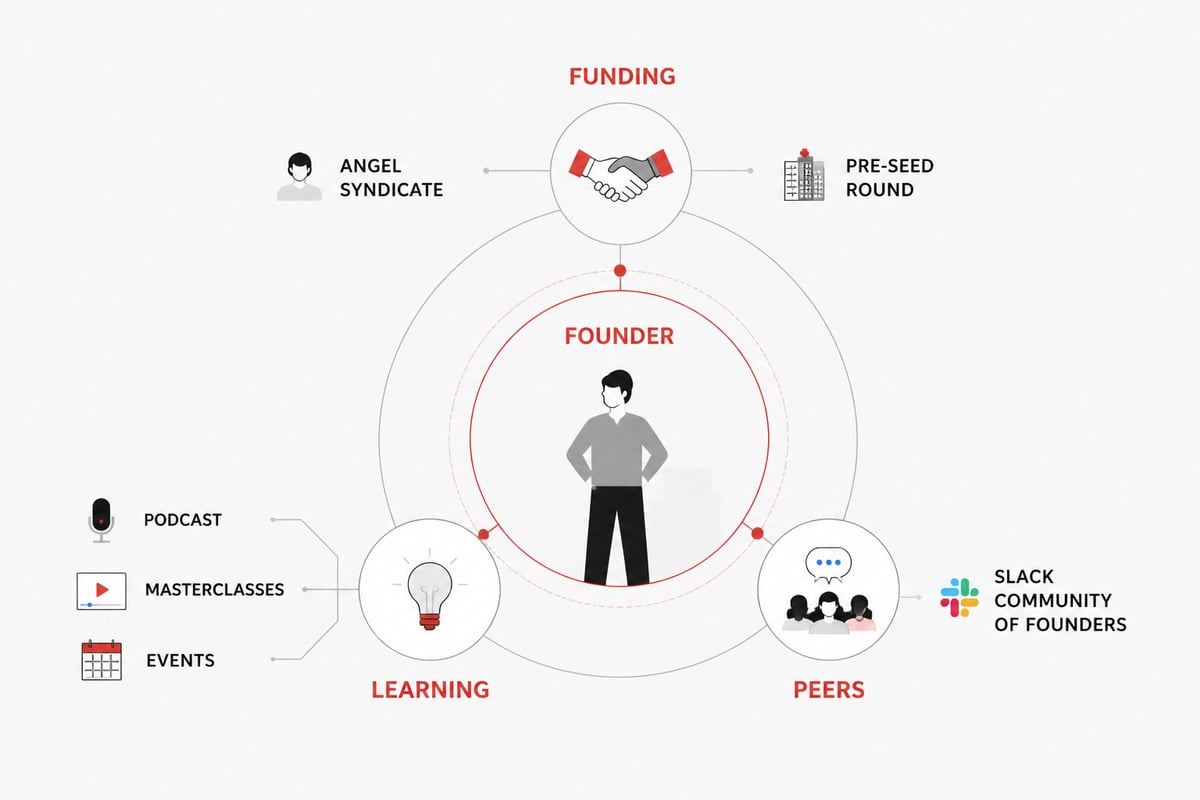
An entrepreneur needs capital, but entrepreneurship needs a funding ecosystem. Swiss founders raising a first outside round benefit from understanding that investors back the process and the team together. Through the Swisspreneur Syndicate, founders decide which investors and founders join each deal, and the Syndicate takes a 15% carried interest with no management fee. Investors can start with as little as CHF 5,000 per deal. Founders who are Swiss legal entities (GmbH or AG) with early traction are the ones this model is built around.
Mentoring and learning
Entrepreneurial skill is partly personal and partly collective. Swisspreneur offers free podcast episodes, free masterclass content, and regular startup events. These resources are free to startups. Founders who treat entrepreneurship as a learnable discipline, rather than a trait you either have or lack, tend to use resources like these earlier and more often. The entrepreneurship lessons collection is a useful starting point.
Peer community
No founder carries a venture alone. Founders are connected through the Swisspreneur Slack channel, which gives a practical picture of entrepreneurship as a network: shared introductions, candid answers about hiring or legal setups, and fast feedback. Entrepreneurs are individuals, but entrepreneurship runs on relationships.
Common Mistakes When Mixing the Two Terms
Confusing the person with the process produces predictable errors, and avoiding them sharpens how you pitch, hire, and plan.
- Equating a founder's passion with a business model. Being an entrepreneur does not by itself prove that the entrepreneurship, meaning the repeatable process of creating value, is working.
- Assuming entrepreneurship is only about starting. The Bentley definition includes managing risk, mobilizing resources, and creating value, which continue long after launch.
- Believing entrepreneurship needs a company you own. Intrapreneurs inside corporations practice it too.
- Treating "entrepreneur" as a personality verdict. Entrepreneurial behavior can be trained. The person who is cautious today may build ventures confidently after a few cycles of practice.
- Ignoring the ecosystem. A strong founder in a weak support environment faces higher friction. This is why regional programs and communities matter.
A short reflection exercise helps: write down three things you do personally as an entrepreneur, and three things your venture needs from the wider entrepreneurship system around you. The second list usually reveals the next gap to close, whether that is investors, advisors, or customers.
Definitions at a Glance
For quick reference, here are the working definitions in plain language.
- Entrepreneur: a person who creates and runs a new venture and accepts its risk.
- Entrepreneurship: the process and discipline of turning opportunity into value through innovation, resources, and risk management.
- Intrapreneur: an employee who acts entrepreneurially inside an existing organization.
- Startup: a young company designed to grow quickly with a scalable model.
- Small business: an independent firm, often focused on stable income rather than rapid scaling.
Different sources phrase these slightly differently, and the boundaries blur in practice. What stays consistent is the split between actor and activity. If a sentence is about a person's decisions, traits, or risk, you are talking about an entrepreneur. If it is about methods, systems, economic effects, or the field of study, you are talking about entrepreneurship.
Where to Find Practical Resources Beyond the Definitions
Once the vocabulary is settled, the useful next step is acting on it. A few external websites show how entrepreneurship plays out in very different sectors, which helps founders see the concept beyond software.
- For founders in the Swiss leisure and experience economy, Innobook offers an online booking platform for activities, tickets, and vouchers, which illustrates how a niche marketplace connects providers and customers.
- For anyone studying how local service businesses grow through search visibility, D.Hennessy Roofing is a Dublin roofing contractor whose site shows how a trade business presents its services.
- For energy-focused founders, INFOLED describes how an engineering company packages solar, battery storage, and EV charging for commercial and residential clients.
- For service-sector founders thinking about advisory models, Hår1 shows how a consultancy supports salons with operations, finance, and HR resources.
These sites are not instructions, but they show the range of ventures that fall under entrepreneurship. The common thread is a person spotting a gap, assembling resources, and building something customers will pay for.
FAQ
What do we call a person who starts a business?
A person who starts a business is most commonly called an entrepreneur or a founder. The term entrepreneur is broader and also covers people who launch several ventures or build in less formal ways. If the business is scalable and venture-backed, the person is usually described as a startup founder.
Can someone practice entrepreneurship without being an entrepreneur?
Yes. Employees who launch new products or business units inside an established company practice entrepreneurship without owning the firm. This is often called intrapreneurship. They use the same skills of opportunity recognition and resource mobilization, but the company carries most of the financial risk.
Is every business owner an entrepreneur?
No. An owner who runs an established business according to a fixed model is managing it, while an entrepreneur typically creates something new or adapts the model in a meaningful way. The line is not always sharp, and many owners move between the two roles at different stages.
If you are a Swiss founder with a GmbH or AG and early traction, a practical next step is to write down what your venture needs from the entrepreneurship system around it, whether capital, advisors, or peers, and rank those needs by urgency. Swisspreneur supports Swiss startup founders with free podcasts, masterclasses, events, and a founder community, plus a syndicate where you can sign up for deals and meet investors who back early-stage Swiss ventures.