

Entrepreneur vs Entrepreneurship: A Founder's Guide
An entrepreneur is a person who identifies an opportunity and takes on the risk of building a business around it, while entrepreneurship is the process, mindset and ecosystem through which that building happens. For anyone researching entrepreneur dan entrepreneurship, the short version is this: one is the actor, the other is the activity. Understanding where they diverge helps founders make better decisions about funding, team and timing.
The distinction sounds academic, yet it shapes real choices. A founder who sees only the "entrepreneur" side tends to treat the company as an extension of personal drive. A founder who also understands entrepreneurship treats it as a repeatable discipline with stages, tools and a support network.
What Is the Difference Between an Entrepreneur and Entrepreneurship?
The difference is one of category: an entrepreneur is a person, and entrepreneurship is the process that person carries out. The first is a noun describing someone who starts and runs a venture; the second describes the full set of activities, from spotting a gap in the market to scaling a company.
A simple comparison makes this concrete.
| Attribute | Entrepreneur | Entrepreneurship |
|---|---|---|
| Nature | A person | A process and a mindset |
| Focus | Vision, decisions, risk-taking | Opportunity recognition, resource use, value creation |
| Scope | One individual or founding team | An entire economy, region or field of study |
| Example | A founder pitching a pre-seed round | The system of investors, mentors, events and policy that makes that pitch possible |
You can be an entrepreneur without practicing much entrepreneurship in the disciplined sense, for example by launching on instinct and never testing assumptions. You can also study entrepreneurship without ever founding anything. Swisspreneur explores this pairing further in its article on the entrepreneur and entrepreneurship relationship.
Who Is an Entrepreneur?
An entrepreneur is someone who creates a new venture, organizes the resources it needs and accepts the financial and personal risk of the outcome. The role is defined by action rather than by title or company size.
Common traits show up across founders, though none is a guarantee of success:
- Opportunity recognition: noticing a problem that others treat as normal.
- Risk tolerance: committing time and capital before the result is known.
- Resourcefulness: assembling a product, team and customers with limited means.
- Resilience: continuing after failed experiments, lost deals or rejected pitches.
Not every entrepreneur builds a venture-backed startup. A craftsperson who opens a workshop, a consultant who forms a GmbH and a software founder chasing a seven-figure round are all entrepreneurs. Their paths differ in scale and capital needs, which is why the label alone says little about strategy. Swisspreneur's piece on the differences between a businessman and an entrepreneur draws this line more sharply.
What Is Entrepreneurship as a Process?
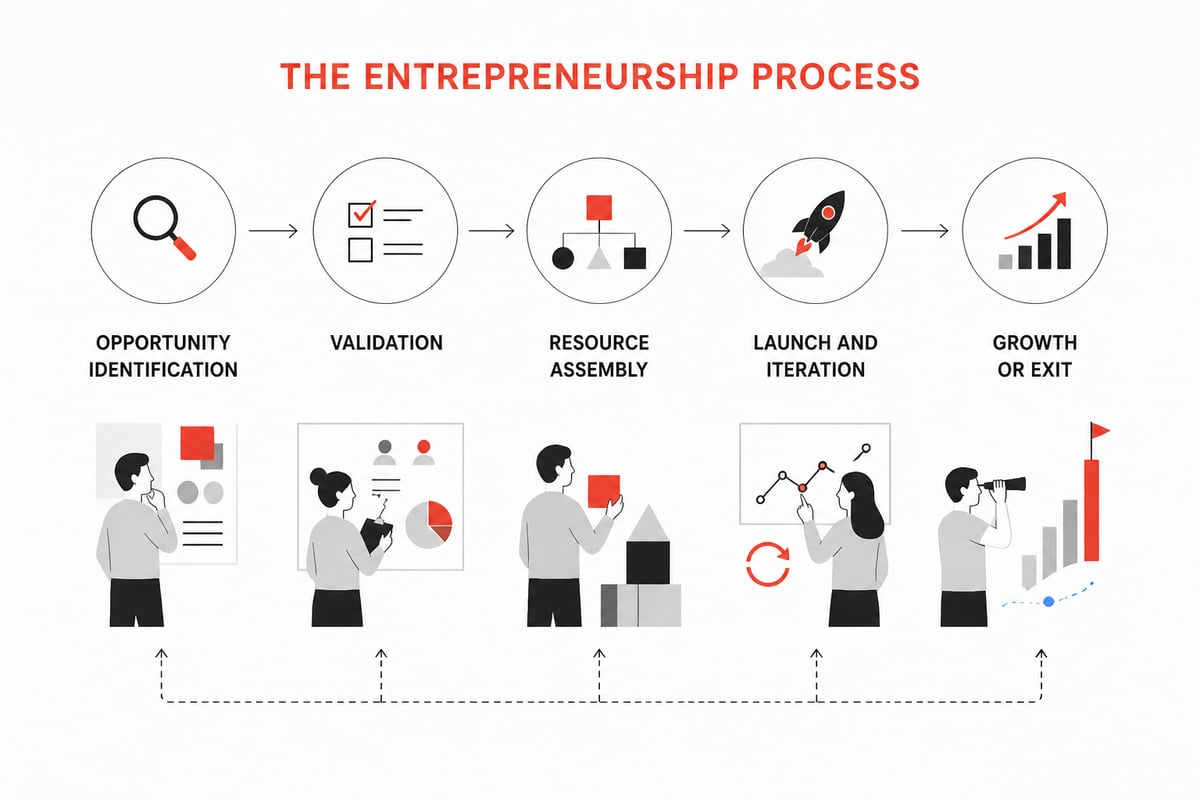
Entrepreneurship is the structured process of discovering opportunities, testing them, gathering resources and turning them into a functioning business. It is also a field of study and a feature of economies.
At the process level, most ventures move through recognizable stages:
- Opportunity identification: a customer problem or market shift is spotted.
- Validation: the founder tests demand with interviews, prototypes or early sales.
- Resource assembly: capital, talent, partners and legal structure are put in place.
- Launch and iteration: the product reaches customers and changes based on feedback.
- Growth or exit: the company scales, merges, is acquired or winds down.
Entrepreneurship also operates at the system level. Universities, investors, accelerators, regulators and peer communities all contribute to whether founders in a region succeed. This is why the same person might struggle in one environment and thrive in another. Swisspreneur's overview of entrepreneurship and society looks at that wider effect.
How the Two Concepts Depend on Each Other
Entrepreneurship cannot occur without entrepreneurs, and entrepreneurs perform better when they work within a deliberate process. Each side feeds the other.
Consider the feedback loop. A founder's decisions generate data: which customers pay, which features get used, which channels convert. That data refines the process. A better process, in turn, lowers the cost of the next decision. Over time, individual entrepreneurs who share lessons also raise the quality of entrepreneurship across a whole community.
Scale gives some context for how much activity is at stake. The U.S. Small Business Administration reported that small businesses represent the large majority of U.S. businesses and employ a large share of American workers in its 2024 FAQ. Those figures describe entrepreneurship as an economic force, built one entrepreneur at a time.
Founders who want to see how business creation connects to wider economic activity can explore the Census Bureau's research tool on business applications and employment, which summarizes studies on that relationship.
Entrepreneur, Startup Founder and Intrapreneur: Where the Labels Differ
What is intrapreneurship? Intrapreneurship is entrepreneurial behavior carried out inside an established company, where an employee builds a new product or business line using the employer's resources instead of personal capital.
The terms are easy to blur, so a quick reference helps:
- Entrepreneur: starts and owns a venture, carrying the full risk.
- Startup founder: a type of entrepreneur building a company designed to scale quickly, often with outside investment.
- Small business owner: an entrepreneur whose goal is a stable, profitable company rather than rapid growth.
- Intrapreneur: an employee who acts entrepreneurially within a larger organization, with lower personal risk and less ownership.
- Serial or portfolio entrepreneur: someone who runs or launches several ventures over time, covered in Swisspreneur's guide to portfolio entrepreneurship.
Large companies increasingly encourage intrapreneurs to stay competitive. Swisspreneur's article on corporate entrepreneurship explains how established firms try to capture that energy. The key difference from independent entrepreneurs is ownership: an intrapreneur rarely holds equity in the idea and does not carry the downside personally.

Why Younger Generations Are Drawn to Entrepreneurship
Gen Z leans toward entrepreneurship because low-cost digital tools, visible founder role models and flexible work expectations reduce the barriers to starting something. The cost of building a first product has fallen sharply compared with previous decades.
New-business data reflects a broader surge in founder activity. The U.S. Treasury Department noted that the country saw new business applications rise well above pre-pandemic levels in the post-COVID expansion. That figure is American, but it points to a wider pattern: more people are testing business ideas, and more of them do so earlier in their careers.
Several drivers recur:
- Software, no-code platforms and cloud services let a small team ship a product quickly.
- Podcasts, interviews and social media make founder journeys visible and relatable.
- Traditional employment feels less secure to many younger workers, which raises the appeal of building their own path.
For Swiss founders, the opportunity is real, though the trade-offs are too. Early enthusiasm needs structure, which is where entrepreneurship as a discipline matters more than raw ambition.
What Entrepreneurship Looks Like for Swiss Startup Founders
For a Swiss founder, entrepreneurship in practice means moving from idea to a funded, legally established company within a small, well-connected ecosystem. The decisive early assets are traction, a Swiss legal entity such as a GmbH or AG, and access to capital and advice.
This is where the entrepreneur dan entrepreneurship distinction becomes practical. The entrepreneur supplies drive and judgment. The entrepreneurship environment supplies the investors, mentors and peers who sharpen both. Founders with an early-stage company and some traction often need three things in parallel:
- Early-stage funding that does not take months to close.
- Mentoring from people who have built and sold companies.
- A peer community that shares candid, current experience.
Swisspreneur is built around those needs for Swiss startup founders. Its free resources include free masterclass content, a podcast archive of 550+ episodes and a Slack community connecting over 700 founders, all at no cost to startups. The company also runs regular startup events.
On funding, the Swisspreneur Syndicate offers investment opportunities to founders and investors, and has raised over CHF 3M in investments through its syndicate. It also draws on a database of 1,000+ investors. Founders considering this route can learn more about investor access and deal structure.
This route fits companies that already have a Swiss GmbH or AG and some traction. It is not designed for idea-stage projects or ventures based outside Switzerland.
Building Entrepreneurial Skills That Compound
Entrepreneurial skill develops through repeated practice, feedback and exposure to people ahead of you on the same path. Reading definitions helps, but habits matter more.
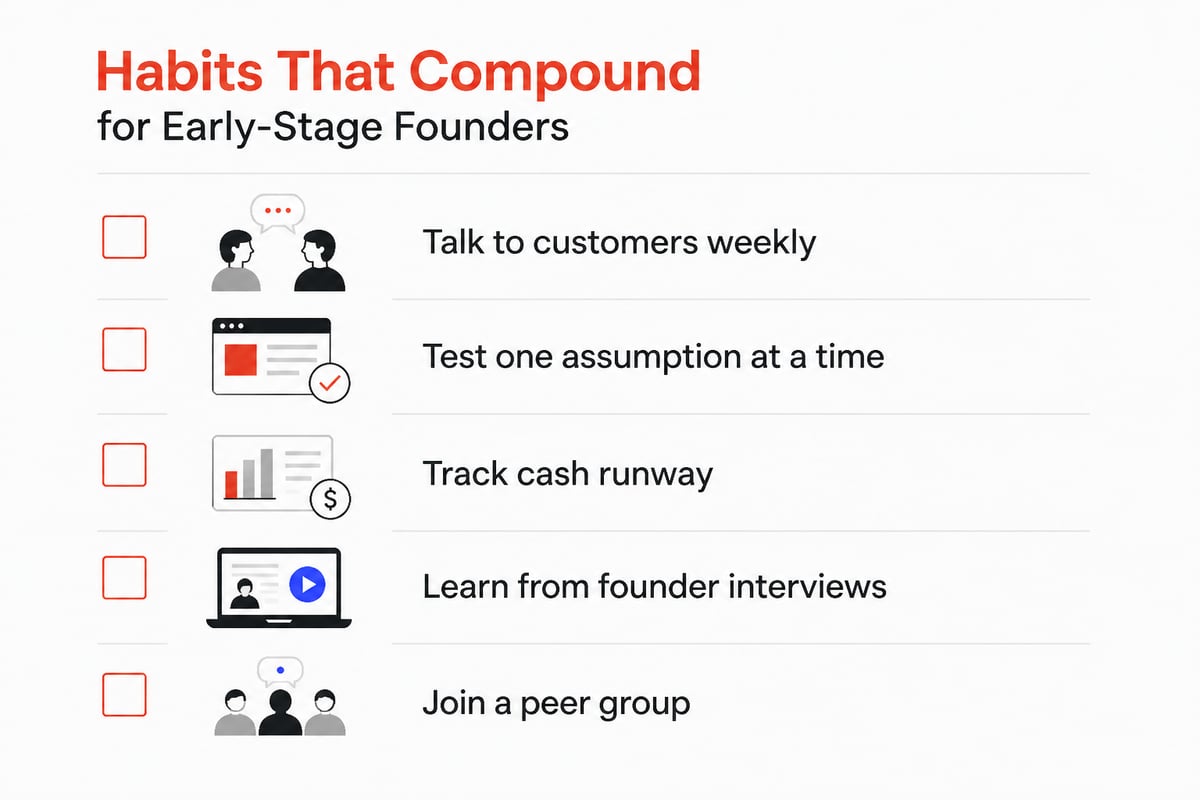
Practical habits that build both the entrepreneur and the entrepreneurship side:
- Talk to customers every week. Direct conversations are the cheapest form of market research.
- Test one assumption at a time. Small experiments reduce the cost of being wrong.
- Track cash runway monthly. Many early-stage failures are liquidity problems before they are product problems.
- Learn from founders ahead of you. Interviews and case discussions compress years of trial and error. Swisspreneur's entrepreneur interviews and its guide to entrepreneurship lessons collect practical material.
- Join a peer group early. Founders who compare notes spot mistakes sooner.
Public support for new businesses also reflects how much weight governments place on this process. The SBA reported that in FY 2024 it supported its highest level of small-business financings across core programs since 2008. The takeaway for founders: capital markets and support programs are built to channel resources toward entrepreneurial activity, but finding the right source still requires effort and the right network.
How to Apply the Distinction to Your Own Venture
Applying the distinction means evaluating yourself as an entrepreneur and your venture as an entrepreneurial process, then closing gaps in each. Treat it as a short diagnostic.
Questions about you as the entrepreneur:
- Do you have the capacity to carry the risk for the next 12 to 24 months?
- Which skills are you missing, and who can fill them?
- Are you decisive when data is incomplete?
Questions about the process:
- Have you validated demand with paying or committed customers?
- Is the company legally set up, with a clear cap table?
- Do you have a repeatable way to acquire customers?
- Who are the investors, mentors and peers you can call this month?
If the first set is weak, invest in your own development. If the second set is weak, strengthen the process and your surrounding network. Most founders benefit from working on both, and from doing so alongside others. Swisspreneur's guide to success in entrepreneurship offers a useful companion for this kind of self-assessment.
FAQ
Who is an entrepreneur in simple terms?
An entrepreneur is a person who starts a business, organizes the resources it needs and accepts the risk of its success or failure. The term covers everyone from sole proprietors to founders of venture-backed companies.
Can you practice entrepreneurship without being an entrepreneur?
Yes. Entrepreneurship is a process and a field of study, so employees, investors, mentors and researchers all take part in it. An intrapreneur, for example, applies entrepreneurial methods inside an existing company without owning the venture.
Is entrepreneurship the same as running a small business?
Not exactly. Running a small business can be entrepreneurial, but entrepreneurship centers on spotting opportunities and creating new value, often with growth in mind. A stable, long-established shop may be well managed without involving much entrepreneurial activity.
Your next step is to write down the three biggest gaps in your venture, one about yourself and two about your process, and talk to a founder who has closed them. If your Swiss GmbH or AG already has traction and you are preparing a pre-seed round, you can sign up for deals through Swisspreneur and see how founders and investors team up on early-stage investments. Alongside the Syndicate, Swisspreneur offers free masterclasses, a large podcast archive and a founder community to support you before, during and after funding.