

How to Start a New Company in Switzerland: Swisspreneur's Guide
A new company start in Switzerland takes five core steps: validate your idea, choose a legal form (usually a GmbH or AG), register with the commercial register, sort out social insurance and tax, and secure early funding. A straightforward GmbH can be operational within a few weeks, provided your documents and capital deposit are ready. This guide walks Swiss founders through each step in sequence, with the funding path that follows once your entity exists.
Validate the Idea Before You Spend on Incorporation
Validate the idea first, because incorporation fees and capital deposits are easier to justify once real customers have shown interest. Paying for a notary and a blocked capital account before you know anyone will buy is the most avoidable early expense.
Validation does not require a finished product. It requires evidence that a specific group of customers has a problem and will pay to solve it. Useful signals include:
- Paid pilots or signed letters of intent from at least a few target customers
- A waitlist with measurable conversion, not just sign-ups
- Repeated customer interviews that produce the same pain point in similar words
- A clear answer to who pays, how much, and how often
Swisspreneur has published practical material on the dos and don'ts of startup idea testing, which is a sound starting point if you are unsure how rigorous your tests should be. Traction matters later too: Swiss pre-seed investors typically expect early evidence that customers want what you are building.
Choose the Right Legal Form for Your New Company
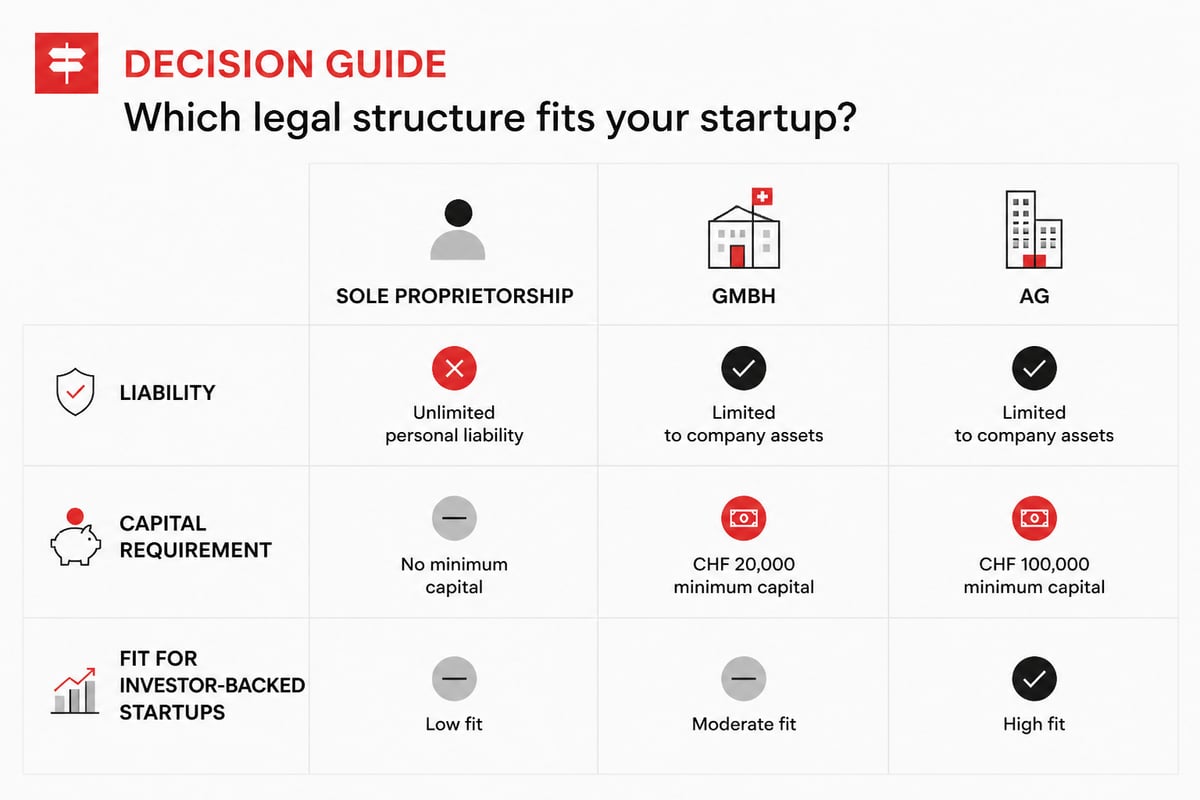
The right legal form depends on how much liability you want to carry, how much capital you can deposit, and whether you plan to raise outside money. For most venture-backed founders, the choice is between a GmbH and an AG.
| Legal form | Minimum capital | Liability | Typical fit |
|---|---|---|---|
| Sole proprietorship | None | Personal, unlimited | Freelancers, very small service businesses |
| GmbH (limited liability company) | CHF 20,000 | Limited to company assets | Small teams, founder-led startups |
| AG (stock corporation) | CHF 100,000 (at least CHF 50,000 paid in) | Limited to company assets | Startups planning to issue shares to investors |
A sole proprietorship is the fastest to set up, but you are personally liable for every debt. Sole proprietors are personally responsible for taxes, insurance and retirement planning, which is a significant burden for a venture with growth ambitions.
For a startup that expects to raise a pre-seed or seed round, a GmbH or AG is the realistic choice. Investors want a clean cap table, defined share classes and limited liability. Switching later is possible but costs time and legal fees, so decide with your funding plans in mind.
How Do You Register a New Company in Switzerland?
You register a new company by drafting articles of association, depositing the share capital, having the documents notarized, and filing with your cantonal commercial register. The process is the same in outline across cantons, though fees and processing times vary.
- Pick a company name. Check availability in the Zefix central business name index and confirm the name is distinctive and not misleading.
- Open a capital deposit account. A Swiss bank holds your paid-in capital in escrow and issues a confirmation for the notary.
- Draft the articles of association. These set out the purpose, capital, share structure and governance rules.
- Notarize the founding documents. A notary public certifies the incorporation deed and the founders' signatures.
- File with the commercial register. Your cantonal office reviews and enters the company. The legal entity exists from the moment of entry.
- Release the capital. Once registered, the bank releases the deposit to your business account.
At least one person with signing authority must reside in Switzerland for a GmbH, and the same applies to AG board members under the representation rules. Founders based abroad should confirm residency requirements early, since this can delay a filing by weeks.
Swisspreneur's podcast includes a Q&A on starting a company in Zurich with Andri Silberschmidt, which gives a founder's view of the practical steps and common snags.
Social Insurance, Pension and Tax Obligations
Founders must register with an OASI compensation office, and salaried founders and self-employed founders are treated differently. Getting this wrong creates back-payments, so settle it in the first weeks.
The Federal Social Insurance Office states that self-employed people register with an OASI compensation office, which decides whether their work qualifies as self-employment under Swiss social-insurance rules. Self-employed individuals pay OASI, disability insurance and income-compensation contributions themselves, at a combined rate between 5.371% and 10% depending on income. The minimum annual contribution is CHF 530.
The sliding scale matters for early-stage founders who pay themselves little. According to the BSV contributions overview, self-employed people earning CHF 10,100 or less a year pay that CHF 530 minimum, while the maximum rate applies from CHF 60,500 in annual income.
Pension planning also differs. Self-employed people are not required to contribute to an occupational pension fund (second pillar), so founders operating as sole proprietors need their own retirement plan. If you hold a GmbH or AG and draw a salary from it, you are generally an employee of your own company, and mandatory pension rules can apply once you pass the salary threshold.
Founders who keep a day job while building a venture should also check the rules on side activity. The Canton of Zurich explains when secondary income may trigger AHV contributions, which is worth confirming before you start invoicing.
Beyond social insurance, plan for:
- VAT registration, mandatory once turnover exceeds the legal threshold, optional earlier
- Corporate and capital taxes, which differ by canton and strongly influence where you incorporate
- Accident and loss-of-earnings insurance for employees, required as soon as you hire
Build Your Financial Foundation
A sound financial setup in the first 90 days means a business bank account, a bookkeeping routine and a realistic runway calculation. Skipping these creates problems at the first due diligence.
Start with a separate business account and keep personal and company money apart from day one. Choose accounting software your fiduciary can access directly, and agree on a monthly close. Swisspreneur's guide on finance essentials for startups covers the basics founders most often need.
Then build a simple runway model:
- List fixed monthly costs: salaries, rent, software, insurance, fiduciary fees
- Add variable costs tied to revenue or delivery
- Forecast realistic monthly revenue, not hoped-for revenue
- Divide cash on hand by net monthly burn to see how many months you can operate
A runway under nine to twelve months is a signal to start funding conversations early, since closing a round takes time even when it goes well.
Know the Odds: Do Most New Startups Fail?
Startup failure rates vary widely by sector, funding stage and how failure is defined, and no single authoritative source settles the figure. A company that closes after a founder takes a better job is counted differently from one that runs out of cash.
What holds up across studies of early-stage ventures is that the main causes of failure are practical and avoidable: no real market need, running out of cash, a weak founding team, and being outcompeted. Each is something you can address in your first year.
- Market need: keep testing with paying customers after incorporation
- Cash: maintain your runway model and revisit it monthly
- Team: agree on roles, equity and decision rights early; Swisspreneur's piece on what makes startup teams successful offers a useful framework
- Competition: know exactly why a customer would choose you
Treat the failure statistic as a prompt to build discipline, not a reason to hesitate.

Is a Startup Founder Also the CEO?
A founder is often the CEO in the early days, but the two titles describe different things. "Founder" refers to a historical fact: you started the company. "CEO" is an ongoing role: you run the business and answer to the board.
In a founding team, one person typically takes the CEO role while others lead product, technology or sales. As the company grows and raises capital, the CEO can change while the founder remains a shareholder, board member or in another executive role. Write down who holds which title, and what authority comes with it, in your shareholder agreement. Disputes about roles are far cheaper to settle at founding than after a funding round.
Fund the New Company Start With a Pre-Seed Round
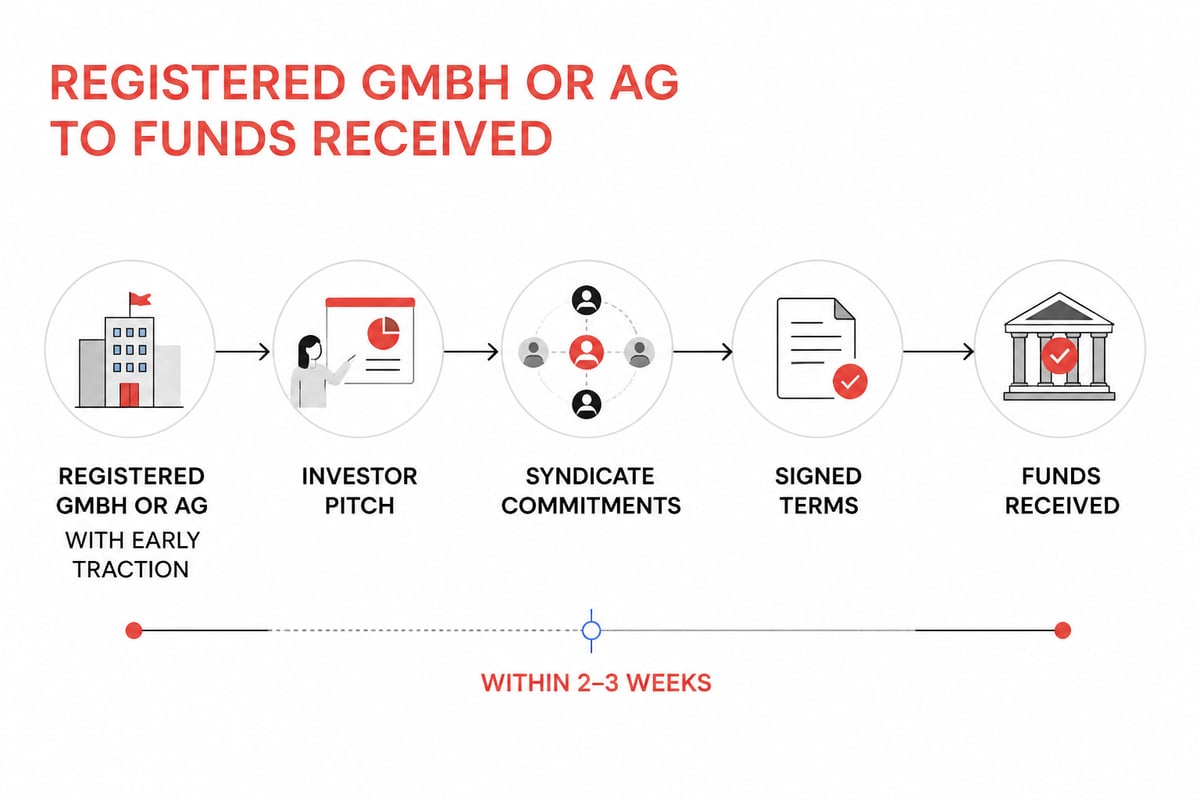
Most Swiss founders fund an early company start through a mix of personal savings, grants, angel money and a pre-seed round. Once your GmbH or AG is registered and you have traction, a syndicate-style round can be quicker than approaching investors one by one.
Swisspreneur's investment service for startups supports pre-seed and seed funding for Swiss startups through its syndicate. Founders decide which investors and founders join each deal, and the syndicate takes a 15% carried interest with no management fee. Swiss startup founders can close a pre-seed round in about two to three weeks through the syndicate, and the network includes investors in the database, with over CHF 3M invested so far. This route suits founders who already hold a Swiss legal entity and have early traction; it is not designed for idea-stage companies.
For individual investors, the syndicate model opens early-stage deals at small tickets, starting from CHF 5,000 per deal, so portfolio building across several startups is realistic.
Build Your Network and Community Early
Founders who join a peer community early get faster answers to legal, hiring and funding questions than those who work alone. In Switzerland's compact ecosystem, a single introduction can save weeks.
Practical ways to build that network:
- Attend regular startup events; Swisspreneur runs regular startup events throughout the year
- Join a founder community; the Swisspreneur Slack channel connects founders
- Listen to founder conversations; the podcast archive holds many episodes, free to access
- Work through the free masterclass content on fundamentals
If you want a guide to events worth your time, see Swisspreneur's overview of networking events for startups. For a broader view of the path ahead, Swisspreneur's startup journey article maps the stages from first idea to scaling.
What Do You Call a Newly Started Business?
A newly started business is most commonly called a startup, a start-up company or an early-stage venture, and the choice of word depends on intent and growth path. In legal and tax terms, it is simply a newly registered company or newly founded enterprise.
"Startup" usually implies a company designed to scale quickly, often with a technology or innovative component and outside funding. A small local business, such as a café or consultancy, is better described as a small business or SME, even though both are new. The distinction matters for founders because investors, grant programs and support organizations often define eligibility around it. If you plan to raise a pre-seed round, describing your company as a scalable startup with measurable traction is clearer than the generic "new business."
FAQ
What business makes $10,000 a month?
No business reaches that figure by category alone; revenue depends on pricing, volume and costs. Service and software businesses with recurring contracts reach it most predictably, for example a handful of retainer clients or a few hundred subscribers at a modest monthly fee. Work backward from your price and margin to see how many customers you need.
How long does it take to set up a company in Switzerland?
A GmbH or AG can often be registered within a few weeks if your articles of association, capital deposit and notarization are ready. Delays most often come from incomplete documents, a missing Swiss-resident signatory or a slow bank confirmation. Starting the capital deposit early shortens the timeline.
Do I need a Swiss entity to raise money from Swiss investors?
In practice, yes. Swiss pre-seed investors generally expect a registered GmbH or AG, since it provides limited liability and a clear share structure for the investment. Incorporating before you start funding conversations avoids delays when terms are signed.
Your next step is to book a notary appointment and open the capital deposit account, since those two items set the pace for the rest of your company start. Once your GmbH or AG is registered and you have early customer traction, take a look at Swisspreneur Investments for startups to see how a syndicate round could fit your plan. Swisspreneur is Switzerland's leading platform for entrepreneurs, with podcasts, free masterclasses and events that connect founders with business leaders and investors. Sign up for deals if you want to back early-stage Swiss startups with small tickets.