

How to Start a Business With No Investment in Switzerland
You can start a business with no investment in Switzerland by selling a service you already know how to deliver, registering as a sole proprietor, and funding growth from client revenue instead of capital. Swiss law sets no minimum start-up capital for a sole proprietorship, so the real constraints are your time, your skills and your first paying customer.
This guide covers the legal form that costs the least, the business models that need no money up front, the Swiss insurance and registration duties you cannot skip, and the point at which outside funding starts to make sense.
What Does a Zero-Investment Business Look Like in Switzerland?
A zero-investment business in Switzerland is one where your skills, time and existing equipment replace cash, and where the first client pays for the work before you incur any significant cost. That usually means a service, not a product.
Products require inventory, packaging, storage or manufacturing. Services require a laptop, a phone and a defined offer. If you already own those, your cash outlay can be close to zero.
Three conditions separate a viable zero-cost start from a hobby:
- A buyer with a budget. Companies in Switzerland pay well for specialized help, so target business clients before consumers.
- A deliverable you can describe in one sentence. "I build financial models for early-stage startups" is sellable. "I do consulting" is not.
- Payment before or at delivery. Invoicing a deposit or full amount up front removes the need for working capital.
Be honest about one limit. "No investment" does not mean no cost. You will pay social insurance contributions, possibly a registration fee, and you will invest unpaid hours. The aim is to avoid putting your savings at risk before the market has confirmed demand.
Which Legal Form Costs Nothing to Start?
The sole proprietorship is the cheapest legal form, because there is no minimum start-up capital requirement for it in Switzerland. You can begin trading as an individual without founding a company.
Compare that with the alternatives. A GmbH requires CHF 20,000 in share capital and an AG requires CHF 100,000 (half paid in at incorporation). Neither is a zero-investment route. Many founders begin as sole proprietors and convert once revenue, hiring or investor requirements justify it.
There are two tradeoffs to weigh:
- Personal liability. As a sole proprietor, you are personally liable for business debts. For a low-risk consulting or design service this is manageable. For anything involving physical risk or large contracts, it deserves more thought.
- Credibility with larger clients and investors. Some corporate buyers prefer a GmbH or AG as a counterparty, and venture investors generally require one.
Registration thresholds matter as you grow. A commercially run sole proprietorship generally must register in the Commercial Register once turnover reaches CHF 100,000 in the previous financial year, and the same source notes that full accounting becomes mandatory at CHF 500,000. Below those levels, simplified bookkeeping of income and expenses is typically sufficient.
For a broader walkthrough of formation options and cantonal differences, see Swisspreneur's guide to starting a business in Switzerland.
How Do You Start a Business Without Any Money?
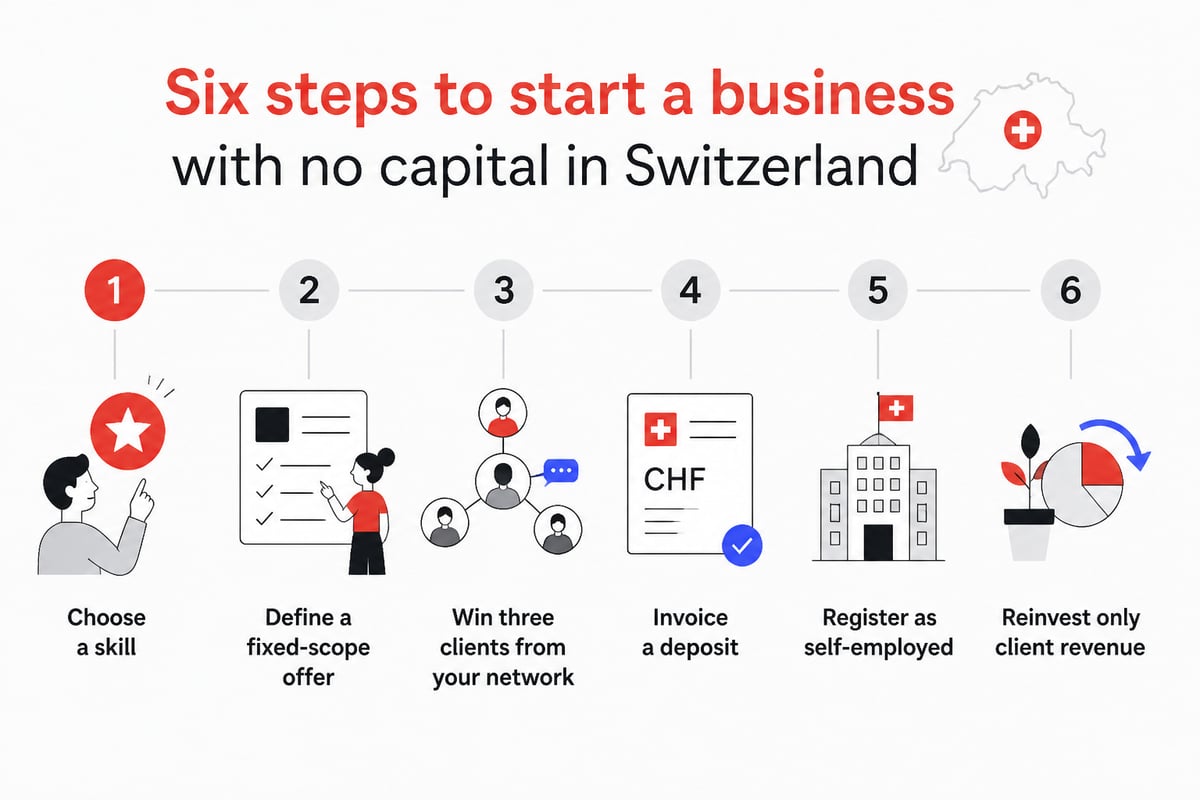
You start a business without any money by selling your time and expertise first, collecting payment in advance, and reinvesting only what clients have already paid you. The sequence below keeps your cash exposure at zero.
- Choose one skill with commercial demand. Look at what employers or clients already pay you for, or what you could credibly deliver within two weeks.
- Define a narrow offer and a price. A fixed-scope package ("a 10-page brand guideline for CHF 1,800") is easier to sell than an hourly rate.
- Find the first three clients through your existing network. Former colleagues, university contacts and LinkedIn connections are free channels with high trust.
- Invoice a deposit. Taking a deposit up front is a common practice and removes financing risk.
- Register as self-employed. Complete the OASI registration described below before or at the time you begin trading.
- Reinvest revenue only once it exists. Buy tools, hire help or pay for advertising from client income, not from savings.
This approach is slow compared with raising capital, but it produces something valuable: evidence. Paying customers prove demand, and that evidence later supports a funding conversation from a stronger position. Swisspreneur's introduction to how to start a business covers the early validation steps in more detail.
Which Business Ideas Need No Upfront Capital?
The best zero-capital business ideas are service businesses that rely on a skill you already hold and a laptop you already own. The table below compares common options on what you need and what limits them.
| Business idea | What you need to start | Main limit |
|---|---|---|
| Freelance writing, translation or design | Laptop, portfolio | Income tied to your hours |
| Bookkeeping and admin for small firms | Accounting knowledge, software with free tier | Requires trust and references |
| Online tutoring or coaching | A subject you teach well | Needs a client base to fill your calendar |
| Social media management | Platform fluency, a few sample accounts | Results are hard to prove at first |
| Consulting in a former professional field | Experience, network | Needs a clear niche |
| Recruitment or talent sourcing | Industry contacts | Success-fee payments arrive late |
| Data entry and document processing | Accuracy, a computer | Low prices, high competition |
A note on data entry, which many searchers ask about: it is accessible and needs no capital, but Swiss labor costs make it hard to compete on price against offshore providers. Pair it with a specialty, such as multilingual document handling for Swiss SMEs or structured data cleanup for finance teams, and the economics improve.
Dropshipping and print-on-demand appear on most zero-cost lists. They technically require no inventory, but in practice they need ad spend, platform fees and customer service capacity, and margins in a high-price market like Switzerland depend on strong branding. Treat them as low-cost, not no-cost.
If you lean toward services, Swisspreneur's overview of good service businesses to start and its piece on business models for startups help you test whether an idea can scale beyond your own hours.
What Swiss Registration and Insurance Duties Apply?
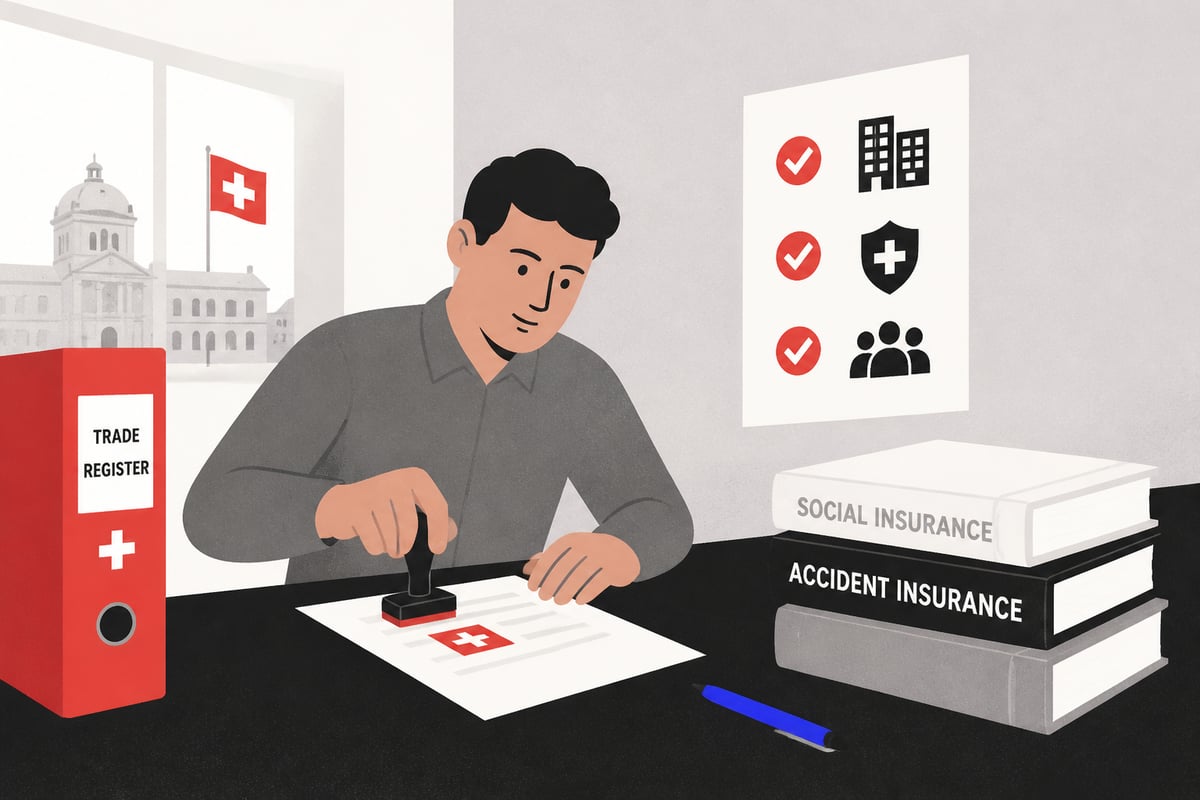
Self-employed people in Switzerland must register with an OASI compensation office, which decides whether your activity qualifies as self-employment. This is the first administrative step, and it carries real financial consequences.
According to the Federal Social Insurance Office, the office assesses factors such as whether you work in your own name and on your own account, how freely you organize your work, and whether you bear the economic risk. If you invoice several clients and decide your own hours, you are likely to be recognized. If you depend on a single client who directs your work, you may be treated as an employee instead, so keep that in mind when you structure early contracts. The practical guide at selbststaendig-erwerbend.ch lays out the supporting documents that help you demonstrate independence.
Contributions are the main recurring cost:
- Rate: OASI, invalidity insurance and income-compensation contributions run from 5.371% to 10%, depending on income.
- Minimum: For 2025, the minimum annual contribution was CHF 530 for self-employed people with income at or below CHF 10,100. Check the current year's figures with your compensation office.
- Registration fee: If you enter your business in the Commercial Register, the entry is estimated at approximately CHF 120, with extra costs possible for signature certification or other entries.
Also consider accident cover, health insurance and occupational pension (second pillar) arrangements, which are not automatically provided as a self-employed person. Budget for them from your first invoices, since they are real expenses even when your start-up costs are zero. Value-added tax registration becomes mandatory once turnover passes the federal threshold, so confirm the current figure with the tax authority.
Why Do Most Small Businesses Fail, and How Do You Avoid It?
Small businesses fail mainly because they run out of cash before they find a repeatable source of customers. Survival rates for small businesses vary by country, sector and year, but the causes behind failure are consistent.
The common ones are:
- No validated demand. Founders build before they sell.
- Underpricing. Low prices attract difficult clients and leave no room to absorb a slow month.
- Mixing personal and business finances. This hides real profitability and creates tax surprises.
- Ignoring fixed obligations. Social insurance, taxes and VAT arrive on schedule whether or not clients pay on time.
- Dependence on one client. Losing it removes most of your income, and it can also threaten your self-employed status.
A zero-investment start protects you against the first and most damaging cause, because you only spend money in response to proven demand. Set aside a share of every payment for contributions and tax as soon as it arrives. A separate business account makes that discipline easier, and costs little.
Founders who have already walked this path often describe the same early mistakes. Swisspreneur's podcast includes a candid episode on going from a family business to a multi-million startup, and its first startup article collects lessons from first-time founders.
When Should You Move From Bootstrapping to Outside Funding?
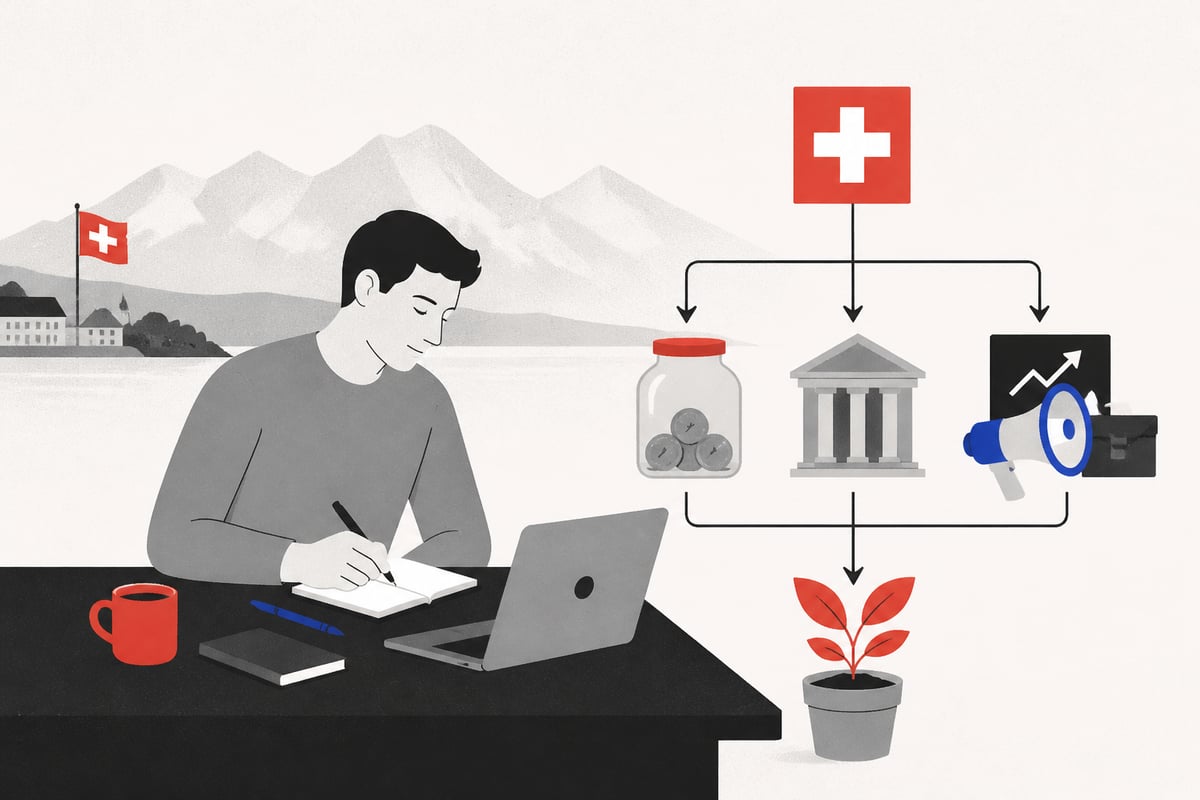
You should consider outside funding once the business shows repeatable traction and a clear use for capital that revenue alone cannot cover quickly enough. If you can still grow from client income, bootstrapping preserves your ownership and your flexibility.
Typical signals that the moment has come:
- Revenue is recurring or growing month over month, with a customer acquisition process you can describe.
- You have more demand than you can serve, and hiring or product development is the bottleneck.
- You are moving from a one-person service toward a product or platform that can scale.
- You have a Swiss legal entity, since investors generally back a GmbH or AG rather than a sole proprietorship.
At that stage, a conversion from sole proprietorship to a company is the natural next step, and it is also the point where angel and syndicate investors become relevant. Swisspreneur's Investments for startups offering provides pre-seed and seed funding for Swiss startups through its syndicate. Founders decide which investors and founders join each deal, the syndicate takes a 15% carried interest with no management fee, and pre-seed rounds can close in about 2 to 3 weeks. It fits startups that already have a Swiss entity and early traction, not ideas that are still on paper.
If you are earlier than that, use the free resources first. Swisspreneur offers free masterclass content, a library of podcast episodes, and a Slack community of founders, all at no cost to startups. A Q&A on starting a company in Zurich is a useful listen if you are weighing where to base the company.
How Can You Build a Network Without a Budget?
You can build a startup network at no cost by attending free founder events, joining online communities and offering useful help before asking for any. In Switzerland, where business relationships tend to run on introductions, a few warm contacts often outperform paid advertising.
Practical places to start:
- Local founder meetups and networking sessions, many of which are free or low-cost. Swisspreneur's list of networking events for startups is a good starting map.
- Online communities where founders trade advice, such as startup Discord and chat groups.
- Your own alumni and former employer networks, which are often the fastest source of first clients.
Mentoring works the same way. Ask specific questions ("how did you price your first project?") rather than for open-ended guidance, and follow up with a result. Founders respond to people who act on advice.
FAQ
Can I start a business in Switzerland without a company?
Yes. You can operate as a sole proprietor without founding a company, and no minimum capital applies. You still need to register with an OASI compensation office and meet social insurance obligations.
What is the cheapest small business to start?
A freelance or consulting service built on a skill you already have is usually the cheapest, because your main costs are time and a computer you already own. Choose a niche where Swiss businesses pay for specialized work, since low-priced generic services struggle to compete in a high-cost market.
Do I need to register my business right away?
You need to register with an OASI compensation office when you begin self-employed work. Entry in the Commercial Register is only required once a commercially run sole proprietorship reaches CHF 100,000 in turnover, though you may choose to register earlier for credibility.
Your next step is to write down one service you can sell this month, price it, and send it to three people in your network. Once that first revenue arrives and you hold a Swiss legal entity, you will be ready for the funding conversation, and Swisspreneur Investments for startups is built for that stage. Until then, the free masterclasses, podcasts and founder community can help you test your idea. When you want to see how early-stage deals are structured, Swisspreneur lets you sign up for deals and follow Swiss startups as they raise.