

Entrepreneur Meet Ups: Where to Find Them in Switzerland
Entrepreneur meet ups are informal or semi-structured gatherings where founders, operators and investors meet in person to share experience, find collaborators and build relationships. In Switzerland, you can find them through startup associations, university spin-off networks, cantonal innovation agencies, community platforms and event organizers in every major business region.
For a founder who already has traction and a Swiss GmbH or AG, the right meet up can shorten the path to mentors, first customers and early-stage capital. For an individual investor, it is one of the most direct ways to meet founders before a round is announced. The difficulty is not a shortage of events. It is choosing the few that deserve your evenings.
Why Entrepreneur Meet Ups Matter in Switzerland Right Now
Entrepreneur meet ups matter in Switzerland because the founder population is growing, and a larger pool of founders means more competition for attention, talent and capital. According to the Swiss Confederation's State Secretariat for Economic Affairs (SECO), the number of companies founded in Switzerland in 2025 was higher than in 2015. The same source reports that company registrations increased in most cantons between 2024 and 2025.
Growth was not evenly spread. SECO's figures show that Zug, Appenzell Innerrhoden and Obwalden recorded the strongest cantonal registration growth in 2025. That pattern matters for anyone planning where to show up. Zurich and Lausanne still anchor the deep-tech and university ecosystems, but smaller cantons are producing new founders who are looking for peers nearby.
If you want to see how registrations move in your own canton, the Startup Monitoring platform lets you explore daily data, long-term trends and regional differences in Swiss business registrations. It is a practical way to decide whether a local scene is large enough to sustain regular gatherings.
The Main Types of Entrepreneur Meet Ups You Will Encounter
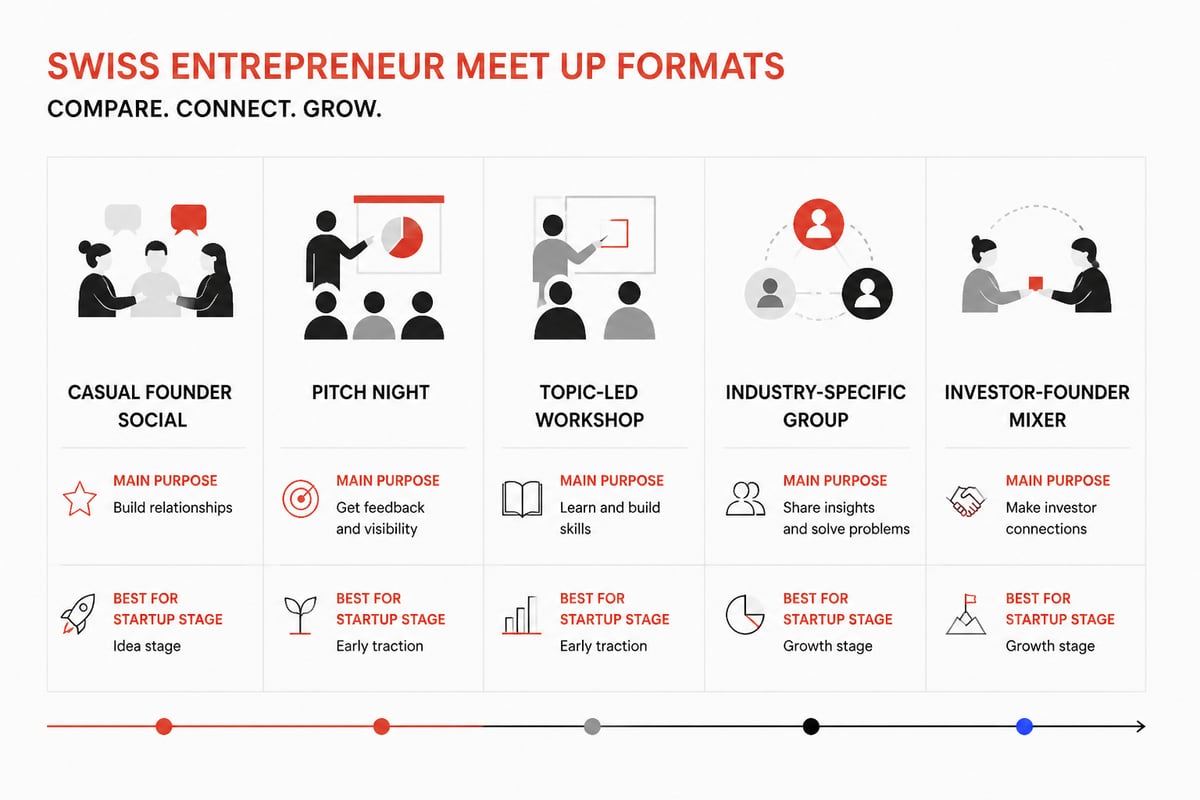
Most gatherings fall into five formats, and each serves a different purpose at a different stage of a company.
- Casual founder socials. Evening drinks or dinners with no agenda. These are best for building trust and finding peers who face the same hiring or fundraising problems.
- Pitch and demo nights. Founders present for a few minutes to a room of peers and investors. Useful for feedback and visibility, less useful for deep conversation.
- Topic-led talks and workshops. A speaker or panel covers a subject such as fundraising, sales or legal structure, followed by networking.
- Industry-specific groups. Fintech, medtech, climate tech, SaaS and similar niches. The conversations are more technical and the contacts more relevant.
- Investor-founder mixers. Smaller formats where angels and early-stage investors meet founders with traction. These are the most useful for readers raising a pre-seed or seed round.
Swisspreneur has written separately about the differences between networking events for startups and broader entrepreneur events, which helps if you are deciding between a large conference and a small room.
Where to Find Entrepreneur Meet Ups Across Swiss Regions
You can find meet ups in every major Swiss business region, and the strongest concentrations sit in Zurich, Zug, Basel, Lausanne and Geneva. Each hub has a different character.
Zurich and Zug
Zurich has the densest calendar in the country, with events tied to ETH Zurich, the finance sector and a large software community. Zug, often called Crypto Valley, hosts blockchain, fintech and commodity-trading founders, and its recent registration growth means new groups form there regularly. A guide to founder communities and networking events in Zurich and across Switzerland lists associations, meet ups and startup events, and is a good starting reference for the German-speaking region.
Lausanne and Geneva
The Lake Geneva region draws on EPFL, the life sciences cluster and international organizations. Events there often run in English and French, and they tend to attract founders in medtech, cleantech and deep tech. If your product depends on scientific credibility, this is where your peers gather.
Basel, Bern and the Rest
Basel is shaped by pharma and life sciences, Bern by public-sector and policy-adjacent ventures, and cities such as Lucerne, St. Gallen and Winterthur host smaller but tight-knit groups. Smaller rooms often produce better conversations because the same people return each month.
National Associations and Platforms
Some organizations run events across several cities. The Swiss Startup Association lists Founders Dinners, in-person education sessions and webinars with dates and details. Swisspreneur runs 10+ startup events per year, which gives founders and investors a reference point for the quality of its gatherings.
How Much Do Networking Events Cost?
Networking events cost anywhere from nothing to several hundred Swiss francs, depending on the format. Community meet ups run by volunteers or sponsors are usually free or charge a small contribution for food and drinks. Conferences with named speakers, curated attendee lists and multiple tracks charge ticket prices that can reach into the hundreds of francs, and some add travel and accommodation on top.
A useful way to budget is to count the real cost per meaningful conversation, not the ticket price. A free event with 200 attendees may yield no useful contact, while a CHF 80 dinner for 20 people may lead to a hire or a customer. Check the organizer's event page for current pricing, since fees change by season and venue.
Swisspreneur offers free masterclasses, podcasts and founder community access at no cost to startups, so a founder who is watching cash can build a strong peer network before spending anything on tickets.
What to Look for Before You Commit Your Evening
Judge a meet up by who attends, how it is run and what happens after the evening ends. A short checklist keeps you from collecting contacts that go nowhere.
- Attendee stage. Are the founders at idea stage, pre-seed or scaling? Match the room to your traction.
- Investor presence. Check whether angels and funds attend or only sponsors with a booth.
- Group size. Rooms of 20 to 60 people allow real conversation. Rooms of 500 mostly allow introductions.
- Language. Confirm whether the event runs in English, German, French or a mix.
- Follow-up channel. The best groups keep a Slack, WhatsApp or newsletter going between events.
- Organizer reputation. Look at past speakers, repeat attendance and whether founders recommend the event to each other.
That last point is where a community outperforms a single event. Swisspreneur's Slack channel connects founders, so conversations that start in a room can continue the next morning. The Swisspreneur Scaleup Circle extends this with an operator-led community, podcasts, curated events and selective capital access aimed at Swiss scaleups.
What Are the 7 Types of Entrepreneurs?
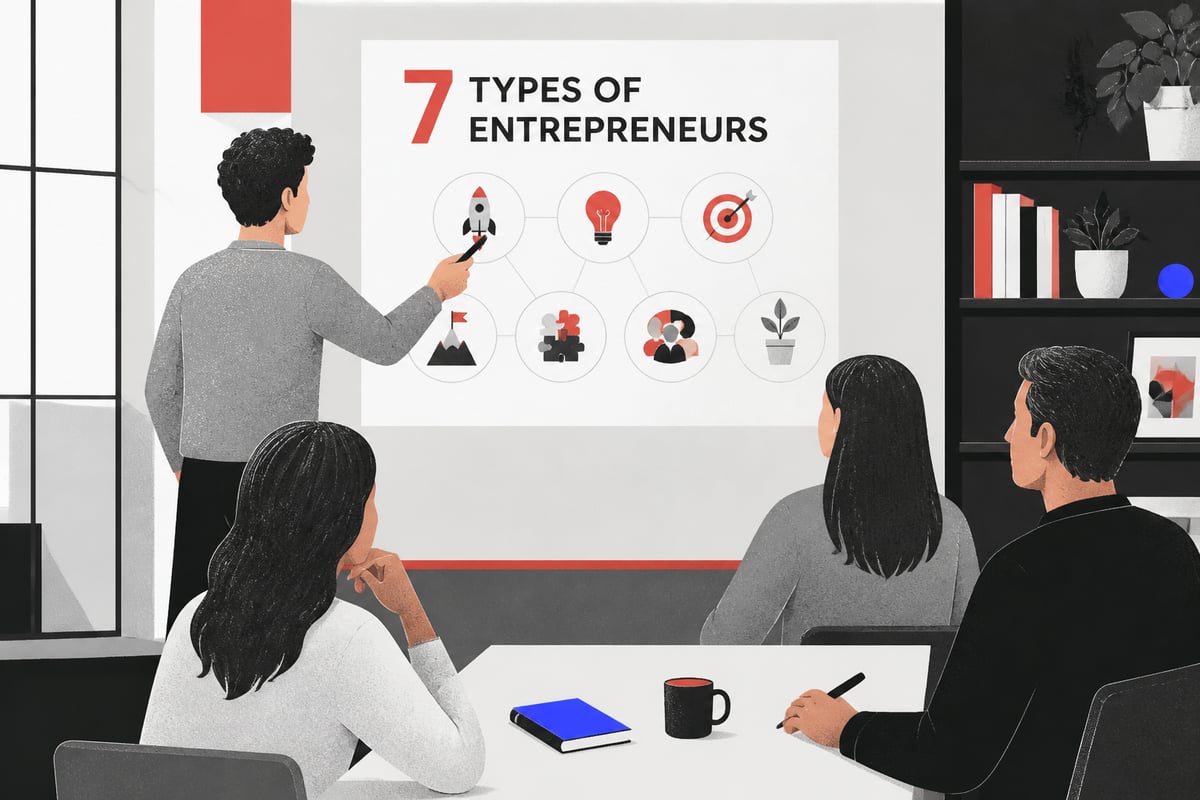
The seven types of entrepreneurs are commonly described as the builder, the opportunist, the innovator, the specialist, the investor, the hustler and the social entrepreneur, though no single official taxonomy exists and different authors use different labels. The categories describe motivation and working style more than company size.
Knowing which type you are helps you choose a room. A technical builder may get more from a product-focused workshop, while a hustler-style founder may prefer pitch nights and investor mixers. If you want to understand how roles overlap, Swisspreneur's article on the technical entrepreneur and the piece on portfolio entrepreneurship explore two common profiles in more detail.
What Are Entrepreneurial Support Organizations?
Entrepreneurial support organizations are groups that help founders start and grow companies through mentoring, education, funding access, workspace or community. They include incubators, accelerators, university transfer offices, cantonal innovation agencies, industry associations and community platforms.
In Switzerland, these organizations often host or sponsor the meet ups described above, which is why one membership can unlock several event series. Swisspreneur has an overview of what an entrepreneur support organization does and how to choose one. When comparing options, ask what a given organization offers beyond events: mentoring hours, investor introductions, legal templates or a peer network that stays active between gatherings.
How to Get Real Value From Entrepreneur Meet Ups
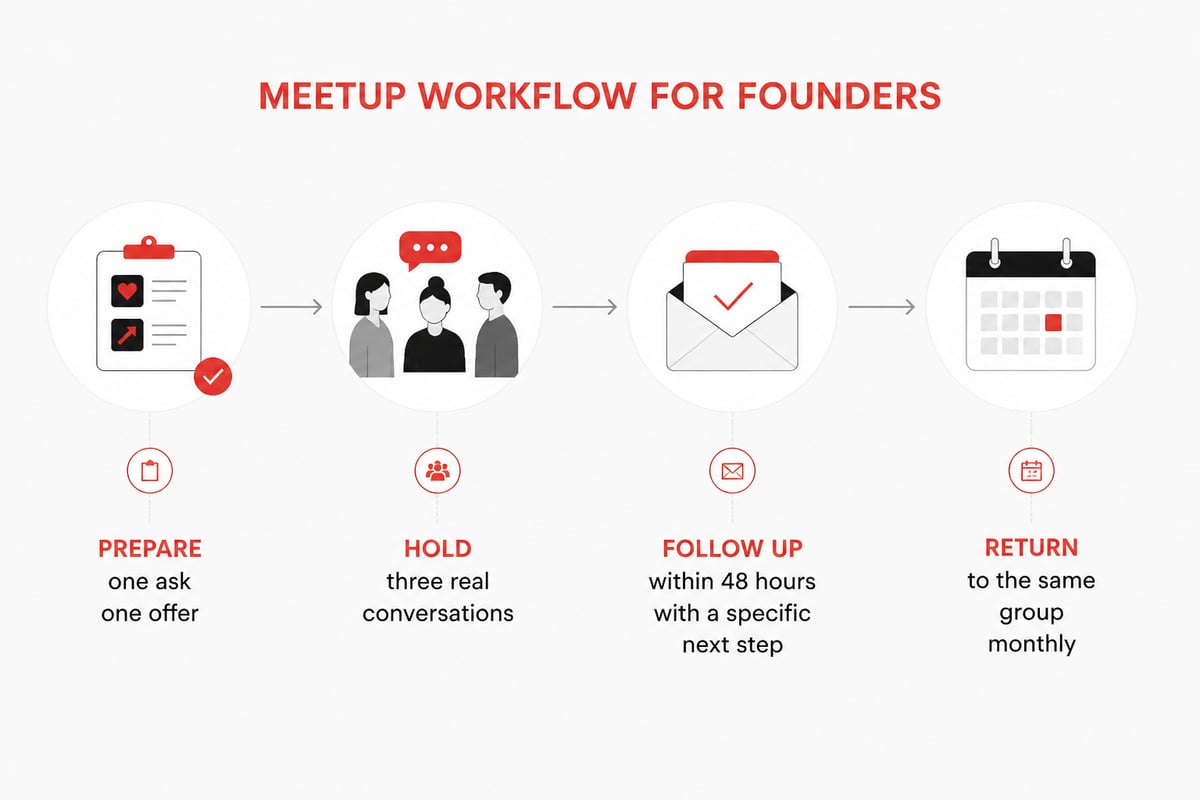
You get value from entrepreneur meet ups by arriving with a specific question, talking to fewer people for longer, and following up within 48 hours. A few habits separate founders who benefit from those who simply attend.
Prepare one ask and one offer. An ask might be an introduction to a Swiss notary, a cybersecurity advisor or a pilot customer. An offer might be a lesson from your own fundraising or a contact you can share. People remember founders who give as well as take.
Aim for three real conversations. Collecting twenty business cards creates a follow-up burden you will never complete. Three deep conversations create relationships that last.
Follow up quickly and specifically. Reference something you discussed, and propose one concrete next step such as a 20-minute call. A generic "great to meet you" message rarely gets a reply.
Return to the same groups. Trust builds through repetition. Founders who attend the same monthly meet up for a year tend to become known, which leads to introductions that cold outreach cannot match.
Entrepreneur Meet Ups for Founders Raising Early-Stage Capital
Founders raising money should treat meet ups as a way to build investor familiarity before a round opens, not as a place to pitch on the spot. Investors rarely commit capital after a ten-minute conversation, but they do remember founders who showed up consistently, shared honest updates and asked precise questions.
For Swiss founders with traction and a GmbH or AG, the Swisspreneur Syndicate offers a more structured route. Swisspreneur reports CHF 3M+ in investments through the Syndicate, a database of 1,000+ investors, and a pre-seed round that can close in about 2 to 3 weeks. Founders decide which investors and founders join each deal, and the Syndicate takes a 15% carried interest with no management fee. For details on eligibility and process, consult Swisspreneur's investment pages directly.
Investors benefit from the same logic. Meeting founders at small events lets you judge character and clarity of thinking before you read a deck. Individual investors can start with as little as CHF 5,000 per deal through the Syndicate, which makes small-ticket participation realistic. Attending a few events first gives you context on the founder community before you write a cheque.
What Is an Entrepreneurship Workshop?
An entrepreneurship workshop is a structured, hands-on session where founders learn and practice a specific skill, such as validating a market, building a financial model, preparing a pitch or negotiating a term sheet. Unlike a talk, it asks participants to work through exercises and leave with a usable output.
Workshops pair well with meet ups. A talk gives you ideas, a workshop gives you a finished artifact, and the networking portion gives you peers who can review it. Swisspreneur provides free masterclass content, and its podcast library lets you prepare for an event by hearing how other Swiss founders handled the topic. One example is an episode on an entrepreneur's secrets to selling two startups.
FAQ
How often should a founder attend entrepreneur meet ups?
Two to four events per month is enough for most founders, provided you return to the same groups. More than that tends to crowd out building the product and serving customers. Pick quality and consistency over volume.
Can you find entrepreneur meet ups in English in Switzerland?
Yes. Many events in Zurich, Zug, Geneva and Lausanne run fully in English, and national platforms often default to it. Check the event description for the working language before you register.
Are online groups a good substitute for in-person meet ups?
They are a useful complement, not a replacement. Online channels keep conversations going between events, but in-person meetings build trust faster.
Start by choosing one event in your canton this month and writing down your single ask and offer before you walk in. If you want a community and capital route that works alongside those evenings, the Swisspreneur Scaleup Circle brings together operators, podcasts and selective capital access for Swiss scaleups. Swisspreneur is Switzerland's leading platform for entrepreneurs, with free masterclasses, candid podcast conversations, regular startup events and syndicate investments that connect founders with business leaders and investors. If you want to back early-stage Swiss startups or follow the next rounds, Swisspreneur is where you can sign up for deals and see them as they open.