

Founding in Switzerland: Complete 2026 Startup Guide
Switzerland has earned its reputation as one of Europe's most attractive destinations for entrepreneurs. With political stability, a highly skilled workforce, and a business-friendly regulatory environment, founding in Switzerland offers compelling advantages for both local and international founders. The country's strategic location in the heart of Europe, coupled with its strong intellectual property protection and access to capital, makes it an ideal launchpad for ambitious startups. This comprehensive guide walks you through everything you need to know about founding in Switzerland, from choosing the right legal structure to securing funding and navigating the registration process.
Understanding Swiss Legal Structures for Your Startup
Choosing the appropriate legal form is one of the most critical decisions when founding in Switzerland. Each structure carries distinct implications for liability, taxation, administrative burden, and future fundraising potential.
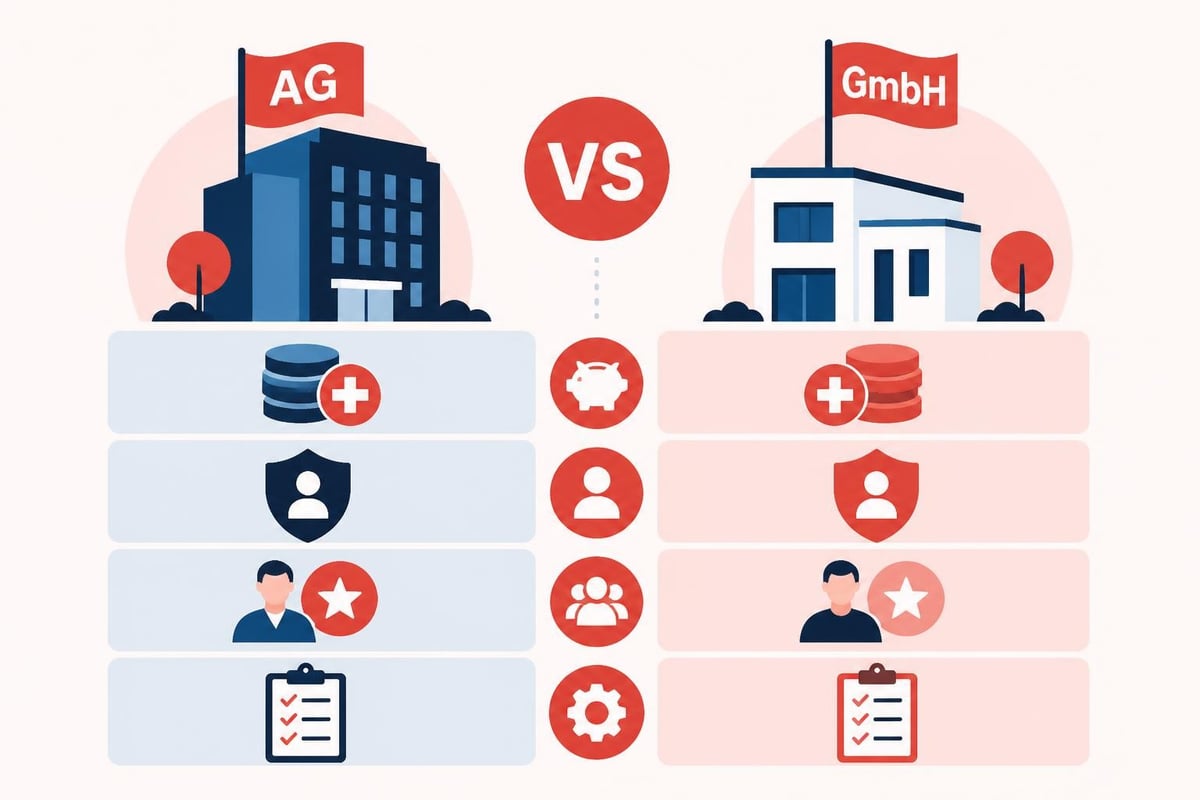
The Aktiengesellschaft (AG) or corporation remains the preferred choice for high-growth startups. This structure limits shareholder liability to their capital contributions and facilitates equity investments from venture capital firms. An AG requires minimum share capital of CHF 100,000, with at least CHF 50,000 paid in at incorporation. The flexibility in share classes and the ability to issue options make it particularly suitable for tech startups planning multiple funding rounds.
The Gesellschaft mit beschränkter Haftung (GmbH) or limited liability company offers a middle ground. With a lower minimum capital requirement of CHF 20,000 (fully paid in), it appeals to founders seeking limited liability without the formality of an AG. However, GmbH structures can complicate future fundraising since ownership transfers require notarization and are more cumbersome than simple share transfers in an AG.
Comparing Key Legal Forms
| Legal Form | Min. Capital | Liability | Best For | Tax Treatment |
|---|---|---|---|---|
| AG (Corporation) | CHF 100,000 (50% paid) | Limited to capital | VC-backed startups, scaling businesses | Corporate + dividend tax |
| GmbH (LLC) | CHF 20,000 (100% paid) | Limited to capital | Service businesses, medium growth | Corporate + dividend tax |
| Sole Proprietorship | None | Unlimited personal | Freelancers, consultants | Personal income tax |
| Partnership | None | Unlimited personal | Professional services, small teams | Personal income tax |
For most entrepreneurs planning to build scalable startups, the AG structure offers the best long-term flexibility. The official guidance on choosing a legal structure provides detailed comparisons to help you match your company's needs to the appropriate legal form.
The Registration Process and Required Documentation
Founding in Switzerland involves several sequential steps that must be completed in the correct order. Understanding this process helps you allocate time and resources appropriately.
Step 1: Name Verification Before investing time in incorporation documents, verify your proposed company name is available. The Zefix Central Business Name Index allows you to search existing registered companies across all Swiss cantons. Your name must be unique and cannot mislead about your business activities or suggest government affiliation.
Step 2: Drafting Founding Documents You'll need professionally prepared articles of association that define your company's purpose, share capital structure, governance rules, and shareholder rights. Many founders work with specialized corporate lawyers to ensure these documents are investor-ready from day one. A well-crafted founders agreement addressing vesting schedules, intellectual property assignment, and exit scenarios protects all parties as the company grows.
Step 3: Capital Deposit Open a capital deposit account at a Swiss bank and transfer the required minimum capital. The bank will issue a confirmation letter proving the funds are available for incorporation. This step can be time-consuming, as Swiss banks conduct thorough due diligence.
Registration Timeline
- Name reservation – 1-2 days
- Document preparation – 1-2 weeks
- Notarization – Within 1 week of scheduling
- Commercial register filing – 1-3 days
- Publication in official gazette – 1-2 weeks
- Final registration confirmation – 2-4 weeks total
The official company registration guide provides canton-specific requirements and processing times. Most founders complete the entire process within 4-6 weeks, though international founders may need additional time for visa arrangements.
Navigating Permits and Immigration Requirements
For non-Swiss founders, understanding residence and work authorization is essential when founding in Switzerland. The country operates a quota system for non-EU/EFTA nationals, making early planning crucial.
EU/EFTA Citizens benefit from free movement agreements and can register for residence permits after arriving in Switzerland. The process is relatively straightforward, though you must demonstrate financial self-sufficiency and health insurance coverage.
Non-EU/EFTA Entrepreneurs face stricter requirements. You'll typically need to demonstrate that your business creates jobs for Swiss residents, fills a market need, and has adequate capitalization. The authorities evaluate whether you have relevant business experience, a solid business plan, and the financial resources to sustain yourself during the startup phase.
The State Secretariat for Migration guidance outlines the current framework for entrepreneurial residence permits. Applications are decided at the cantonal level, and some cantons are more entrepreneur-friendly than others. Zurich, Zug, and Geneva generally have established processes for evaluating startup founders' applications.
Key permit considerations:
- Demonstrate CHF 100,000+ in accessible capital for your venture
- Present a detailed business plan showing market potential
- Prove relevant industry experience and qualifications
- Show how your business benefits the Swiss economy
- Secure office space before submitting your application
- Allow 3-6 months for permit processing
Many international founders initially establish their company while based abroad, then relocate once the business demonstrates traction and they can meet permit requirements more easily.
Tax Advantages and Financial Considerations
Switzerland's tax system significantly influences the economics of founding in Switzerland. While tax rates vary by canton and municipality, the overall framework offers several advantages for growing companies.
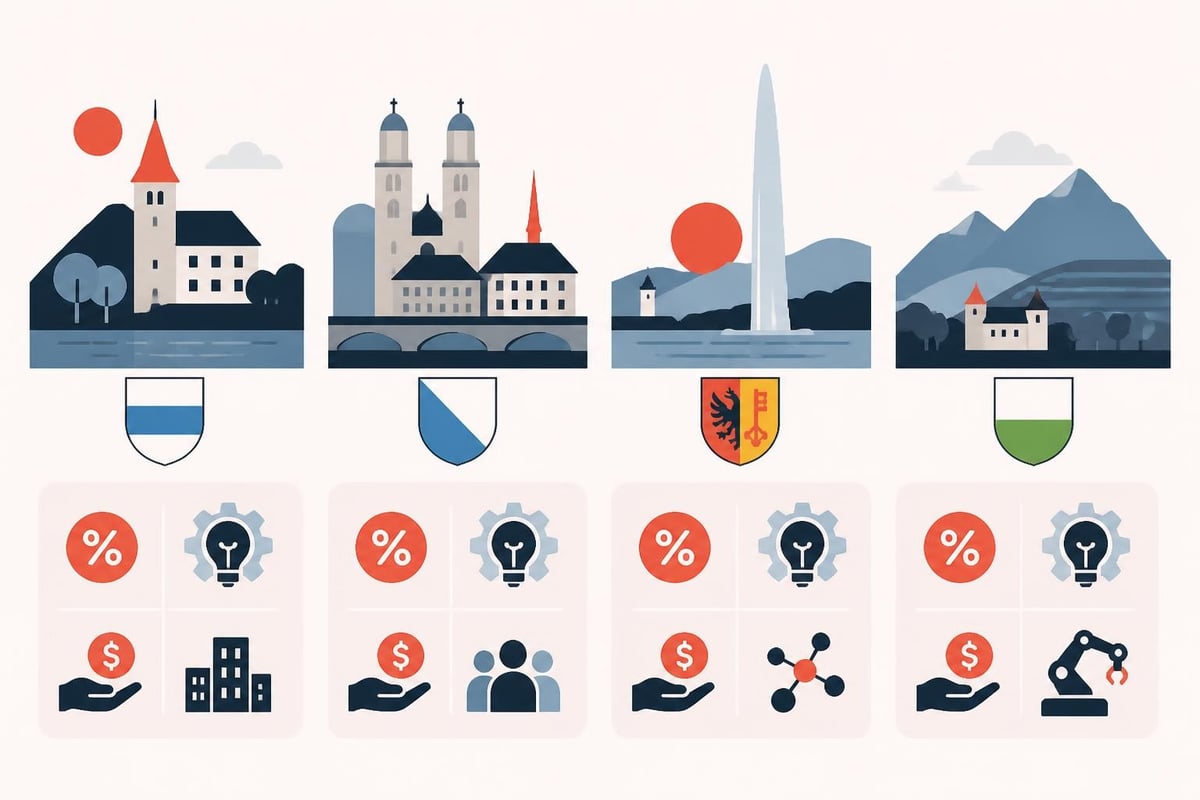
Corporate income tax combines federal, cantonal, and municipal rates, typically ranging from 11% to 21% depending on location. Zug, often called "Crypto Valley," offers some of the lowest rates, while Geneva and Zurich are higher but provide access to larger talent pools and customer markets.
Patent Box Regimes allow qualifying companies to tax income from intellectual property at reduced rates, sometimes as low as 6-9%. This proves particularly valuable for deeptech and biotech startups commercializing proprietary innovations.
Research and Development Tax Relief enables companies to claim super-deductions on R&D expenses, effectively reducing the taxable base. The enhancement varies by canton but can reach 150% of qualifying expenditures.
Canton Tax Comparison (2026)
| Canton | Effective Corp. Tax Rate | Notable Advantages | Typical For |
|---|---|---|---|
| Zug | ~11.8% | Crypto-friendly, low rates | Blockchain, fintech |
| Zurich | ~19.7% | Largest talent pool | Tech, consumer |
| Geneva | ~14.0% | International access | Biotech, luxury |
| Vaud | ~14.0% | EPFL proximity | Deeptech, cleantech |
The comprehensive Swiss taxation review details cantonal differences and strategic planning opportunities. Most founders benefit from consulting with a Swiss tax advisor before choosing their company's registered seat.
Accessing Funding and Support Programs
The Swiss startup ecosystem offers multiple funding pathways for companies at different stages. Understanding these options is essential when founding in Switzerland, as securing adequate capital often determines your growth trajectory.
Innosuisse, Switzerland's innovation agency, provides non-dilutive funding for startups developing innovative products or services. Their innovation project programs can cover up to 50% of project costs, with funding ranging from CHF 100,000 to over CHF 1 million for qualifying companies. Eligibility requires a research partner (typically a Swiss university) and a clear commercialization path.
Cantonal Economic Development Agencies offer grants, loans, and advisory services to companies establishing operations in their regions. Programs vary significantly, with some cantons providing rent subsidies, tax holidays, or direct grants to companies creating high-value jobs.
The Swiss venture capital landscape has matured considerably, with deal activity and funding rounds reaching record levels in recent years. Key investor types include:
- Angel networks focusing on pre-seed and seed rounds (CHF 50K-500K)
- Early-stage VC firms investing in Series A rounds (CHF 1M-10M)
- Growth equity funds supporting later-stage expansion (CHF 10M+)
- Corporate venture arms from established Swiss multinationals
Many successful founders leverage Swisspreneur's syndicate to access experienced investors who understand the Swiss market. The platform connects startups with business angels and provides valuable feedback beyond just capital.
Building Your Founding Team and Advisory Board
The quality of your team dramatically influences your success when founding in Switzerland. Swiss investors place heavy emphasis on founder experience, complementary skill sets, and prior track record.
Co-founder Dynamics Establishing clear roles, responsibilities, and equity splits early prevents future conflicts. Questions around co-founders versus founders matter less than ensuring alignment on vision, commitment level, and decision-making processes. Vesting schedules (typically four years with a one-year cliff) protect the company if a co-founder departs early.
Technical Talent Acquisition Switzerland's highly educated workforce provides access to world-class engineers, scientists, and business professionals. However, salaries are correspondingly high, making it essential to offer competitive compensation packages combining base salary, equity, and benefits.
Key hiring considerations:
- ETH Zurich and EPFL graduates command premium salaries
- Multilingual capabilities (German, French, English) expand your talent pool
- Remote work arrangements can reduce costs while maintaining quality
- Employee stock option plans (ESOPs) require careful legal structuring
- Social security and pension contributions add ~15-20% to gross salaries
Advisory Board Formation Strategic advisors provide credibility, industry connections, and operational guidance. When founding in Switzerland, advisors with experience in your target market, fundraising relationships, or technical expertise prove invaluable. Typical advisor compensation ranges from 0.25% to 1% equity, vesting over 2-3 years based on active involvement.
Consider advisors who can help with specific challenges like navigating Swiss regulations, accessing international markets, or recruiting senior executives. The Swisspreneur podcast features numerous successful founders sharing lessons learned that can inform your team-building strategy.
Establishing Banking and Financial Infrastructure
Opening corporate bank accounts represents a significant hurdle when founding in Switzerland. Swiss banks maintain strict compliance standards, requiring extensive documentation and conducting thorough background checks on founders and business activities.
Traditional Swiss Banks offer stability and comprehensive services but often have lengthy onboarding processes (8-12 weeks). You'll need to present your business plan, explain your revenue model, demonstrate the source of your capital, and often attend in-person meetings.
Digital Banking Alternatives have emerged to serve startups more efficiently. These fintech platforms offer faster account opening (1-2 weeks), lower fees, and modern digital interfaces. However, they may have transaction limits or restricted services compared to traditional banks.
Essential banking documents:
- Notarized articles of association
- Commercial register extract
- Beneficial ownership declaration
- Business plan and financial projections
- Personal identification for all authorized signatories
- Proof of registered address
Beyond basic banking, consider establishing relationships with banks that understand startup needs and can later provide venture debt facilities or working capital lines as you scale.

Protecting Intellectual Property and Legal Compliance
For technology startups, intellectual property protection is paramount when founding in Switzerland. The country's robust IP framework and strong enforcement mechanisms provide significant advantages.
Patent Protection Switzerland's participation in the European Patent Convention allows you to file patents that cover multiple jurisdictions efficiently. The Swiss Federal Institute of Intellectual Property processes national patents, while the European Patent Office in Munich handles broader filings. For breakthrough innovations, patent protection should begin before public disclosure or fundraising conversations.
Trademark Registration Securing your brand identity through trademark registration protects against infringement and builds enterprise value. Swiss trademark registration covers the national territory, while EU and international registrations extend protection. The process typically takes 6-8 months and costs CHF 550-950 for Swiss registration alone.
Trade Secrets and NDAs Not all IP requires patent protection. Trade secrets, confidential processes, and proprietary data can be protected through contractual arrangements. Robust non-disclosure agreements with employees, contractors, and partners prevent unauthorized disclosure.
Employment Compliance Swiss labor law requires written employment contracts, adherence to collective bargaining agreements in certain industries, and specific provisions around working hours, vacation time, and termination notice periods. Foreign founders often underestimate these requirements when hiring their first employees.
Data Protection The revised Swiss Federal Act on Data Protection (FADP), aligned with GDPR principles, imposes strict obligations on how companies collect, process, and store personal data. Compliance requires privacy policies, data processing agreements with vendors, and appointed data protection officers for larger operations.
Launching and Scaling Your Swiss Startup
Once legal foundations are established, founding in Switzerland transitions from administrative tasks to growth execution. Your launch strategy should balance building product, acquiring customers, and preparing for future funding rounds.
Minimum Viable Product Development Swiss investors expect higher quality and more robust validation than some other markets. Rather than launching with a basic prototype, plan for a polished MVP that demonstrates clear value proposition and initial traction. The expectations reflect Switzerland's quality-focused business culture.
Customer Acquisition Strategy Switzerland's small domestic market (8.7 million people) means most startups must think internationally from inception. Successful founders often target German-speaking markets (Germany, Austria) or leverage Switzerland's reputation for quality to enter premium segments globally.
Pricing Considerations Swiss purchasing power is among the world's highest, allowing premium pricing strategies for domestic customers. However, international expansion may require different pricing tiers to remain competitive. Consider how your business model adapts across markets with different willingness to pay.
Performance Metrics Track metrics that matter for your stage and business model. Early-stage B2B companies should monitor customer acquisition cost, sales cycle length, and logo acquisition. B2C companies need cohort retention, viral coefficient, and unit economics. Having clean data becomes crucial when fundraising, as Swiss investors conduct thorough due diligence.
Preparing for Series A Most Swiss startups raising Series A demonstrate:
- CHF 500K+ annual recurring revenue (SaaS) or clear path to profitability
- 20-30% month-over-month growth sustained over 6+ months
- Strong unit economics with path to positive contribution margin
- Proven ability to acquire customers through repeatable channels
- Clear strategy for scaling from CHF 2M to CHF 20M revenue
The journey from founding to Series A typically takes 18-36 months for successful companies. Resources like Swisspreneur's masterclasses provide frameworks for building investor-ready companies.
Leveraging the Swiss Startup Ecosystem
Switzerland's startup ecosystem has evolved dramatically over the past decade. Rather than operating in isolation, successful founders actively engage with accelerators, networks, and community resources.
University Partnerships ETH Zurich and EPFL operate world-class startup programs providing space, mentorship, and initial funding. Their networks connect founders with technical talent, research collaborations, and potential customers. Many successful Swiss startups trace their origins to these institutions.
Startup Hubs and Coworking Spaces Zurich, Lausanne, Geneva, Zug, and Basel each offer vibrant startup communities with dedicated coworking facilities. These spaces provide more than desks – they offer networking opportunities, knowledge sharing, and the peer support essential during the challenging early years.
Industry Associations Joining relevant industry associations provides advocacy, networking, and credibility. Swiss Startup Association, digitalswitzerland, and sector-specific groups organize events, lobby for founder-friendly policies, and connect members with resources.
Learning from others who have successfully navigated founding in Switzerland accelerates your own journey. The Swisspreneur community brings together hundreds of founders sharing practical insights, making introductions, and supporting each other through the inevitable challenges of building companies.
Founding in Switzerland offers exceptional opportunities for entrepreneurs willing to navigate its unique requirements. The combination of political stability, access to capital, strong IP protection, and talented workforce creates an environment where ambitious startups can thrive. From choosing the right legal structure to securing funding and building your team, each decision shapes your company's trajectory. Swisspreneur provides the resources, connections, and community support to help you successfully build and scale your Swiss startup, offering masterclasses, podcast insights from experienced founders, regular networking events, and access to investors who understand the Swiss ecosystem.