

How to Find a Co-Founder for Your Startup in Switzerland
To find your co-founder in Switzerland, start with the people you already know, then widen the search through founder communities, startup events, university networks and specialized matching platforms. Test any candidate on a real project before you sign anything, and put equity, roles and exit terms in writing before the company is registered. The sections below explain where to look, what to check and how to formalize the partnership.
The timing matters. Switzerland saw substantially more companies founded in 2025 than in 2015, according to the Swiss Federal SME Portal. More founders means more competition for talent, and the strongest candidates are rarely idle.
Why a Co-Founder Changes Your Odds
A co-founder shares the workload, the risk and the decisions that no single person can carry well. Investors tend to back teams whose skills complement one another, and a solo founder who handles product, sales and fundraising alone often hits a ceiling early.
A good partner brings more than extra hands:
- Complementary skills. A technical founder paired with a commercial founder covers the two areas where early startups most often stall.
- Emotional resilience. Fundraising rejections and failed launches are easier to absorb when someone shares the weight.
- Credibility. A second founder with a full-time commitment signals to investors and early hires that the venture is serious.
Many founders also succeed alone, so a co-founder is a strategic choice and not a requirement. If you want a deeper look at how the roles differ, Swisspreneur's overview of co-founders is a useful starting point.
What to Look for in a Co-Founder
Look for complementary skills, aligned ambition and a working style that holds up under pressure. Chemistry matters, but it should come after those three.
Complementary skills, shared values
Map your own gaps honestly. If you build products, you likely need someone who can sell, hire and manage investors. If you come from business, you need an engineer or scientist who can ship. Overlap in skills creates friction over who leads; overlap in values creates trust.
Commitment and risk appetite
Ask directly how much runway each of you can afford, how many hours a week you can commit and whether you both intend to work on the company full time. A mismatch here, such as one founder keeping a day job while the other has quit, is one of the most common causes of early breakups.
Conflict style
Every founding team disagrees. What matters is how. Ask each candidate to describe a past disagreement and how it was resolved. Founders on Swisspreneur's podcast often return to this theme, including in a Q&A on co-founders with Michael Born.
Where to Find Your Co-Founder in Switzerland
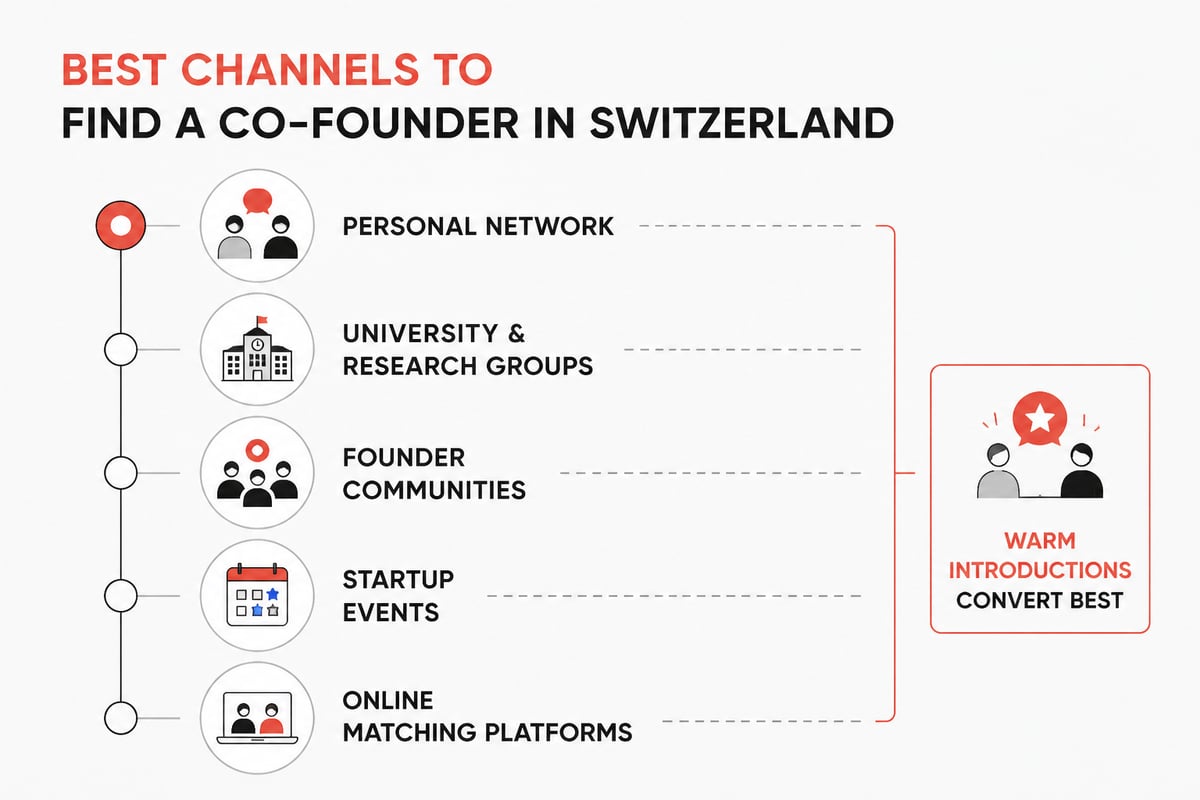
The best channels for finding a co-founder in Switzerland are your existing network, university and research ecosystems, founder communities, in-person startup events and online matching platforms. Work through them in that order, because warm introductions convert far better than cold outreach.
Your existing network
Former colleagues, classmates and clients already know how you work. Tell people plainly what you are building and what kind of partner you want. Most successful pairings start with a second-degree introduction.
University and research networks
Swiss universities and federal institutes produce a steady stream of technical talent. ETH Zurich, EPFL and the regional universities of applied sciences all run entrepreneurship programs, and spin-off teams often form there. For deep-tech founders, Deeptech Nation offers context on the Swiss deep-tech ecosystem, including scale-up figures and investment trends that help you see where the strongest teams are forming.
Founder communities and events
In-person contact reveals things a profile never will. Regional founder meetups and curated dinners let you watch how someone listens, argues and thinks. Swisspreneur runs regular startup events, and its founders dinner format is built around candid conversation among peers. The wider guide to founder communities explains how to pick the right group.
Online, the Swisspreneur Slack channel connects a growing number of founders, which makes it a practical place to ask for introductions or describe the profile you need.
Matching platforms and practical guides
Online platforms let you filter by skill, location and stage. They work best as a supplement, not a replacement, for personal contact. For Switzerland-specific tactics on networks, matching events and trial collaborations, Startup Campus publishes a practical walkthrough.
How to Approach a Prospective Co-Founder
Approach a candidate with a specific reason, a clear description of the opportunity and a low-stakes first step. A vague message asking to "build something together" rarely gets a reply.
Follow this sequence:
- Lead with relevance. Mention a specific project, talk or skill that made you think of them.
- State the opportunity in three sentences. Cover the problem, your traction so far and the role you have in mind.
- Ask for a short call, not a commitment. Thirty minutes is enough to judge whether a second conversation makes sense.
- Prepare questions in advance. Cover motivation, availability, financial runway and what each of you wants from the company in five years.
- Propose a small joint task. A prototype, a customer interview round or a pitch deck draft shows how you collaborate before any paperwork exists.
If a candidate resists a trial project, treat that as information.
Test the Partnership Before You Commit
Work together on a real, time-boxed project for several weeks before agreeing to a long-term partnership. Shared work exposes habits that interviews hide, such as how someone handles deadlines, feedback and ambiguity.
Good trial tasks include running ten customer discovery calls, building a landing page that collects sign-ups, or preparing an investor update. Keep the scope small and the goal measurable. Agree at the start on who owns which part, how often you will check in and what a successful outcome looks like, so the trial is judged against criteria set in advance and not against impressions formed afterward.
Pay attention to the texture of the work. Notice whether messages are answered promptly, whether commitments made on Monday are met by Friday, and how each of you reacts when a customer rejects the idea or a deadline slips. Debrief honestly: Did you both enjoy the pace? Did decisions come easily? Did either of you feel carried? Write down each person's answers separately before comparing them, because differences in perception are often the most useful finding. Keep the trial free of equity promises. Compensate real costs only, and revisit the partnership once you both have evidence.
Reference checks are also reasonable. Speak to people who have worked with the candidate, ideally including someone from a difficult period. Founders in a romantic or family relationship face an extra layer of complexity, which Swisspreneur's podcast covers in an episode on founders in love.

Equity, Roles and Legal Basics
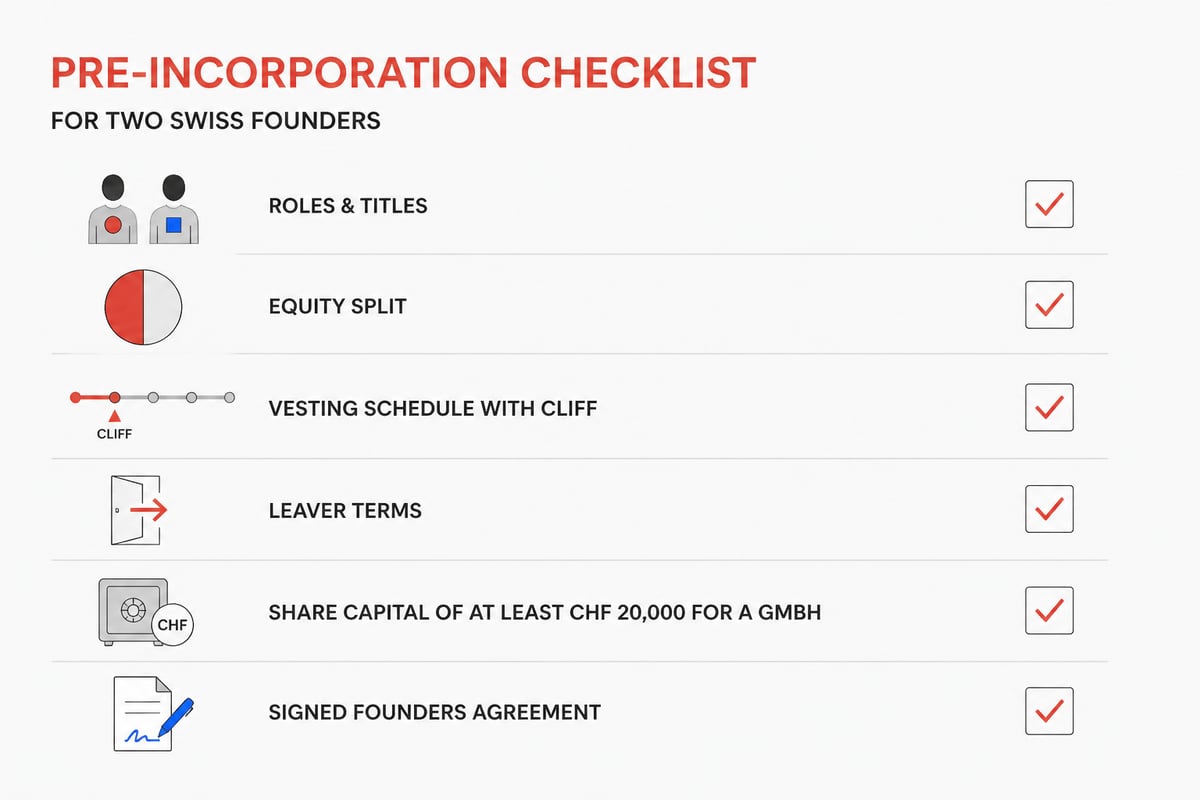
Agree on equity, roles, vesting and exit terms in writing before you register the company. Doing it early is far cheaper than negotiating it after a disagreement.
Splitting equity
There is no universal formula, but a few principles hold:
- Avoid reflexive 50/50 splits without discussing contribution, risk and who takes the CEO role.
- Use vesting. A schedule over several years, often with a one-year cliff, protects the company if one founder leaves early.
- Document leaver terms. Decide in advance what happens to a departing founder's shares.
A written founders agreement covers these points, and Swisspreneur's masterclass on founders agreements walks through what to include. Take the final draft to a Swiss startup lawyer.
Choosing a legal entity
Most Swiss startups incorporate as a GmbH or an AG. A GmbH requires at least CHF 20,000 in share capital, paid in full at incorporation, according to the Canton of Zurich. The same source notes that a GmbH becomes a legal entity only upon entry in the Commercial Register, so any agreement made before that date should be drafted with care.
This is also why you should settle the founder relationship first. Share capital, the allocation of shares and the signing authority of each founder all flow from decisions you make with your partner.
Common Mistakes When Searching for a Co-Founder
Most failed partnerships trace back to a handful of avoidable errors:
- Choosing a friend by default. Friendship helps trust but does not guarantee compatible working styles. Two people who enjoy weekends together may still disagree on risk, pace and how to spend the first CHF 20,000 of share capital. Test the working relationship separately from the friendship.
- Rushing the decision. Settling on the first interested person because the search feels lonely often leads to a costly breakup. A breakup after incorporation means renegotiating share allocations in a company that already exists as a legal entity, which is slower and more expensive than walking away early.
- Ignoring commitment gaps. Different expectations about full-time work and personal financial risk surface later as resentment. If one founder works nights and weekends while the other has quit a salaried job, say so openly and agree when the part-time founder will switch over, with a date attached.
- Skipping the written agreement. Verbal understandings fade, and memories of who promised what diverge quickly. Put equity, roles, vesting and leaver terms on paper before registration.
- Hiring a skill instead of a partner. If you only need a developer, hire or contract one. A co-founder should share ownership of the vision.
If you realize you need help but not a partner, consider an early hire or advisor. Swisspreneur's episode on hiring and managing your startup team covers that decision.
Build Credibility With Traction First
Showing traction makes you a more attractive partner, because strong candidates want evidence that the opportunity is real. Even a small amount helps: a handful of paying customers, signed letters of intent or a working prototype changes the conversation.
This is also where the Swiss funding context becomes relevant. Founders with a Swiss GmbH or AG and early traction can explore Swisspreneur's Syndicate, where founders choose which investors and founders join each deal and the Syndicate takes a 15% carried interest with no management fee. Swiss startup founders can close a pre-seed round in about 2-3 weeks through it, and the investor database is large and growing. A credible funding path makes it easier to ask a talented person to leave a stable job.
For founders at the scaleup stage, the Swisspreneur Scaleup Circle is an operator-led community with podcasts, curated events and selective capital access, which can also surface experienced operators who later become senior team members or co-founders of a new venture.
Practical Resources While You Search
A few free resources help you prepare. Swisspreneur offers free masterclasses and a large library of podcast episodes, many featuring founders who describe how their teams formed and sometimes broke apart. Listening to these accounts gives you a realistic picture of the warning signs.
Meeting people in person remains the strongest accelerator. Swisspreneur's events are designed to help attendees meet peers, and many find them worthwhile for that purpose. Pair event attendance with a clear one-paragraph description of the partner you want, so people can place you quickly.
Finally, expect the search to take months. Treat it as a structured project: define the profile, list thirty names, make introductions, run trial projects and decide with a clear head. The founders who find the right partner usually did so by showing up consistently and being specific about what they needed.
Your next step is to write a one-page profile of the co-founder you need, covering skills, hours, equity expectations and the first project you would trial together, then share it with five people in your network this week. If your company already has a Swiss GmbH or AG and early traction, Swisspreneur can support the next stage through its Scaleup Circle and its startup funding pipeline, where you can sign up for deals alongside a community of Swiss founders and investors.