

Business Pitch Contest Guide for Swiss Founders
A business pitch contest is a competition where founders present their company to a panel of judges within a strict time limit, usually for prize money, mentoring, or investor access. For Swiss founders with a legal entity and early traction, the best contests offer all three, and the right one can shorten the path to a first funding round considerably.
This guide covers how to pick a contest, what judges actually score, how to structure a pitch, and how to use the result whether you win or not.
What a Business Pitch Contest Offers Swiss Founders
A business pitch contest gives founders a fixed deadline, a live audience, and structured feedback, which makes it one of the fastest ways to test a company's story in front of strangers.
The benefits fall into four groups:
- Capital. Prize money, often non-dilutive, can fund a prototype, a pilot, or several months of runway.
- Credibility. A finalist badge from a recognized Swiss competition helps in later conversations with investors and customers.
- Mentoring. Many contests pair finalists with coaches, who sharpen the pitch and the business model behind it.
- Network. Judges, fellow finalists, and audience members become future investors, hires, and peers.
The cost is mostly time. A serious application and rehearsal cycle can consume several weeks, so it pays to be selective. A founder who enters five contests with a weak pitch will usually do worse than one who enters two with a rehearsed, well-evidenced story.
Which Swiss Competitions Are Worth Entering
The best contest for your company is the one whose eligibility, theme, and prize structure match your stage, so check those three points before you write a single slide.
The >>venture<< competition is a well-known Swiss example. According to Venture.ch, the 2027 edition is open to early-stage, Swiss-based startups and nonprofits with an innovative idea, and applications run from October 1 to November 30, 2026. The same source describes the application as a short online submission covering the team, the idea, and why it matters.
The prize side is also clear. Venture.ch states that the 2027 Spotlight Award focuses on the theme "Work, Reimagined," and that entry is free with no equity taken. Free entry and no equity are the two terms to look for in any contest, because a competition that asks for shares in exchange for a prize is really an investment, and it should be evaluated as one.
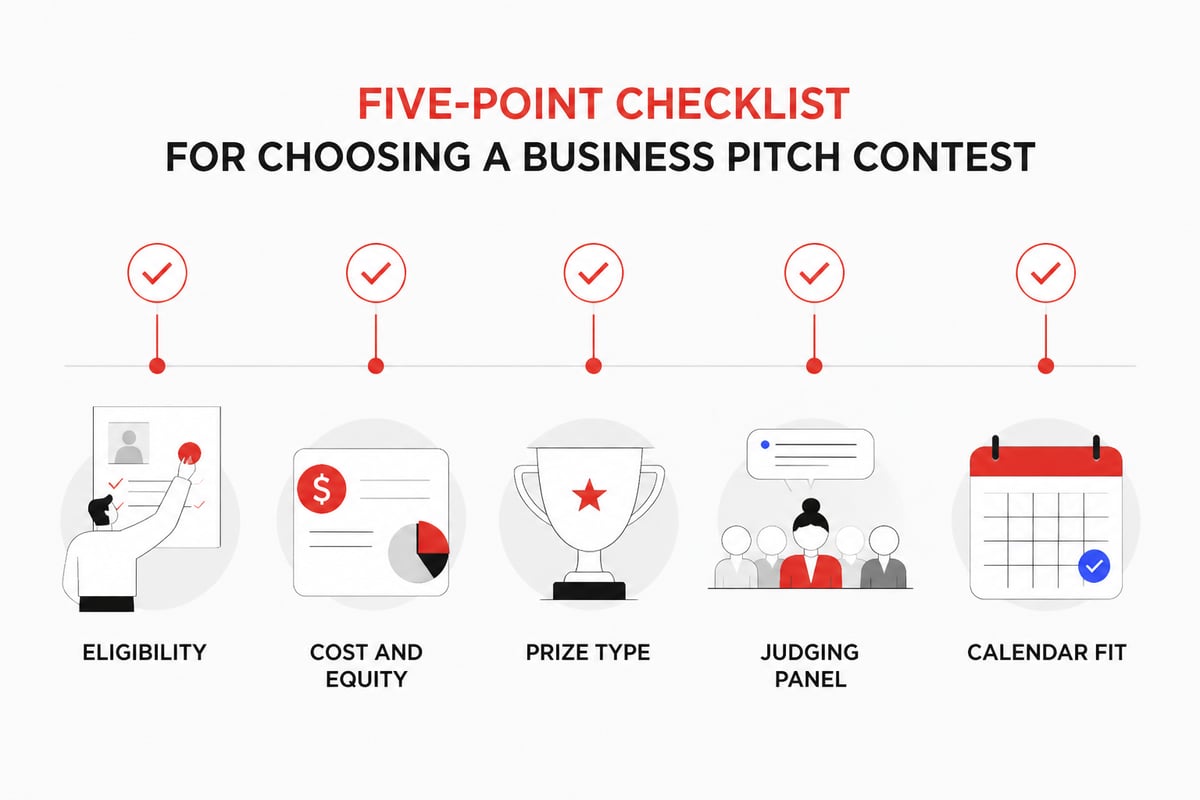
Use this checklist when comparing options:
- Eligibility. Does the contest require a Swiss legal entity, a specific sector, or a maximum company age?
- Cost and equity. Is entry free, and does the organizer take any stake?
- Prize type. Is it cash, services, or an investor introduction?
- Judging panel. Are the judges investors, operators, or academics? Their background shapes what they reward.
- Calendar. Can you realistically prepare before the deadline?
What Makes a Business Pitch Good
A good business pitch states a specific problem, shows evidence that real customers share it, explains how the company makes money, and asks for something concrete, all in a few minutes.
Judges rarely reward cleverness on its own. They reward clarity and proof. A scorecard approach helps here: MAPD Events' judging criteria guide discusses typical scoring categories, time limits, Q&A, and transparent scoring, and reading it before you build your deck shows you the rubric your pitch will probably be measured against.
Most scorecards reward some version of these elements:
- Problem and market. Who has the problem, how often, and how much does it cost them?
- Solution and differentiation. Why is your approach better than the current alternative?
- Traction. Paying customers, pilots, letters of intent, or usage data. Traction separates a company from an idea.
- Business model. How revenue is generated and what the unit economics look like. Founders who need to firm this up can start with Swisspreneur's guide on how to create a business model.
- Team. Why you are the right people to solve this problem.
- Ask and use of funds. What you need and what it will achieve.
Weak pitches fail in predictable ways. They open with the technology instead of the customer, hide the ask on the last slide, or cram twenty slides into a five-minute slot. For a deeper look at structure, Swisspreneur's article on the entrepreneur pitch is a useful companion.
How to Prepare Your Pitch in Four Weeks
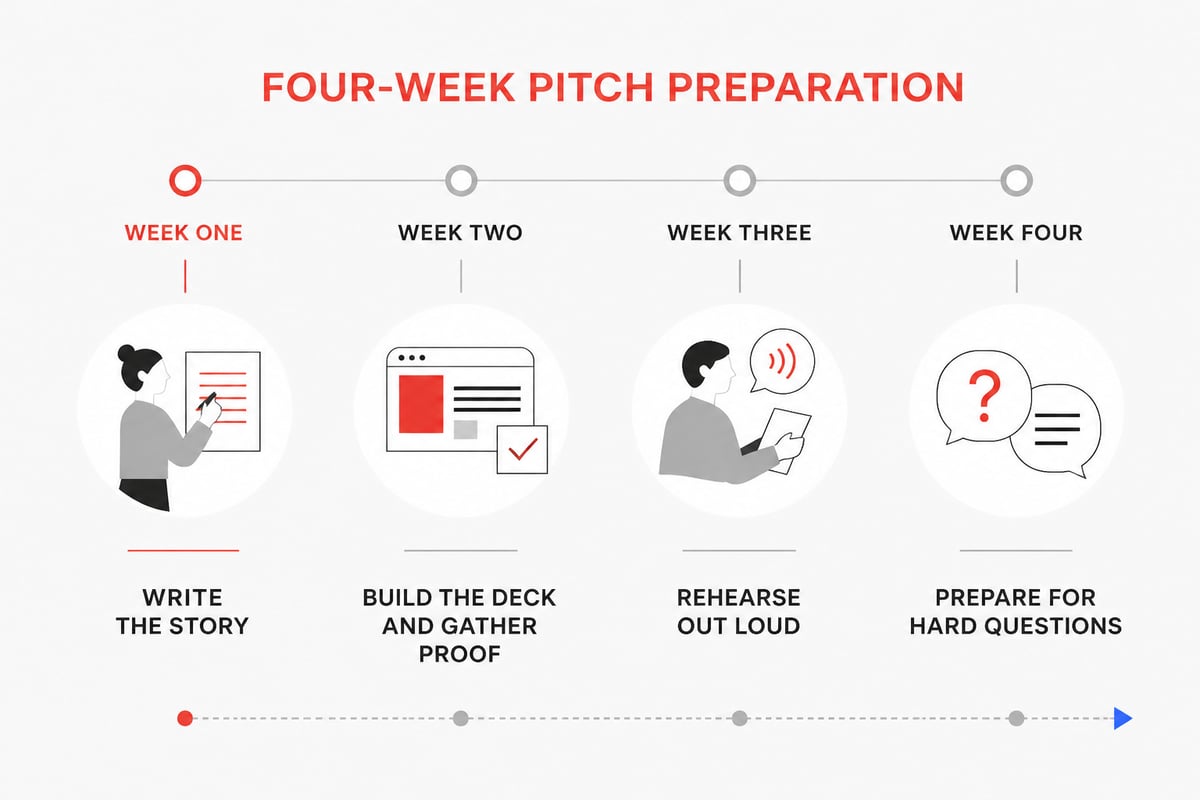
A four-week plan gives you enough time to build the story, test it, and rehearse until the delivery feels natural, without over-polishing it.
Week one: write the story, not the slides. Draft the pitch as a spoken narrative of roughly 400 to 600 words for a five-minute slot. Decide on the single sentence you want judges to remember. Only then open a slide tool.
Week two: build the deck and gather proof. Keep slides sparse, with one idea each. Replace claims with evidence: a customer quote, a revenue figure, a pilot result. If you have no traction yet, a contest may be premature, and more time spent on customer work will serve you better.
Week three: rehearse out loud. Time every run. Present to people who will interrupt you, ideally other founders. Swisspreneur's founder community is one place to find rehearsal partners who understand the Swiss market.
Week four: prepare for questions. Write down the ten hardest questions a skeptical investor could ask and answer each in two sentences. Practice the answers until they sound conversational.
What Not to Say to Investors
The phrases that damage a pitch are the ones that signal weak preparation or poor judgment, and they are easy to avoid once you know them.
Avoid these statements:
- "We have no competition." Every problem has an existing alternative, even if it is a spreadsheet or doing nothing. Naming competitors shows you understand the market.
- "If we capture just 1% of the market..." This reasoning suggests you have no real plan for acquiring customers.
- "Our projections are conservative." Judges have heard this about every forecast. Show the assumptions instead.
- "We just need funding to get started." Investors fund milestones, not hope. Say what the money will achieve and by when.
- Anything you cannot back up under questioning. An inflated claim that collapses in Q&A costs more credibility than a modest, accurate one.
Honesty about weaknesses usually helps. A founder who says "our churn is higher than we want, and here is how we are addressing it" earns more trust than one who deflects. Swisspreneur's podcast episode on winning business angels over as investors covers how angels evaluate founders in conversation.
How to Handle Judges' Questions and Feedback
Strong Q&A answers are short, direct, and honest about what you do not yet know, and they matter as much as the pitch itself.
Answer the question that was asked before adding context. If a judge asks about customer acquisition cost, give the number first and the explanation second. If you do not know, say so and describe how you will find out. Judges tend to penalize bluffing more than they penalize gaps.
Treat the feedback as data. After the event, write down every comment you received, from judges and from the audience. Patterns matter more than single opinions: if three different people say your market size slide is unclear, fix it. If one person dislikes your logo, you can probably ignore it.
Losing is common and informative. Most entrants do not win, and a clear rejection with feedback is cheaper than a vague rejection from an investor six months into a fundraise. Ask organizers whether they provide scoring notes, and use them to improve the next version of your pitch.

From Contest Result to Funding
A pitch contest rarely closes a funding round by itself, but it creates the introductions and the polished story that make a round easier to start.
If you win cash, treat it as a bridge and plan how to use it to hit the milestone that unlocks the next stage of financing. If you only reach the finals, follow up within a week with the judges and attendees you met, sending a short update and a specific request, such as a thirty-minute call.
Before approaching investors, make sure the basics are in place: a Swiss GmbH or AG, a clear cap table, and a founders' agreement. Swisspreneur's article on the founders agreement explains why this document matters before outside money arrives.
For founders with a Swiss entity and early traction who are ready to raise a pre-seed or seed round, Swisspreneur Investments for startups offers funding through its syndicate. Founders decide which investors and founders join each deal, and the syndicate takes only a 15% carried interest with no management fee.
The Seven Stages of a Startup and Where Contests Fit
Startups commonly move through seven stages, and a business pitch contest suits some of them much better than others.
The stages are:
- Ideation. You identify a problem and a possible solution.
- Validation. You test demand through interviews, prototypes, or pilots.
- Launch. You release a first version and win initial customers.
- Early traction. You find repeatable ways to acquire and keep customers.
- Growth. You scale the team, product, and revenue.
- Expansion. You enter new markets or product lines.
- Maturity or exit. You reach stable profitability, an acquisition, or an IPO.
Contests fit best between validation and early traction. At ideation, you have little evidence to show, and judges will notice. By growth, institutional investors are usually more relevant than competitions. Founders still at idea stage without traction are better served by customer interviews and free learning resources, such as Swisspreneur's masterclasses, than by a rushed application.
FAQ
How do you obtain funding for a startup?
Most Swiss startups combine several sources: founder savings, grants and prizes, angel investors, and later venture capital or syndicate rounds. Start with non-dilutive options such as competition prizes, then approach investors once you can show customer traction and a clear use of funds.
What should you bring to a pitch event besides the deck?
Bring a short one-page summary, a few printed or digital proof points such as customer quotes or metrics, and a plan for follow-up conversations. Having a clear request ready, such as an introduction or a meeting, helps you convert brief conversations into outcomes.
Is it worth entering a contest if you do not expect to win?
Yes, if the entry is free and the preparation improves your pitch. The deadline forces clarity, the feedback exposes weak points, and the network can lead to mentors and investors even when the prize goes elsewhere.
Your next step this week is to pick one contest whose eligibility fits your company and write your five-minute pitch as a spoken script before touching any slides. If you hold a Swiss GmbH or AG and have early traction, Swisspreneur can help you move from stage to funding: you can explore Swisspreneur Investments for startups, listen to hundreds of founder conversations on the podcast, and join the community to find rehearsal partners. When you are ready to see what is on offer, Swisspreneur lets you sign up for deals and hear about upcoming rounds first.