

10 Startup Company Lessons From Swiss Founders
A startup company is a young business built to grow fast by solving a problem at scale, and the founders who succeed treat the first two years as a series of tests rather than a fixed plan. Swiss founders work in one of Europe's most capital-rich and demanding markets, and their experience points to ten repeatable lessons. Funding is moving their way: Swiss startups raised CHF 3.3 billion in 2025, a 44% increase from 2024, according to the EY Startup Barometer Switzerland 2026. The lessons below are ordered from validation to funding to community, and a few include a named tool or service where one genuinely helps.
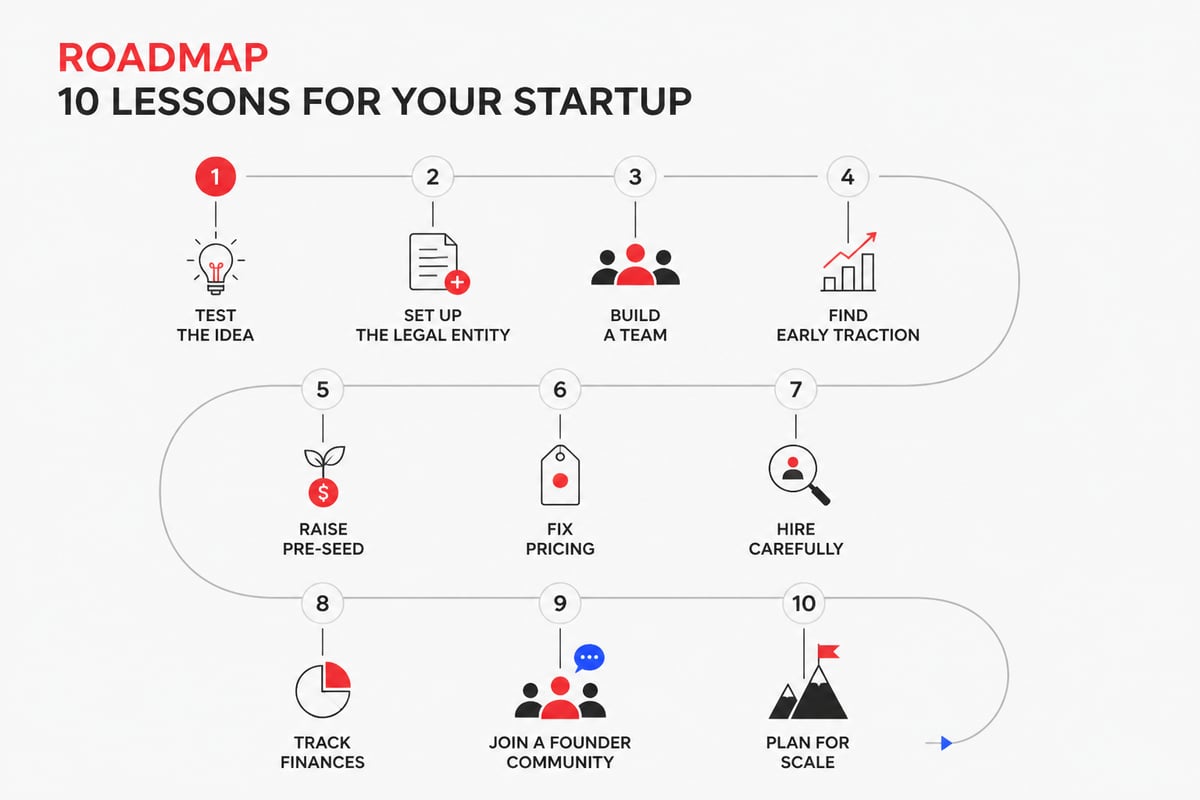
1. Test the idea before building anything
The first lesson is to prove that a specific customer will pay for a specific solution before writing code or ordering stock. Swiss founders tend to run small, cheap experiments: a landing page, ten customer interviews, a paid pilot with one company. The goal is evidence, not enthusiasm.
A useful rule is to ask for money or a signed letter of intent early. A compliment costs nothing; a deposit tells you something real. Swisspreneur's guide to the dos and don'ts of startup idea testing covers how to structure these experiments.
2. Set up a proper Swiss legal entity early
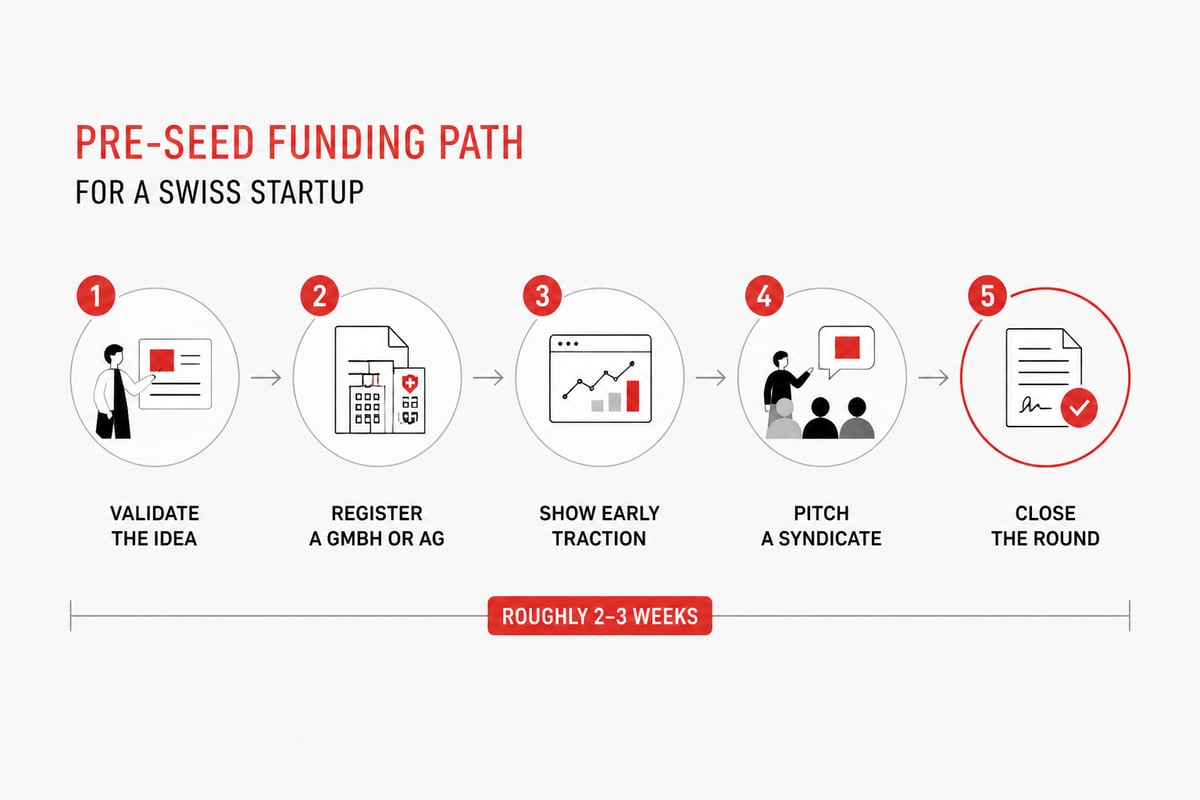
A GmbH or AG gives investors a clear structure to back, and it protects founders personally. Setting it up before the first financing conversation saves weeks later, because most Swiss investors will not wire money into an informal arrangement.
Cap table hygiene matters just as much. Agree founder vesting, document equity splits in writing and keep share issuance clean. Our overview of how to build a company in Switzerland walks through the practical steps.
3. Build the team around complementary skills
A startup company with three founders who all do the same job has a gap in two of three seats. Swiss founding teams that raise successfully usually combine technical depth, commercial drive and operational discipline.
Four habits show up repeatedly in strong teams:
- Clear ownership of each function from day one
- A written agreement on decision rights
- Regular, honest feedback between founders
- Hiring for the gap, not for comfort
For a deeper look at team composition, see four things to know about successful startup teams.
4. Find traction before you chase capital
Traction is the strongest fundraising asset a pre-seed founder can bring. Revenue, signed pilots, a growing waitlist or retention data all outweigh a polished deck.
Swiss investors are known for asking hard questions about unit economics early. Founders who arrive with ten paying customers and honest churn numbers negotiate from a stronger position than those with a larger vision and no evidence. If your business is still at idea stage without any early customers, finish validation first; funding conversations will go better afterward.
5. Raise a pre-seed round through a syndicate
A syndicate lets a founder gather many small investors behind one lead, which keeps the process short. Swiss startup founders can close a pre-seed round through the Swisspreneur Syndicate, and founders decide which investors and founders join each deal. The Syndicate takes only a 15% carried interest and charges no management fee.
Swisspreneur Investments for startups
Swisspreneur Investments for startups is the Syndicate's route to pre-seed and seed funding for Swiss startups. Founders pay nothing; Swisspreneur takes a 15% carried interest on investor profits. It draws on a large investor database and has channeled millions of francs in investments. Investors can join a deal from CHF 5,000.
Best for: Swiss GmbH or AG startups with early traction that want a fast, founder-led pre-seed round.
Verdict: A practical fit for founders who want control over their cap table and a short timeline.
6. Use data to find investors and peers
Sourcing the right investor beats sending a hundred cold emails. Databases can shorten that search by showing who funds your stage, sector and region.
Harmonic
Harmonic is a startup database with 70 million companies and 210 million people profiles, plus 250,000 investor profiles. Data is refreshed weekly for bulk delivery, and access comes through a console, an API or bulk-data files. Pricing runs from $170 to $4,600, depending on the plan.
Best for: Investors and startup teams sourcing companies, founders and investor connections at scale.
Verdict: Strong breadth for research-heavy teams; smaller founders may only need the lower tier.
7. Price for value, not for comfort
Many first-time founders underprice because they fear rejection. Swiss customers, particularly in B2B, generally expect to pay for quality and will question a price that looks too low.
Test price points with real buyers, anchor on the outcome you deliver and revisit pricing every quarter. Swisspreneur's piece on price tags, positioning and your startup explains how positioning shapes what customers are willing to pay.
8. Track finances from the first franc
Cash runway is the number that decides whether a startup company survives to its next round. Founders who review a simple monthly dashboard of burn, runway and receivables avoid most surprise shortfalls.
Keep personal and company accounts separate, forecast conservatively and plan fundraising when you still have at least six months of runway. For the essentials, read finance essentials for startups.
9. Join a community of operators
Swiss founders consistently credit peers, not just capital, with helping them avoid expensive mistakes. A trusted group gives you hiring referrals, honest feedback and warm introductions.
Swisspreneur's own community includes over 700 founders connected through its Slack channel, 550+ podcast episodes, free masterclass content and regular startup events per year. Founders can use these resources at no cost.
10. Plan for scale before you need it
Growth exposes every weakness in hiring, process and culture. Founders who document how they work, set values early and build management habits before reaching 20 employees scale with less friction.
Swisspreneur Scaleup Circle
Swisspreneur Scaleup Circle is an operator-led community with podcasts, curated events and selective capital access for Swiss scaleups. It suits companies that have moved beyond the first round and want guidance from leaders who have scaled before.
Best for: Swiss scaleups with existing revenue and a team, looking for peer operators and selective capital access.
Verdict: Most useful after product-market fit, when the challenge shifts from finding customers to managing growth.
Comparison of the tools and services above
The table below places each named item side by side so you can match it to your stage.
| Item | Type | Key detail | Approximate price (as of November 2026) | Best stage |
|---|---|---|---|---|
| Swisspreneur Investments for startups | Funding service | Syndicate from CHF 5,000 per investor; 15% carried interest | Free for founders | Pre-seed and seed |
| Harmonic | Startup database | 70M companies, 250,000 investor profiles | $170 to $4,600 | Research and sourcing |
| Swisspreneur Scaleup Circle | Community | Podcasts, events, selective capital access | Not listed | Scaleup |
Search results for similar terms can surface unrelated products, so check that any tool you consider is built for startup work.
What the 2025 Swiss numbers say about timing
The market data supports acting on these lessons now. Swiss startups completed 515 financing rounds in 2025, compared with 513 in 2024, per the EY Startup Barometer Switzerland 2026. The number of deals held steady while the total raised climbed, which suggests larger rounds for companies that clear the bar rather than a flood of new deals.
Sector patterns matter for positioning. AI-related startups were involved in 163 Swiss funding rounds in 2025, up 46%, and funding for AI-focused startups reached CHF 1.06 billion, up 206% from CHF 345 million in 2024. Health-related startups raised approximately CHF 1.5 billion, or 44% of total investment volume.
Gender balance is still uneven: 23% of funded Swiss startups had at least one woman founder, while 6% had all-women founding teams. Founders building diverse teams can find practical advice on how to champion diversity in your startup.
For a second angle on the same year, a 2025 overview of Swiss startup equity funding breaks down rounds, sector totals and stage mix.
Why most startups fail, and how to avoid it
Most startups fail because they build something too few customers want, run out of cash or lose their founding team. Failure is usually traced to those three causes more than to any single bad decision.
Each cause has a practical countermeasure. For demand, write down the one customer type and the one problem you serve, then test it with a paid pilot or deposit before expanding the product. For cash, review burn and runway monthly and start the next raise while you still have at least six months in the bank, since rounds rarely close on the schedule founders hope for. For the team, agree on founder vesting, decision rights and equity splits in writing before the first disagreement, because conflicts between co-founders are far cheaper to settle when nothing is yet at stake.
The Swiss lessons above address each one directly. Founders should also keep learning from people who have been through it; the Swisspreneur podcast episode on how to sell a company for 1.5bn is a candid look at what an exit takes.

Tools that save founders time
Marketing and content consume hours that early teams rarely have. A founder who also handles sales, hiring and product often finds that the blog, the landing page copy and the search visibility fall to the bottom of the list, even though organic traffic compounds over months and lowers the cost of acquiring each customer.
For founders publishing regularly, RankPill offers SEO automation that plans, writes and publishes articles to a website on autopilot. It is worth a look once your product is live and you want organic traffic without a full-time content hire. A sensible way to start is to define the three or four problems your customers search for, let the tool draft articles around them, and review each piece for accuracy and tone before it goes out, since you remain the expert on your own market. Revisit the results after a quarter, looking at which articles bring visitors who sign up or book a call, and put your own writing time into those topics.
FAQ
How do startup valuations work?
Early-stage valuations are negotiated rather than calculated, and they rest on traction, team quality, market size and comparable deals. At pre-seed, investors often pay for potential, so evidence such as revenue, pilots or retention moves the number more than a financial model does.
What are startup incubators?
Startup incubators are programs that give early companies workspace, mentoring, networks and sometimes small amounts of funding, usually in exchange for equity or a fee. They suit founders who need structure and introductions before a first institutional round.
What are some promising startup sectors in Switzerland?
Based on 2025 funding data, AI and health lead, with health startups taking about 44% of Swiss investment volume and AI funding rising sharply. Founders in these areas still need clear customer proof, because investors are more selective as the market grows.
Start this week by listing the three assumptions your startup company depends on most and testing the riskiest one with real customers. If you are a Swiss founder with a GmbH or AG and early traction, explore Swisspreneur Investments for startups to see how the Syndicate approaches pre-seed rounds. If you are an individual investor who wants to back early-stage Swiss founders from CHF 5,000 per deal, you can sign up for deals with Swisspreneur, Switzerland's leading platform for entrepreneurs, offering podcasts, free masterclasses, events and syndicate investments.