

Business Opportunities Worth Pursuing in Switzerland
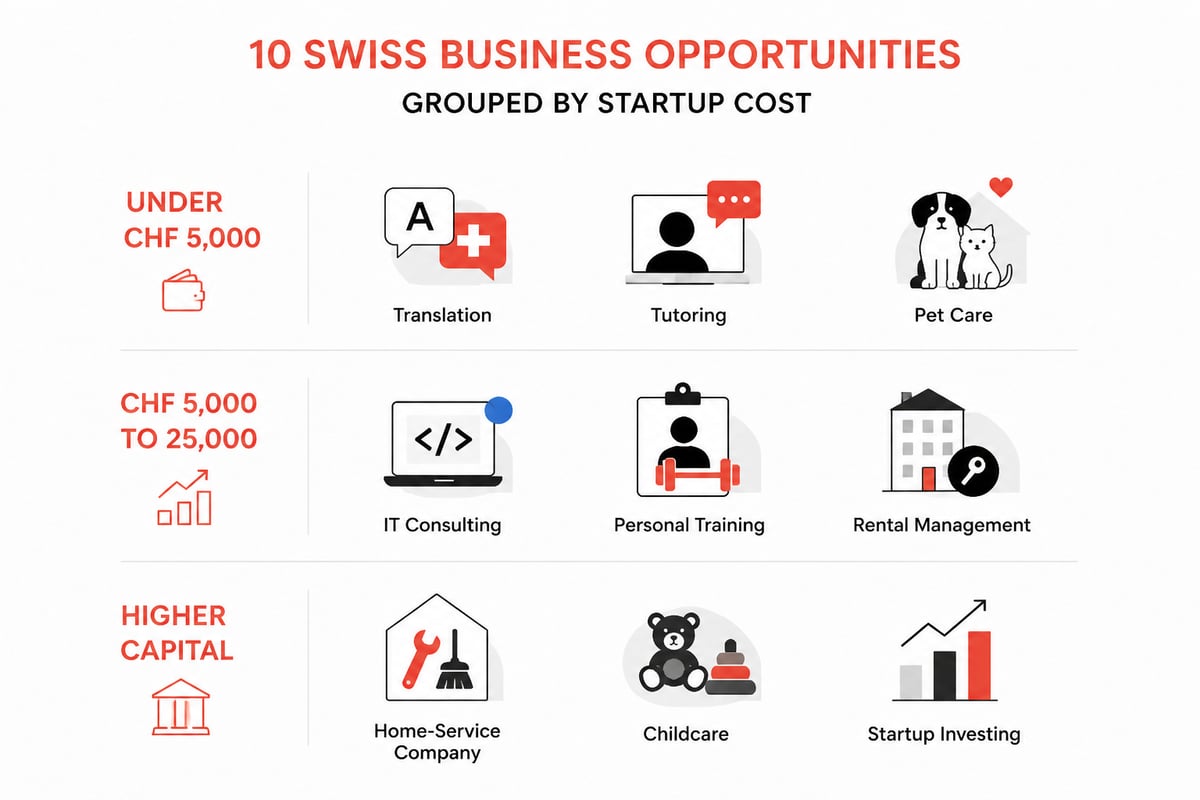
The strongest business opportunities in Switzerland today sit in service businesses with low capital needs, in niches tied to a multilingual and high-income market, and in early-stage investing for those who prefer backing founders to building their own company. The market supports all three: Swiss company formations in 2025 were higher than in 2015, according to the Swiss Federal SME Portal. This article ranks ten options by how well their specs fit a Swiss founder or small-ticket investor, with startup costs, income signals and a clear verdict for each.
Prices below are approximate and reflect general market conditions as of November 2026. Verify local requirements before committing capital.
What makes business opportunities in Switzerland different?
Switzerland rewards businesses that are specialized, trust-based and compliant. High labor costs push buyers toward expertise rather than the cheapest provider, while four national languages and a dense network of international companies create steady demand for translation, consulting and administrative services.
Three structural facts shape every option on this list:
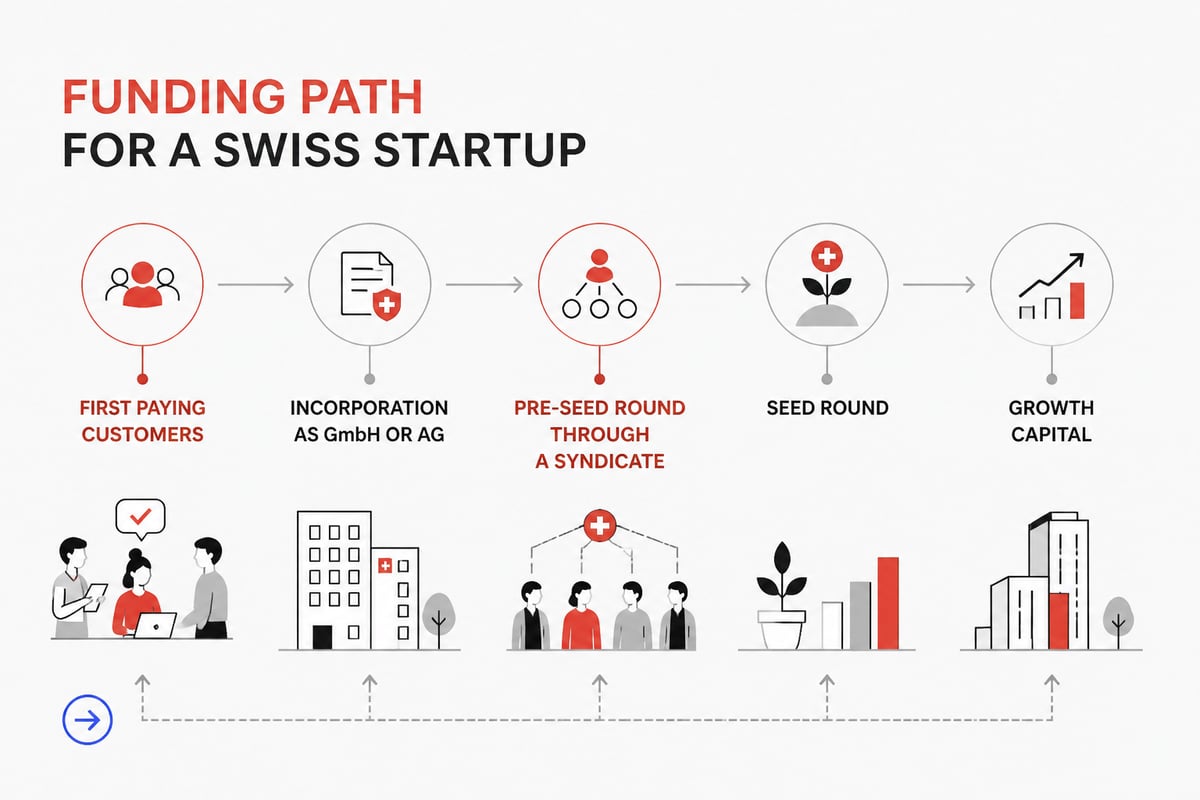
- Legal form matters. Most scalable ventures incorporate as a GmbH or AG, which also determines access to institutional funding. The guide to setting up a business in Switzerland covers the formal steps.
- Regional demand varies. Swissinfo's reporting on the 2025 start-up record highlights which regions and segments produced the most new businesses.
- Trust is the product. Clients pay a premium for reliability, so credentials and references carry more weight than price.
For a wider view of the ecosystem, Swisspreneur's overview of startups in Switzerland is a useful starting point.
1. IT and cybersecurity consulting
IT and cybersecurity consulting is a service business where a founder sells technical expertise to small and mid-sized companies that cannot afford a full in-house team.
- Key specs: Startup costs are mainly a laptop, liability insurance and certifications. Revenue is billed by the day or by retainer.
- Approximate price to start: CHF 2,000 to 10,000, plus a GmbH formation fee if you incorporate.
- Best use: A solo or two-person practice with a low budget, serving regulated sectors such as finance and healthcare where compliance work is recurring.
- Verdict: The lowest barrier to entry on this list and one of the easiest to scale into a small agency.
2. Translation and localization services
Translation and localization is a language-based service that fits Switzerland's German, French, Italian and English-speaking markets.
- Key specs: Requires native-level fluency in at least two languages and, for legal or technical work, subject expertise. Revenue comes from per-word or per-project pricing.
- Approximate price to start: Under CHF 1,500 for software and a website.
- Best use: A home-based practice on a minimal budget, focused on legal, pharma and software documentation where accuracy commands higher rates.
- Verdict: Cheap to launch, but growth depends on specializing rather than competing on volume.
3. Online tutoring and exam preparation
Online tutoring sells subject expertise in one-to-one or small-group sessions, often for language exams, mathematics or university entrance preparation.
- Key specs: Needs a video platform, teaching materials and a clear subject niche. Hourly rates vary by subject and qualification.
- Approximate price to start: Under CHF 1,000.
- Best use: A part-time launch alongside other work, with room to add group courses or recorded content later.
- Verdict: A fast way to validate demand before committing capital, though income is capped by hours unless you productize it.
4. Short-term rental management
Short-term rental management means operating furnished properties on behalf of owners, handling guests, cleaning, pricing and compliance.
- Key specs: Revenue is typically a percentage of booking income. You need reliable cleaning partners, local knowledge and awareness of municipal rules on short-term lets.
- Approximate price to start: CHF 5,000 to 20,000, mostly for software, linen and initial marketing.
- Best use: Tourist regions and larger cities where owners want income without daily involvement.
- Verdict: Strong demand and recurring revenue, but regulation varies by canton and municipality, so check local rules first.
5. Personal training and online fitness coaching
Personal training combines in-person sessions with virtual coaching, which widens the client base beyond one neighborhood.
- Key specs: Requires recognized certification and insurance. A 2026 small-business guide from Xero estimates personal-training income potential at $25 to $75 per hour, depending on specialization and experience. Swiss rates may sit toward the higher end given local costs.
- Approximate price to start: CHF 1,500 to 6,000.
- Best use: A low-capital practice that can later add paid online programs for scale.
- Verdict: Accessible and flexible, though differentiation through a clear specialty matters more than price.
6. Home-service and handyman companies
A home-service company bundles repairs, renovations and maintenance for homeowners and landlords who want one reliable provider.
- Key specs: Needs tools, a vehicle, trade qualifications where required and liability insurance. Revenue is job-based, with repeat clients forming the core.
- Approximate price to start: CHF 10,000 to 40,000.
- Best use: A local operation with a modest budget, strongest where skilled trades are in short supply.
- Verdict: Reliable demand and repeat business, but it is labor-bound until you hire a team.
7. Childcare and family support services
Childcare and family support covers daycare, after-school care and nanny placement, a sector shaped by working-parent demand and strict licensing.
- Key specs: Licensing, staff qualifications and premises requirements vary by canton. Staffing is the main cost. Entrepreneur's roundup of business ideas discusses home daycare alongside the regulatory considerations involved.
- Approximate price to start: CHF 20,000 to 100,000 depending on scale and premises.
- Best use: Founders with an education background and capital to cover licensing and staffing before reaching capacity.
- Verdict: Meaningful and steady, but compliance-heavy and not a quick launch.
8. Executive assistance and virtual office support
Virtual executive assistance provides scheduling, correspondence, bookkeeping support and project coordination to busy founders and small firms.
- Key specs: Requires strong organization, multilingual ability and secure handling of client data. Revenue comes from monthly retainers or hourly billing.
- Approximate price to start: Under CHF 2,000.
- Best use: A remote practice that can grow into a small team serving multiple clients.
- Verdict: Low risk and well suited to multilingual professionals, with clear paths to hire and scale.
9. Swisspreneur Investments for startups
Swisspreneur Investments is a funding route for Swiss startups that already have traction and want pre-seed or seed capital without giving up control of who joins the round. It is a business opportunity for founders rather than a service to launch.
- Key specs: Available to startups with a Swiss legal entity (GmbH or AG) and early traction. Founders pay nothing, and Swisspreneur takes a 15% carried interest on investor profits with no management fee. Founders decide which investors and founders join each deal, and a pre-seed round can close in about 2 to 3 weeks through the Syndicate.
- Approximate price: Free for founders.
- Best use: A startup with revenue or user traction seeking its first institutional round, where speed and founder control matter. It is not suited to idea-stage companies, startups outside Switzerland or those without a Swiss entity.
- Verdict: A practical funding path for traction-stage Swiss founders. Details are on the Swisspreneur Investments page.
Founders weighing this route can also read the guide on how to win business angels over before preparing a pitch.
10. Swisspreneur Syndicate for investors
The Swisspreneur Syndicate lets individual investors in Switzerland back early-stage startups through curated deals pooled in a Special Purpose Vehicle.
- Key specs: Entry from CHF 5,000 per deal. Swisspreneur reports over CHF 3M invested through the Syndicate and 1,000+ investors in its database. Swisspreneur takes a 15% carried interest with no management fee.
- Approximate price: From CHF 5,000 per deal.
- Best use: An investor building a diversified early-stage portfolio with small tickets rather than a single large bet. Early-stage investing carries a high risk of loss, so size positions accordingly.
- Verdict: A low-minimum entry into Swiss startup investing with deal flow curated for you. Deal details are on the Syndicate for investors page.
Business opportunities compared
| # | Opportunity | Approx. startup cost | Best suited to | Main constraint |
|---|---|---|---|---|
| 1 | IT and cybersecurity consulting | CHF 2,000 to 10,000 | Solo practice, regulated clients | Certifications |
| 2 | Translation and localization | Under CHF 1,500 | Home-based specialist | Rate pressure on volume work |
| 3 | Online tutoring | Under CHF 1,000 | Part-time validation | Hours-capped income |
| 4 | Short-term rental management | CHF 5,000 to 20,000 | Tourist regions, cities | Local regulation |
| 5 | Personal training and coaching | CHF 1,500 to 6,000 | Low-capital practice | Differentiation |
| 6 | Home-service company | CHF 10,000 to 40,000 | Local operation | Labor-bound |
| 7 | Childcare and family support | CHF 20,000 to 100,000 | Licensed, capitalized founders | Licensing, staffing |
| 8 | Executive assistance | Under CHF 2,000 | Remote multilingual practice | Client acquisition |
| 9 | Swisspreneur Investments | Free for founders | Traction-stage startups with a Swiss entity | Needs traction |
| 10 | Swisspreneur Syndicate | From CHF 5,000 per deal | Small-ticket early-stage investors | High risk of loss |
How do I market my business in Switzerland?
Marketing a Swiss business works best when you lead with credentials, local references and the right language for each region, rather than broad advertising. Trust drives purchasing decisions here, so a few strong proof points outperform high ad spend.
- Localize by language region. A message in German, French or Italian converts better than one translation applied everywhere.
- Collect references early. Short case descriptions and named testimonials, with permission, build credibility quickly.
- Join the community. Founder networks and events shorten the path to partners and first customers. Swisspreneur runs 10+ startup events per year, and its Slack channel connects over 700 founders.
- Study working models. Swisspreneur's guide to business models for startups helps you choose pricing and revenue structures before you market them.

How to choose among these business opportunities
Choose by matching three variables: available capital, existing skills and how quickly you need revenue. A founder with technical skills and little capital should look at items 1, 2 or 8, while someone with capital and a licensed background can consider items 4, 6 or 7.
A short decision path:
- List your realistic budget and how many months you can fund yourself.
- Name the one skill you already sell well.
- Check canton-level licensing before spending on branding.
- Test demand with three paying clients before hiring.
Mistakes in the early months usually come from skipping step 4. Swisspreneur's piece on common mistakes in business is a practical read before you commit.
FAQ
What are the four types of business?
The four common types are sole proprietorship, partnership, limited liability company and corporation. In Switzerland, the practical options are usually a sole proprietorship, a GmbH or an AG, and the choice affects liability, funding access and tax treatment.
What are the most profitable businesses to acquire?
Profitability depends on the sector, but service businesses with recurring revenue, such as IT consulting practices and property management firms, tend to be attractive to acquire. Always review financial statements, client concentration and owner dependence before buying.
Do I need a Swiss legal entity to raise startup funding?
For funding through Swisspreneur's Syndicate, yes: startups need a Swiss legal entity (GmbH or AG) and some early traction. Other funding sources set their own requirements, so confirm eligibility early.
Your next step is to pick one option from this list, validate it with three paying customers or one small investment, and confirm the legal form it needs. If you want to back early-stage Swiss startups with small tickets, Swisspreneur Syndicate for investors offers curated deals from CHF 5,000. Swisspreneur is Switzerland's leading platform for entrepreneurs, with podcast conversations, free masterclasses and regular startup events, so you can sign up for deals and start building your pipeline today.