

People in Entrepreneurship: Who Succeeds and How to Start
People entrepreneurship describes the human side of building a company: who becomes a founder, which traits and habits predict success, and how a person turns an idea into a working business. Success rarely depends on one trait. It comes from a fit between a person's temperament, skills, team and the venture they choose to build.
For Swiss founders, that fit matters more than most. A small home market, high costs and demanding investors reward people who prepare carefully and surround themselves with the right peers. This article covers the traits research associates with founders, the types of entrepreneurs you will meet, how teams and networks shape results, and a practical path from idea to launch.
What Traits Define People in Entrepreneurship?
The most consistent research findings point to a handful of personality dimensions rather than a single "founder type." A 2024 systematic review and meta-analysis in the Entrepreneurship Research Journal identified seven commonly used dimensions of entrepreneurial personality:
- Innovativeness: a drive to create or combine things in new ways
- Risk-taking: comfort with uncertainty and incomplete information
- Achievement orientation: a strong need to reach demanding goals
- Locus of control: the belief that your actions, not luck, determine outcomes
- Proactiveness: acting ahead of events instead of reacting to them
- Self-efficacy: confidence in your ability to perform specific tasks
- Autonomy orientation: a preference for independence in how you work
These traits describe tendencies, not guarantees. A founder who scores low on risk-taking can still build a strong company by pairing with a co-founder who scores high, or by validating demand before committing capital. The useful question is not whether you have every trait, but which ones you can rely on and which ones your team must cover.
Swisspreneur has explored this theme in its piece on success in entrepreneurship, which is a good companion for founders assessing their own strengths.
Person-Entrepreneurship Fit: Why Some Founders Outperform Others
Founders tend to outperform when their strengths match the demands of the specific venture, not when they match a generic profile. This idea, often called person-entrepreneurship fit in academic literature, explains why a brilliant engineer may thrive building a deep-tech company yet struggle running a high-volume consumer brand.
Fit has three practical layers:
- Fit with the work. Does the daily reality of selling, hiring and fundraising suit your energy?
- Fit with the market. Does your background give you credibility with the customers you serve?
- Fit with the stage. Early-stage chaos rewards generalists; scaling rewards people who build systems.
A founder who recognizes a misfit early can adjust. Many bring in a commercial co-founder, hire an operator, or step into a different role as the company grows. Treating your role as something that changes, rather than a fixed identity, is one of the clearest habits among durable founders.
Which Types of Entrepreneurs Exist?
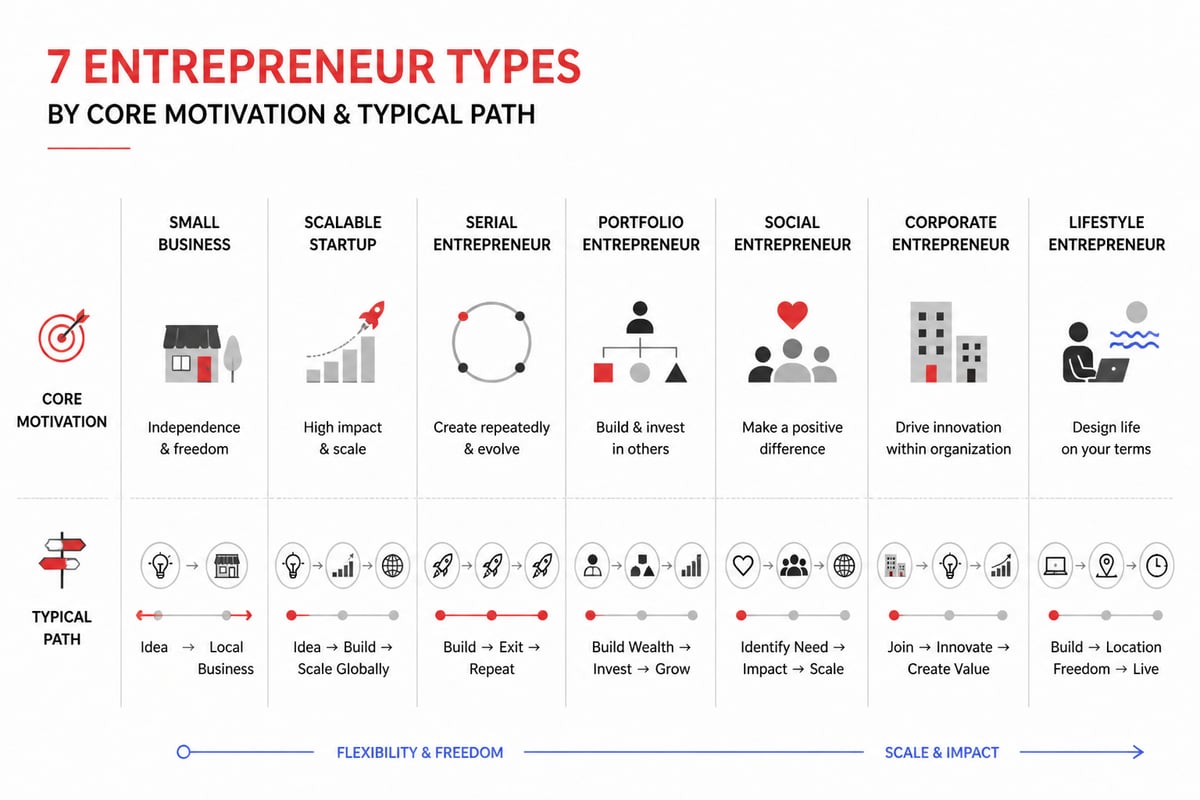
Entrepreneurs are commonly grouped into several recognizable types, and knowing which one you resemble helps you choose the right path. There is no official list of seven, but the following categories appear repeatedly in entrepreneurship literature and practice.
| Type | Core motivation | Typical path |
|---|---|---|
| Small business founder | Independence and steady income | Local service, shop or consultancy |
| Scalable startup founder | Rapid growth and large markets | Venture-backed product company |
| Serial entrepreneur | Starting new ventures repeatedly | Builds, exits, then starts again |
| Portfolio entrepreneur | Running several ventures at once | Holds multiple companies in parallel |
| Social entrepreneur | Solving a societal problem | Mission-led company or nonprofit hybrid |
| Corporate entrepreneur | Innovating inside an organization | New units or products within a firm |
| Lifestyle entrepreneur | Flexibility and personal freedom | Small, founder-centered business |
Two of these deserve a closer look. Portfolio entrepreneurship suits people who can manage attention across several ventures, while corporate entrepreneurship lets employees build new products with the resources of an established company behind them. If you are unsure how a startup differs from a general small business, this breakdown of the difference between a startup and entrepreneurship clarifies the terms.
Who Are the Top Entrepreneurs, and What Can Founders Learn From Them?
Famous founders are useful less as role models to copy than as case studies in how different temperaments produce results. The names that appear on most lists, such as Steve Jobs, Henry Ford, Sara Blakely, Oprah Winfrey and Richard Branson, built very different businesses with very different styles.
Several patterns repeat across them:
- Obsession with a specific problem. Blakely focused on a single product gap in hosiery and built a company around it.
- Willingness to be early and wrong. Many early products were rough, and iteration did the rest.
- Strong storytelling. Jobs and Branson sold a vision before the product was fully proven.
- Resilience after setbacks. Ford and Disney both faced business failures before their breakthroughs.
The lesson for a Swiss founder is practical. You do not need a famous founder's personality, but you do need a clear problem, an honest feedback loop with customers and the stamina to keep going when early numbers disappoint. Hearing founders describe these moments in their own words is often more instructive than reading a profile, which is why Swisspreneur's podcast archive of freely available episodes is a useful resource. One example is this conversation on the success formula behind 20 years of entrepreneurship.
Social Entrepreneurs: Building Companies With a Mission
Social entrepreneurs build ventures whose primary goal is to address a societal or environmental problem while remaining financially sustainable. They are a distinct strand of people entrepreneurship because their success is measured on two axes: impact and viability.
In Switzerland, this often means ventures in areas such as clean energy, healthcare access, education and inclusion. The founder profile overlaps with commercial founders, but the pitch to investors differs. Funders want evidence that the impact is measurable and that the business model can survive without constant grant support.
If you are weighing this route, the same fundamentals apply. You still need a validated customer need, a workable business model and a team that can execute. The broader relationship between companies and communities is covered in Swisspreneur's article on entrepreneurship and society.

Why Teams and Networks Shape Entrepreneurial Success
Founders rarely succeed alone, and the strength of the team and surrounding network often predicts outcomes better than any single founder's talent. A solo founder carries every weakness personally; a balanced team distributes them.
Three decisions deserve early attention:
- Who joins the founding team. Complementary skills beat similar backgrounds. A technical founder paired with a commercial founder covers more ground than two engineers.
- How you formalize the relationship. A written founders' agreement settles equity, roles and exit scenarios before tension appears.
- Who you learn from. Peer founders who are a few steps ahead shorten your learning curve.
Culture also forms earlier than most founders expect. The habits you set with the first few hires become the company's default, which is why guidance on building culture in a Swiss startup is worth reading before you hire.
Community is the other half. Over 700 founders are connected through Swisspreneur's Slack channel, and the organization runs 10+ startup events per year. Regular contact with people facing the same problems is a practical form of mentoring that costs founders very little.
How to Start: A Practical Path From Idea to Launch
Starting a venture follows a fairly consistent sequence, and following it in order prevents expensive mistakes. The U.S. Small Business Administration's startup guidance covers market research, business planning, startup-cost estimates, funding, business structure, registration, tax IDs, permits, banking and insurance. The steps are written for the United States, but the logic carries over to Switzerland, where the legal details differ. The SBA's 10 steps to start your business is a useful companion for seeing the full sequence at a glance.
Here is a Swiss-oriented version of that path:
- Validate the problem. Speak with potential customers before building anything.
- Draft the business model. Define who pays, for what, and how you reach them.
- Choose the founding team and agree terms. Settle equity and roles in writing.
- Select a legal structure. In Switzerland this is typically a GmbH or an AG. The SBA notes that businesses generally need to choose a business structure before registering, and the same sequencing logic applies here.
- Register and set up the basics. Handle commercial register entry, banking, insurance and any required permits.
- Build to early traction. Investors back evidence, so aim for paying customers or strong usage before approaching them.
Founders weighing Swiss-specific rules can also read about how to build a company in Switzerland.
Building Your Visibility Early
Early visibility gives a young company credibility with customers and investors alike. A professional website, a clear message and a consistent presence are inexpensive to set up and hard to retrofit later.
Practical options exist for founders at different budgets. A no-code builder such as Avantiy lets you launch a website, store or portfolio without writing code. If you sell physical products online, Socivolve builds Shopify stores with AI assistance and charges through a revenue-share model after launch. For ongoing promotion, agencies such as Buzzhive Marketing offer SEO, social and CRM support, while Manfredi Marketing focuses on social media management and ads for German-speaking audiences.
Choose tools that match your stage. Before you have traction, simple and cheap beats sophisticated. Spend on marketing once you know which message converts.
How Funding Fits Into People Entrepreneurship
Funding is a people decision as much as a financial one, because early investors back founders before they back numbers. At pre-seed, there is often little revenue to analyze, so investors weigh the team's credibility, speed of learning and clarity about the problem.
Swisspreneur's Syndicate reflects this approach. Founders decide which investors and founders join each deal. The Syndicate has facilitated over CHF 3M in investments, and the database includes 1,000+ investors.
This route suits Swiss startups with a Swiss legal entity (GmbH or AG) and early traction. If you are still at the idea stage, the free masterclasses and podcast library are the better starting point. More than 150 minutes of masterclass content is available at no cost to startups.
For founders weighing investor relationships and ecosystems more broadly, the article on the entrepreneurship network offers useful context.
FAQ
Who are 10 famous entrepreneurs?
Frequently cited examples include Steve Jobs, Henry Ford, Walt Disney, Oprah Winfrey, Richard Branson and Sara Blakely. They span different eras and industries, which shows that no single founder personality dominates.
What are the 7 types of entrepreneurs?
There is no single official list, but common categories are small business, scalable startup, serial, portfolio, social, corporate and lifestyle entrepreneurs. Each differs mainly in motivation and in how much growth the founder is seeking.
Do you need to be a specific personality type to succeed?
No. Research identifies tendencies such as proactiveness and self-efficacy, but these can be developed, and a strong co-founder can offset your weaker areas. What matters most is fit between you, your team and the venture.
Your next step is to talk to five potential customers this week and write down exactly what problem they would pay to solve. Once you have that evidence, Swisspreneur can support the stages that follow, from free masterclasses and a founder community to early-stage investment through its Syndicate. If you are an individual investor who wants to back Swiss startups with small tickets, sign up for deals and see which founders are raising now.