

The Entrepreneur Society: How Founders Shape Communities
The entrepreneur society is a community of founders who share knowledge, capital, contacts and accountability, and who in turn shape the economy and civic life around them. The term covers student clubs, founder collectives and broader networks, but the idea is the same: entrepreneurs do better together, and the places they operate in benefit from the result. For Swiss founders raising early-stage funding and looking for mentors and peers, understanding how these communities form is a practical advantage.
What Is the Entrepreneur Society?
An entrepreneur society is a group of founders and aspiring founders who organize around shared goals, usually mutual learning, introductions and support. The format varies. A university society might run pitch nights and speaker series. A regional network might host monthly founder dinners. An online community might operate through a Slack workspace where founders answer each other's questions within hours.
What unites them is reciprocity. Members give advice, make introductions and share lessons from failures, and they expect the same in return. That norm separates a society from a simple event series.
Three features tend to define a functioning one:
- A clear membership logic. Members share a stage, a geography or a sector, so conversations stay relevant.
- Regular contact. Communities that meet or interact weekly or monthly build trust faster than those that gather once a year.
- Visible give-and-take. Newer founders receive help, and experienced founders see value in giving it.
If you want a closer look at related formats, Swisspreneur has written about entrepreneur clubs and entrepreneur groups and how each one operates.
How Founders Shape Their Communities
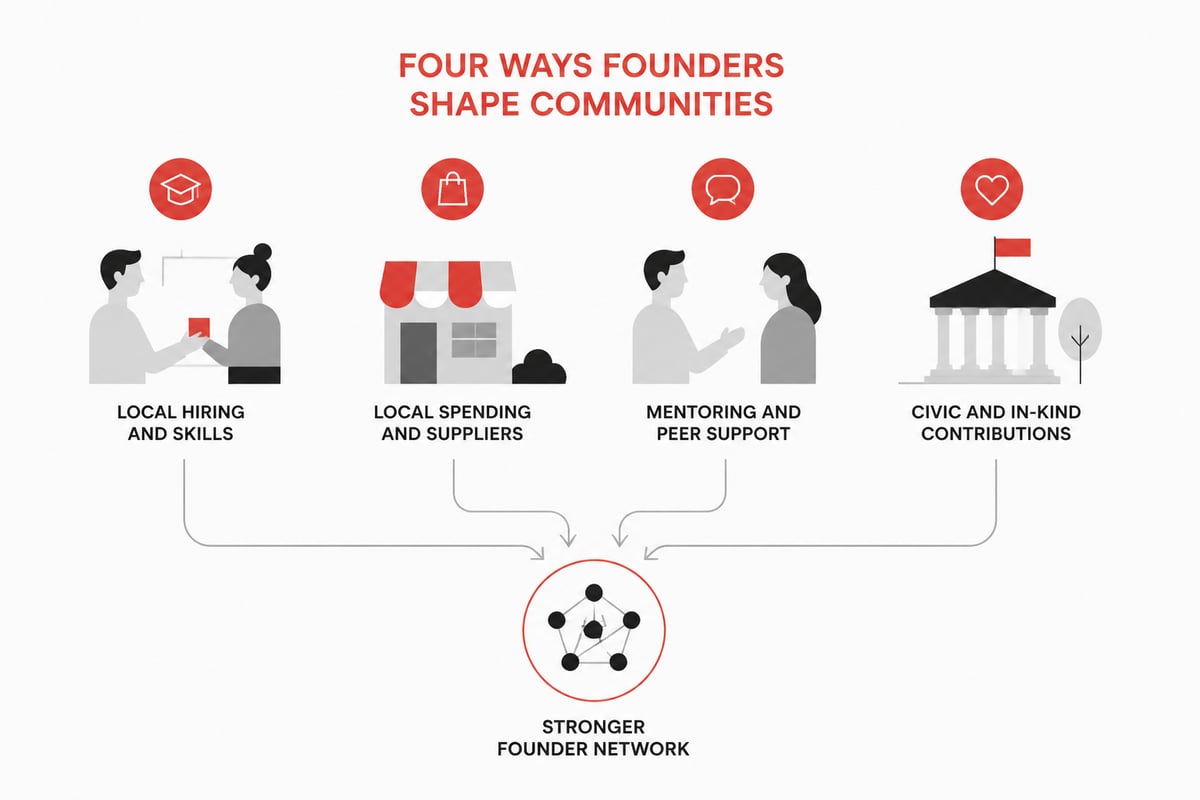
Founders shape their communities through employment, local spending, mentoring and civic participation, often more than their company size would suggest. A ten-person startup may look small on a balance sheet, yet it hires locally, buys from local suppliers and trains people who later start companies of their own.
The data on small-business owners supports this. In a 2024 survey reported by the NFIB, most small-business owners said they volunteered for community or civic activities in the prior 12 months. The same survey found that most had financially supported local groups or causes, and many had made in-kind contributions such as meeting space or donated inventory.
Those figures come from small-business owners in general, not only venture-backed startups, but the pattern carries over. Founders are embedded in the places they build in. They sponsor events, open their offices to meetups and sit on advisory boards.
Jobs and Skills
Early-stage companies create the roles where people learn to operate under uncertainty. Employees who leave a startup after three or four years often carry that experience into their own ventures, which extends the founder community outward over time.
Spillovers and Role Models
A visible success changes what feels possible locally. When a founder in Zurich, Lausanne or Basel closes a funding round or reaches a market milestone, peers recalibrate their own ambitions. Stories and examples matter here, which is why founder interviews and success stories of entrepreneurs circulate so widely inside these networks.
Why Peer Community Matters at the Early Stage
Peer community matters early because most founders face the same problems for the first time, and someone one step ahead can often save months of trial and error. Hiring the first employee, choosing between a GmbH and an AG, setting a pre-seed valuation and handling a difficult co-founder conversation are all problems with known patterns.
A peer group offers three concrete benefits:
- Faster answers. A question posted in a founder channel often gets several responses the same day, from people who have solved it recently.
- Honest benchmarks. Founders learn what typical traction, runway and hiring timelines look like at their stage, which prevents both overconfidence and unnecessary panic.
- Warm introductions. Investors and customers respond far better to introductions from trusted peers than to cold outreach.
Emotional support deserves a mention too. Founding a company is isolating, and a circle of people who understand the pressure reduces the risk of burnout and rash decisions.
Swiss founders sometimes assume their market is too small for a dense community to form. In practice, the opposite holds. A compact ecosystem means that a few strong connections can reach most of the relevant investors, operators and customers.
The Entrepreneur Society and Early-Stage Funding
The entrepreneur society and early-stage funding are closely linked, because capital in the pre-seed and seed stages moves mostly through trust and relationships. Investors writing small first cheques rely heavily on referrals and on what other founders say about a team.
That has practical consequences for founders:
- Reputation travels. How you treat suppliers, employees and fellow founders becomes part of your fundraising profile.
- Referrals shorten rounds. A warm introduction from a respected founder can replace weeks of cold emails.
- Founders make good investors. Many operators who exit or scale a company reinvest in the next generation, which keeps capital circulating locally.
Swisspreneur's investment model reflects this logic. Through its Syndicate, founders decide which investors and founders join each deal. Swisspreneur has channeled over CHF 3M in investments through the Syndicate, supported by a database of more than 1,000 investors.
This route is built for Swiss startups with a legal entity (GmbH or AG) and some traction. If you are still at the idea stage, community resources such as masterclasses and podcasts are a better starting point than a funding round. For a broader view of how formal bodies back founders, see this overview of institutional support to entrepreneurs.
Formats That Build Founder Communities
Founder communities are built through a small set of repeatable formats, and the strongest ones combine several of them. No single format does everything. In-person events create trust quickly, but they only happen a few times a year. Online channels keep conversation going between those events, though they rarely produce the same depth. A founder who attends a dinner, then continues the discussion in a shared channel the next morning, gets the benefit of both.
| Format | What it offers | Typical strength |
|---|---|---|
| In-person events | Face-to-face trust, spontaneous introductions | Deep relationships |
| Online channels | Fast answers, constant presence | Speed and reach |
| Podcasts and interviews | Candid lessons from experienced founders | Learning at scale |
| Masterclasses | Structured, practical skills | Tactical knowledge |
| Investor access | Capital tied to community reputation | Funding momentum |
Swisspreneur runs several of these in parallel. It hosts 10+ startup events per year, with an overall event NPS score of 84. Its Slack channel connects over 700 founders. Its podcast library holds 550+ freely available episodes and reaches 10k plays per month, and its free masterclasses add 150+ minutes of practical content at no cost to startups.
The formats also serve different moments. A founder preparing a first hire might listen to a podcast episode on the way to work, watch a masterclass on the topic that evening, and then ask a narrow question in the Slack channel the following day. A founder approaching a pre-seed round will rely more on events and investor access, where reputation and warm introductions carry the most weight.
For founders weighing which events are worth their time, this guide to entrepreneur events outlines what to look for.

How Established Founders Give Back
Established founders give back by mentoring, investing, hosting and speaking, and these contributions are what keep a community healthy over time. Without them, a society becomes a group of beginners swapping guesses.
Typical forms of giving back include:
- Mentoring. One or two hours a month with a founder one or two stages behind can change that founder's trajectory.
- Angel investing. Writing small cheques into peers' rounds, often alongside others.
- Sharing failures publicly. Candid accounts of what went wrong teach more than polished success narratives.
- Opening doors. Introducing a first customer, a senior hire or a specialist advisor.
Podcasts are one scalable way to do this. A founder who tells the full story of a hard decision reaches thousands of listeners who would never have had a coffee with them. Swisspreneur's conversation with Jann Tadorian on two decades of entrepreneurship is an example of a long career turned into practical lessons. Founders who want to publish their own show can look at production specialists such as Podcast Monkey, which turns raw recordings into finished episodes ready for distribution.
Inclusion belongs in this conversation as well. A society that draws on only one profile of founder leaves talent unused. The episode on the state of female entrepreneurship in Switzerland examines where that gap sits and what peers can do about it.
Choosing the Right Community for Your Stage
The right community is one where your questions are shared by most members and where you can contribute something in return. Prestige and size matter less than fit.
Use these questions to assess a community before committing time:
- Is it relevant to your stage? A pre-seed founder gains little from a group focused on Series C governance.
- Is it active? Check how recent the posts, events and introductions are.
- Do members help each other without being asked? This is the clearest sign of a healthy culture.
- Is there a route to capital or customers? Not every community needs one, but at the fundraising stage it helps.
- What does it cost in time? A few well-chosen touchpoints beat a calendar full of passive networking.
For Swiss scaleups that have moved past the earliest stage, the Swisspreneur Scaleup Circle offers an operator-led community with podcasts, curated events and selective capital access, which suits founders who want peers facing similar growth problems.
Founders working across borders sometimes need supporting services as well. A team hiring internationally may need to verify candidates' English proficiency, and an accredited provider such as the English Exam Centre offers Cambridge English assessments for individuals and companies.
Practical Habits for Getting More From a Founder Community
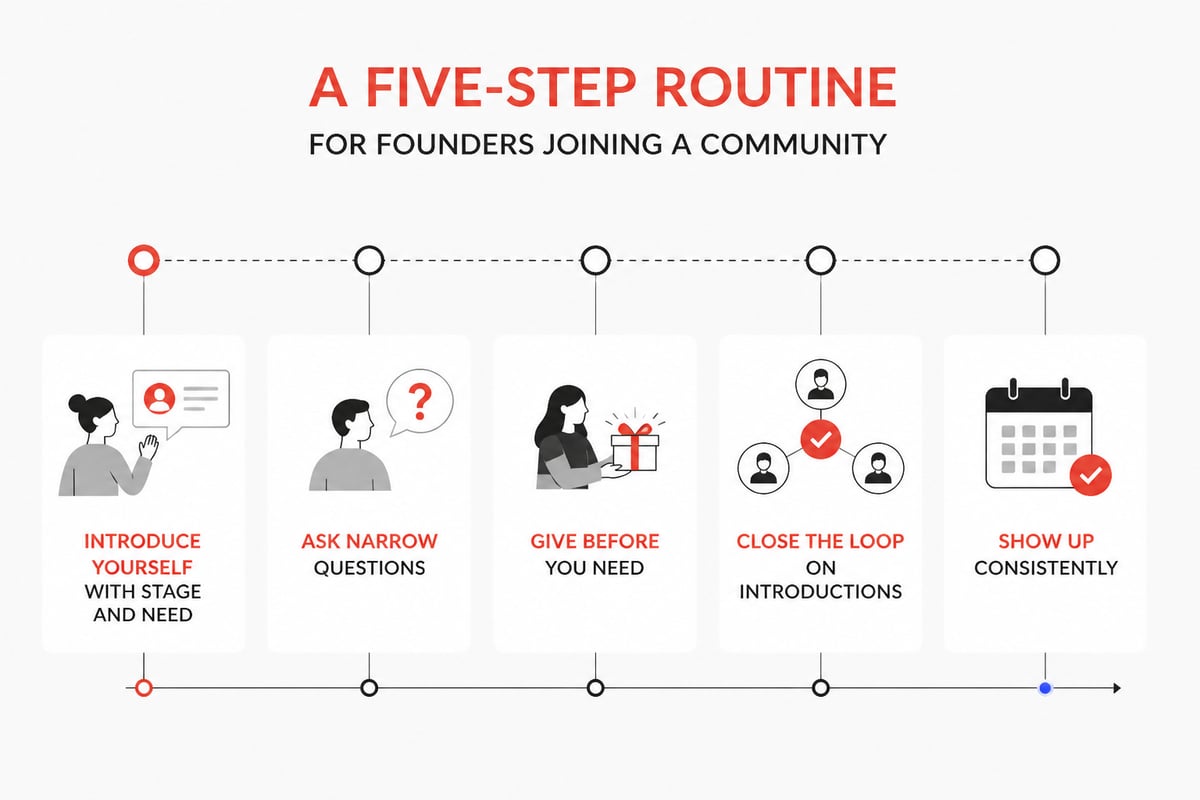
Founders get more from a community by contributing early, asking specific questions and following up on every introduction. Passive membership produces little. The founders who benefit most tend to treat a community like a working relationship, with small, regular inputs rather than occasional large requests.
Start with these habits:
- Introduce yourself with context. State your stage, your market and one thing you need and one thing you can offer. A line such as "pre-seed, B2B software, looking for a contact in industrial procurement, happy to share our onboarding checklist" gives others an easy way to respond.
- Ask narrow questions. "How did you structure your first employee option plan?" gets better answers than "Any advice on hiring?" A narrow question also shows you have done your own groundwork, which makes experienced founders more willing to reply.
- Close the loop. When someone makes an introduction or answers a question, report back on what happened. People help more readily when they see the outcome, and a short thank-you with a result takes two minutes.
- Give before you need. Share a template, a contact or a lesson when nothing is at stake. The NFIB survey found that 63% of small-business owners made in-kind contributions such as meeting space, and the same instinct applies here: lending a room, a spreadsheet or an hour of time builds goodwill that lasts.
- Show up consistently. Trust builds through repeated contact, not a single impressive appearance.
For more on the mechanics of building and using these connections, Swisspreneur's pieces on the entrepreneurship network and on entrepreneurship and society cover the topic from complementary angles.
Your next step this week is to pick one founder community that fits your stage and make a specific, useful contribution to it, whether that is an answer to a peer's question or an introduction. If you run a Swiss GmbH or AG with early traction and are preparing a pre-seed round, the Swisspreneur Scaleup Circle is worth exploring as you grow, and the Syndicate gives you a route to investors who back founders through the community itself. Sign up for deals on Swisspreneur to see how founder-led funding rounds work from the inside.