

Founder Connect Guide: Finding a Co-Founder in Switzerland
A founder connect is any structured way of meeting, vetting and partnering with a potential co-founder, and in Switzerland it works best through trusted networks, curated events and a trial period before you commit. Online matching platforms exist, but Swiss founders tend to find lasting partners where reputation and referrals carry weight.
The Swiss market gives you good reasons to look carefully. Swiss startups raised CHF 2.3 billion in 2024, according to the EY Startup Barometer Switzerland 2025, and the pool of new companies keeps growing. This guide covers where to look, how to evaluate a candidate, and how to formalize the partnership once you have found the right person.
Why a Co-Founder Matters in the Swiss Startup Landscape
A strong co-founder shortens the path to traction, shares the financial and emotional load, and signals to investors that the venture does not depend on one person. Swiss investors, including angels writing small tickets, routinely look at team composition before they look at the product.
The environment is active. Switzerland recorded 55,427 new company formations in 2025, up 4.6% year over year, and Zurich passed 10,000 registrations for the first time with 10,140, according to the Startups.ch Startup Report 2025. Many of those companies are solo ventures. Founders who find a complementary partner early often move faster through the pre-seed stage.
Three practical reasons to prioritize the search:
- Skill coverage. A technical founder paired with a commercial founder can cover product and sales without early hires.
- Resilience. Startup timelines are long, and a partner helps you sustain momentum through slow quarters.
- Investor confidence. Syndicates and angels prefer teams where responsibilities are clearly divided.
If you want a wider view of how roles differ, the Swisspreneur piece on the difference between a co-founder and a founder is a useful starting point.
Where to Meet a Potential Co-Founder in Switzerland
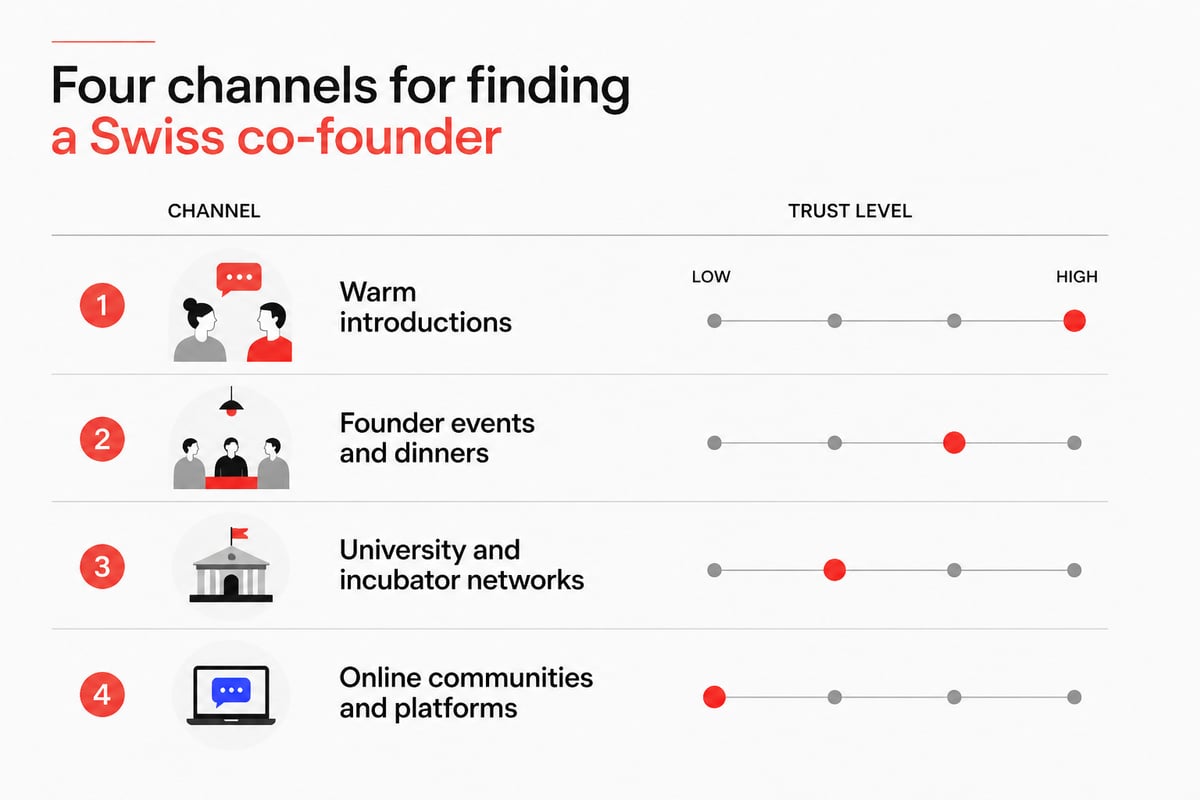
The most reliable sources of co-founders in Switzerland are university ecosystems, curated events, peer communities and warm introductions from people who know you both. Cold outreach on generic platforms rarely produces the depth of trust needed for a partnership that may last a decade.
University and Research Networks
ETH Zurich, EPFL, the University of St. Gallen and the regional universities of applied sciences produce a steady flow of founders. EPFL reported 39 new startups in 2025, and its startups raised CHF 701 million that year, according to the EPFL Startup Launchpad. Technical talent frequently forms in these labs, and founders from outside academia often find partners by attending demo days, thesis presentations and incubator open houses.
Events and Communities
In-person meetings still do the heavy lifting in Switzerland. Startup events, founder dinners and meetups let you observe how someone communicates, handles disagreement and talks about failure. Swisspreneur runs 10+ startup events per year, and its events have an overall NPS score of 84. You can see the current formats on the founder events page and learn what a smaller setting looks like through the founders dinner.
Online communities add reach between events. Swisspreneur's Slack channel has connected over 700 founders, which gives you a way to post what you are building, ask for introductions and see how people behave in public discussion before you ever meet them.
Warm Introductions
Former colleagues, advisors and investors are often the best source of a match. A practical Switzerland-specific walkthrough of sourcing through networks, universities, matchmaking events and online platforms is available in the Startup Campus guide to finding a co-founder, and it supports the same conclusion: referrals shorten the trust-building phase.
How to Evaluate a Co-Founder Before You Commit
You evaluate a co-founder by testing the working relationship on real work, comparing values and commitment on specific questions, and confirming that your skills complement rather than duplicate each other. Chemistry in a first coffee tells you very little about how someone behaves under pressure.
Use this sequence before any equity changes hands:
- Define the gap. Write down what the company needs in the next 18 months and which of those tasks you cannot or do not want to do.
- Hold a values conversation. Discuss ambition, risk tolerance, financial runway, exit expectations and how many hours each of you can commit.
- Run a paid or unpaid trial project. Work on a defined deliverable for four to eight weeks. Observe how decisions get made and how conflict is handled.
- Check references. Speak with people who have worked with the candidate, including someone who saw them in a difficult situation.
- Agree on a decision date. Set a clear moment when you both decide to formalize or part ways.
The relationship dimension deserves honesty. The Swisspreneur podcast conversation Founders in Love looks at what happens when personal and professional lives overlap, and a Q&A on co-founders with Michael Born covers practical questions about choosing and working with partners.
Swiss Founder Profiles and Team Composition
Swiss founding teams are more varied than the stereotype suggests, but the data shows room for broader participation. Among 431 Swiss startups with known founding teams that raised at least one round in 2024, 76 had at least one woman on the founding team, and 30 had all-women founding teams, according to the EY Startup Barometer. The funded teams covered by the analysis included 919 founders, of whom 130 were women (14%).
For anyone searching for a partner, that suggests widening the search beyond your immediate circle. Teams with different backgrounds, disciplines and perspectives tend to cover blind spots that homogeneous teams miss. Funding activity for female-led companies has also been a notable theme, as covered by Startupticker's reporting on record investment in women-led companies.
A balanced team does not need to mean a large one. Two to three founders is the common range for pre-seed companies, and each additional founder dilutes equity and complicates decisions.
Formalizing the Partnership: Agreements, Equity and Legal Structure
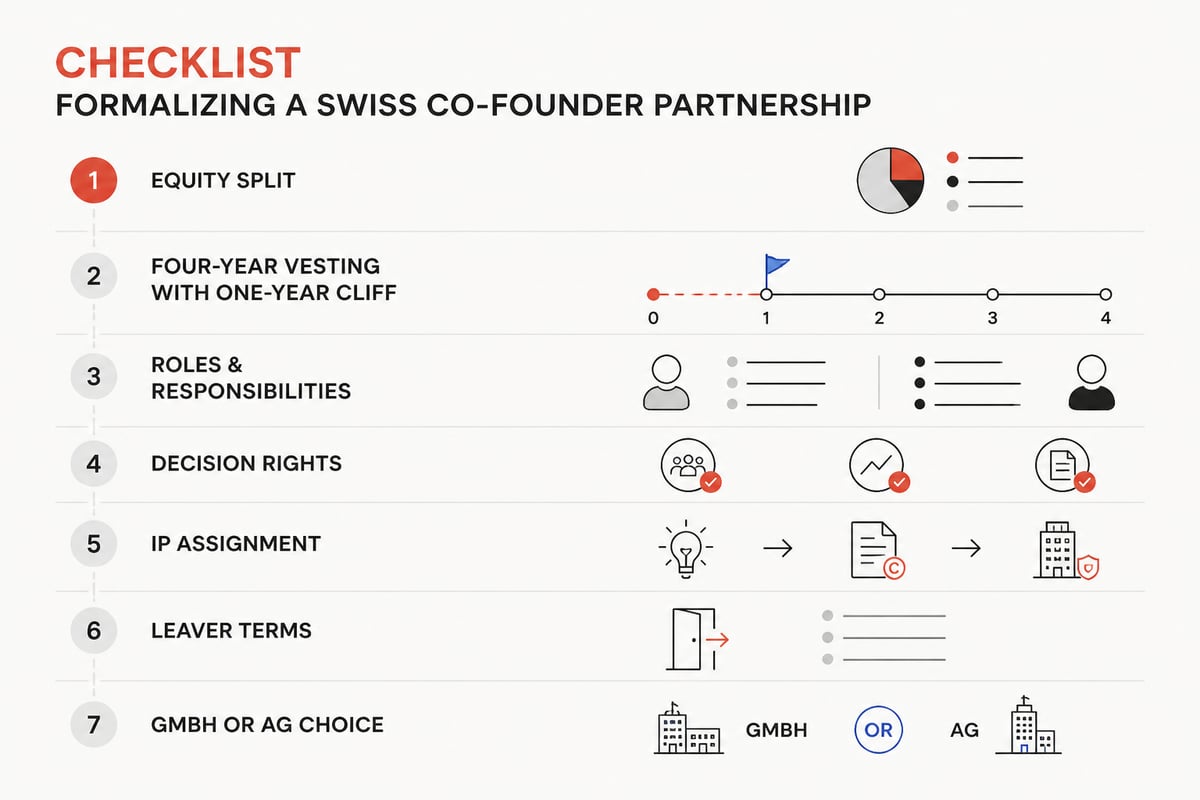
Formalizing a co-founder relationship means signing a written agreement that covers equity, roles, vesting, decision rights and exit terms, and doing it before the company takes on investors or customers. Verbal understandings tend to break precisely when a company becomes valuable.
What a Co-Founders Agreement Should Cover
- Equity split and vesting. A four-year vesting schedule with a one-year cliff is common, and it protects the company if a founder leaves early.
- Roles and responsibilities. Define who owns product, sales, finance and hiring decisions.
- Decision-making. Specify which decisions require unanimous consent and how deadlocks are resolved.
- Intellectual property. Confirm that all work related to the business is assigned to the company.
- Leaver provisions. Set out what happens to shares if a founder departs voluntarily or is removed.
- Time commitment. State whether each founder works full time and what outside activities are allowed.
Swisspreneur offers 150+ minutes of free masterclass content for startups.
Choosing GmbH or AG
Most Swiss startups incorporate as a GmbH or an AG, and more than 60% of new Swiss company formations in 2025 were structured as limited liability companies, according to Startups.ch data. A GmbH is quicker and cheaper to set up. An AG offers more flexibility for issuing shares to investors. Your choice affects how easily you can bring on a syndicate or angel investors later, so discuss it with a lawyer before you sign.
Common Mistakes When Choosing a Co-Founder
The most frequent mistakes are choosing a friend over a fit, splitting equity equally by default, skipping the trial period and ignoring misaligned expectations about commitment. Each of these is avoidable with an honest conversation at the start.
| Mistake | Why it hurts | Better approach |
|---|---|---|
| Picking someone with the same skills | Gaps remain unfilled | Map skills to company needs first |
| Equal split without discussion | Resentment when contributions differ | Base split on role, risk and commitment |
| No vesting | A departed founder keeps a large stake | Use vesting with a cliff |
| Skipping a trial project | Problems surface after incorporation | Work together on real deliverables first |
| Vague roles | Duplicated or dropped responsibilities | Assign clear ownership areas |
Timing also matters. Investors in Switzerland look closely at cap tables, and a messy founder split can slow a round. Founders who resolve these questions early close faster. Through the Swisspreneur Syndicate, founders can move quickly on a round, but only when the team and legal structure are in order.

Building Momentum After You Find Your Partner
Once you have a co-founder, the priority is to build shared habits, validate the business with customers and create the track record that attracts mentors and investors. A partnership gains value through repeated, visible progress.
Start with weekly alignment meetings and a short written record of decisions. Agree on how you will give each other feedback, and revisit your roles every quarter. As the team grows, culture becomes a shared responsibility, and the Swisspreneur resource on building a culture in a Swiss startup offers a practical framework.
Peer learning keeps both of you sharp. The Swisspreneur podcast has 550+ episodes freely available, so you can hear how other Swiss founders handled hiring, fundraising and disagreements between partners. For teams that are growing beyond the earliest stage, the Swisspreneur Scaleup Circle offers an operator-led community with podcasts, curated events and selective capital access for Swiss scaleups.
How Founder Connect Fits Into Your Funding Journey
A founder connect pays off most when it leads into a funding plan, because investors back teams as much as products. Swiss angels and syndicates want to see a complete founding team, a clear agreement and early evidence of traction before they write a cheque.
Founders with a Swiss legal entity and some traction can use the Swisspreneur Syndicate to raise capital while keeping control over who joins the round. Founders decide which investors and founders join each deal. Over CHF 3M has been invested through the Syndicate, and the database holds 1,000+ investors.
For individual investors, the same structure offers a way to back early-stage Swiss startups with small tickets. Investors can start with small tickets per deal, which makes it practical to build a diversified portfolio of founding teams rather than concentrating on one.
Whether you are the founder or the investor, the principle is the same: strong teams form through trust, tested through real work and protected by clear agreements. Meeting the right people, in the right settings, early enough to matter, is the practical core of any founder connect effort in Switzerland.