

Start Up Startup: A Complete Guide for Swiss Founders
When you decide to start up startup ventures, you're embarking on one of the most challenging yet rewarding journeys in business. The Swiss startup ecosystem has matured significantly over the past decade, creating unprecedented opportunities for founders who understand the fundamentals of building scalable companies. Whether you're developing a tech platform, creating innovative hardware, or launching a service business, the principles of starting and growing a successful startup remain consistent. Understanding these fundamentals can mean the difference between joining the ranks of successful Swiss unicorns and becoming another cautionary tale.
Understanding What Makes a Startup Different
A startup isn't just a new business. It's a company designed to grow fast and scale rapidly. While the terminology debate between "startup" and "start-up" continues, the business model remains distinct from traditional small businesses.
Traditional businesses often focus on:
- Steady, predictable growth
- Local or regional markets
- Proven business models
- Self-funding or traditional loans
Startups typically emphasize:
- Exponential growth potential
- Global or large addressable markets
- Innovation and disruption
- Venture capital and investor funding
The fundamental difference lies in scalability. A restaurant can be a successful business, but it's not a startup unless it has a model to scale to hundreds of locations rapidly. A software platform serving thousands of users with minimal additional costs? That's startup territory.
The Swiss Startup Advantage
Switzerland offers unique benefits for those looking to start up startup companies. The country's stable political environment, strong intellectual property protection, and access to capital create fertile ground for innovation.
Swiss startups benefit from world-class universities producing top talent, a multilingual workforce that facilitates international expansion, and proximity to major European markets. The Swisspreneur platform has become instrumental in connecting founders with these resources and opportunities.

Planning Your Startup Journey
Before you start up startup operations, thorough planning separates successful founders from those who struggle. This planning phase requires honest assessment and strategic thinking.
Validating Your Idea
The biggest mistake founders make is building something nobody wants. Industry experts consistently warn against creating technology without addressing real problems.
Validation steps include:
- Identify a genuine pain point that affects a specific group of people
- Talk to potential customers before writing a single line of code
- Test assumptions with minimal viable products or prototypes
- Analyze market size to ensure sufficient growth potential
- Study competitors to understand the existing landscape
A structured approach to building products people want to buy can save months of wasted effort and capital.
Assembling the Right Team
You cannot start up startup ventures alone. The founding team often determines success more than the initial idea itself.
| Team Element | Why It Matters | Common Mistakes |
|---|---|---|
| Complementary skills | Covers technical, business, and domain expertise | Hiring friends without needed skills |
| Shared vision | Ensures alignment during difficult times | Assuming everyone wants the same outcome |
| Clear roles | Prevents conflicts and overlaps | Leaving responsibilities undefined |
| Legal agreements | Protects all parties and the company | Delaying formal founders agreements |
Swiss founders should formalize relationships early. Verbal agreements among friends quickly become problematic when the company gains value or faces challenges.
Funding Your Startup
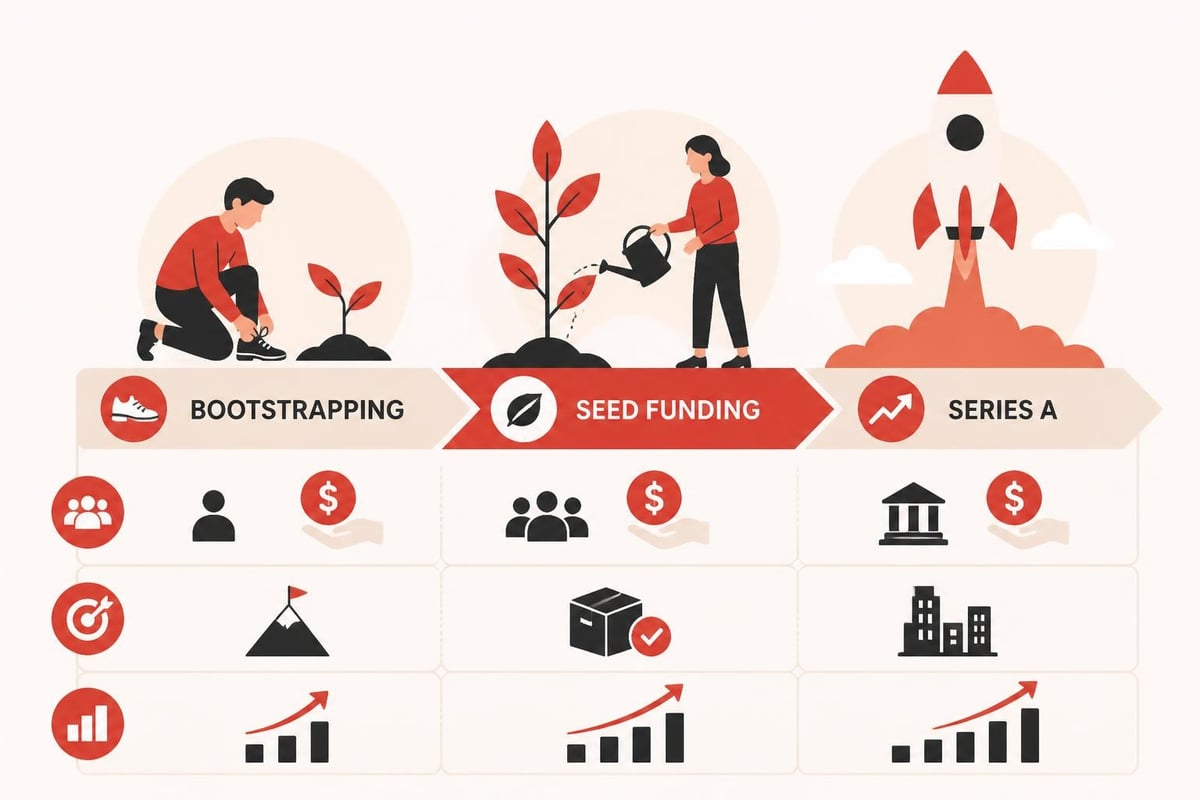
Understanding how startups obtain funding is crucial when you start up startup companies. Different funding stages align with different growth phases.
Bootstrapping and Early Funding
Many Swiss startups begin with personal savings, support from friends and family, or revenue from early customers. This approach offers maximum control but limited resources.
Bootstrapping advantages:
- Full ownership and decision-making authority
- Customer focus from day one to generate revenue
- Lean operations that build disciplined execution
Bootstrapping challenges:
- Slower growth compared to funded competitors
- Personal financial risk for founders
- Limited runway before needing external capital
Seed and Series A Funding
As your startup demonstrates traction, venture capital becomes accessible. The Swisspreneur syndicate provides Swiss startups with access to experienced investors who understand the local ecosystem.
Seed funding typically supports:
- Product development and iteration
- Initial market testing
- Small team expansion
- Customer acquisition experiments
Series A funding enables:
- Scaling proven business models
- Significant team growth
- Market expansion
- Infrastructure development
Preparing for these funding rounds requires understanding investor expectations, creating compelling pitch materials, and demonstrating clear metrics. Attending pitch competitions helps founders refine their presentations and meet potential investors.
Building Your Product and Business Model
When you start up startup operations, the product development approach differs dramatically from traditional business launches. Speed and iteration replace perfection and planning.
Minimum Viable Product Strategy
The MVP philosophy centers on launching quickly with just enough features to satisfy early customers and gather feedback.
Your MVP should:
- Solve one core problem exceptionally well
- Reach market quickly to test assumptions
- Enable learning from real user behavior
- Conserve resources for future iterations
Your MVP should not:
- Include every planned feature
- Require perfect polish or design
- Take more than three months to launch
- Address multiple customer segments simultaneously
Iterating Based on Feedback
Research on software engineering practices in startups reveals that successful companies maintain tight feedback loops with users throughout development.
Effective iteration processes include:
| Stage | Activity | Key Metrics |
|---|---|---|
| Build | Create features based on hypothesis | Development velocity, feature completion |
| Measure | Track user behavior and outcomes | User engagement, conversion rates, retention |
| Learn | Analyze data and gather qualitative feedback | Customer satisfaction, problem-solution fit |
| Decide | Determine next iteration or pivot | ROI on features, strategic alignment |
This cycle repeats continuously, with each iteration bringing the product closer to market fit.
Navigating Common Startup Challenges
Every founder faces obstacles when they start up startup companies. Understanding these challenges helps you prepare and respond effectively.
Market Timing and Competition
Entering the market too early means educating customers who aren't ready. Entering too late means fighting established competitors with more resources.
Timing considerations:
- Is the technology ready and affordable?
- Do regulatory frameworks support your solution?
- Have customer behaviors shifted to create demand?
- Can you differentiate from existing solutions?
Resource Constraints
Startups always have too much to do and too few resources. Research on startup challenges shows that successful founders master prioritization and focus.
Resource management strategies:
- Focus on activities that directly impact revenue or learning
- Automate or eliminate low-value tasks
- Build strategic partnerships instead of hiring
- Use tools designed for entrepreneurs to maximize efficiency
Scaling Operations
Growth creates new problems. Systems that worked for 10 customers fail at 100. Processes supporting 5 team members break with 50.
Plan for scaling by:
- Documenting processes before they become critical bottlenecks
- Building systems that handle 10x your current volume
- Investing in infrastructure before you absolutely need it
- Developing leaders within your team to manage growth
Legal and Administrative Foundations
The legal structure you choose when you start up startup ventures has lasting implications for taxes, liability, and fundraising.
Choosing the Right Legal Structure
Swiss startups typically choose between GmbH (LLC) and AG (Corporation) structures. For venture-backed companies planning to raise significant capital, the AG structure offers advantages:
- Share classes for different investor types
- Stock option programs for employee incentives
- International recognition by investors
- Scalable governance as the company grows
Understanding company launching requirements in Switzerland prevents costly mistakes and delays.
Protecting Intellectual Property
Your IP often represents your most valuable asset. Swiss founders benefit from strong IP protection, but you must take proactive steps:
- File patents for novel inventions before public disclosure
- Register trademarks for your brand and products
- Secure copyrights for creative works and software
- Use NDAs when discussing confidential information
- Implement trade secret protections for proprietary processes

Building Community and Networks
When you start up startup businesses in Switzerland, your network becomes one of your most valuable assets. The Swiss entrepreneurial community offers unique support systems.
Leveraging Entrepreneurial Communities
Connecting with other founders provides emotional support, practical advice, and business opportunities. Entrepreneur groups create spaces for sharing challenges and solutions.
Network benefits include:
- Learning from others' mistakes and successes
- Finding potential co-founders or early employees
- Discovering partnership opportunities
- Accessing warm introductions to investors
- Staying motivated during difficult periods
Learning from Swiss Success Stories
Switzerland has produced remarkable startup successes across industries. Studying these entrepreneur success stories reveals patterns and strategies applicable to your venture.
The Swisspreneur podcast features candid conversations with founders who've navigated the journey from idea to successful company, sharing insights rarely discussed publicly.
Marketing and Customer Acquisition
Building a great product means nothing without customers. When you start up startup ventures, customer acquisition strategy determines survival.
Finding Your First Customers
Your initial customers rarely come from broad marketing campaigns. They come from:
- Personal networks and direct outreach
- Industry events and conferences
- Online communities where your target customers gather
- Content marketing that demonstrates expertise
- Strategic partnerships with complementary businesses
Early customer acquisition should prioritize learning over volume. Ten deeply engaged customers who provide detailed feedback matter more than a hundred disengaged users.
Scaling Marketing Efforts
As you validate product-market fit, systematic marketing becomes essential. Different channels work for different business models:
| Channel | Best For | Key Metrics |
|---|---|---|
| Content marketing | B2B SaaS, complex products | Organic traffic, lead quality |
| Paid advertising | Consumer products, high LTV | CAC, ROAS, conversion rates |
| Partnership marketing | B2B services, platforms | Partner-sourced revenue |
| Community building | Developer tools, platforms | Community size, engagement |
Measuring Success and Pivoting
When you start up startup companies, metrics guide decisions. Choose the right metrics and track them religiously.
Key Performance Indicators
Focus on metrics that truly indicate business health:
For product-led growth:
- Active users (daily, weekly, monthly)
- User retention curves
- Feature adoption rates
- Net Promoter Score
For sales-led growth:
- Monthly Recurring Revenue (MRR)
- Customer Acquisition Cost (CAC)
- Customer Lifetime Value (LTV)
- Sales cycle length
For marketplace businesses:
- Gross Merchandise Value (GMV)
- Take rate
- Seller and buyer retention
- Transaction frequency
Knowing When to Pivot
Not every startup idea succeeds as originally conceived. Research on startup development practices shows that flexibility and adaptation characterize successful companies.
Pivot signals include:
- Consistently missing growth targets despite execution
- Strong engagement with unexpected use cases
- Market conditions fundamentally changing
- Technology enabling new approaches to the problem
Pivots require courage and clear thinking. Maintain focus on solving real problems while remaining flexible about the solution.
Maintaining Founder Health
The startup journey tests mental and physical resilience. When you start up startup businesses, personal sustainability ensures long-term success.
Managing Stress and Burnout
Founder burnout damages both individuals and companies. Sustainable practices include:
- Setting boundaries between work and personal life
- Maintaining physical health through exercise and sleep
- Building support systems with other founders and mentors
- Celebrating small wins rather than only focusing on distant goals
- Delegating effectively as the team grows
Continuous Learning
The startup landscape evolves rapidly. Successful founders commit to ongoing education through founder events, masterclasses, and peer learning.
Attending specialized workshops on topics like fundraising strategies accelerates learning beyond trial and error alone.
The Swiss Startup Ecosystem in 2026
Switzerland's position as a startup hub continues strengthening. Government support programs, corporate innovation partnerships, and growing venture capital availability create momentum.
Key ecosystem trends:
- Increased focus on deep tech and hard science startups
- Growing connections between Swiss and European startup hubs
- More corporate venture capital from Swiss multinationals
- Expansion of accelerator and incubator programs
- Stronger bridges between academic research and commercialization
Swiss startups increasingly compete globally while leveraging Switzerland's unique advantages. The combination of technical talent, stable infrastructure, and international orientation positions Swiss founders for success.
Starting and growing a startup requires preparation, resilience, and connection to resources that accelerate your journey. The path from initial idea to successful company involves countless decisions, each building on previous lessons learned. Swisspreneur supports Swiss founders throughout this journey with candid podcast insights, practical masterclasses, valuable networking events, and investment opportunities designed specifically for the Swiss startup ecosystem. Whether you're just beginning to explore your startup idea or scaling an established venture, connecting with Switzerland's entrepreneurial community provides the support and resources every founder needs.