

Largest Companies in Switzerland: 2026 Market Leaders
Switzerland has long been recognized as a global business powerhouse, punching well above its weight despite its modest geographic size. The country's economic stability, favorable tax policies, and world-class infrastructure have attracted some of the world's most valuable corporations. Understanding the landscape of the largest companies in Switzerland provides crucial insights for entrepreneurs looking to identify partnership opportunities, benchmark their growth, or understand the competitive ecosystem they're entering. These corporate giants not only dominate their respective sectors but also create ripple effects throughout the Swiss startup ecosystem, offering potential collaboration paths, acquisition opportunities, and talent pipelines.
The Pharmaceutical and Healthcare Giants Leading Switzerland's Economy
Switzerland's pharmaceutical sector represents the backbone of the country's corporate landscape. Roche Holding AG and Novartis AG consistently rank among the largest companies in Switzerland by market capitalization, with valuations exceeding hundreds of billions of Swiss francs. These Basel-based pharmaceutical titans have established Switzerland as a global healthcare innovation hub.
Roche, founded in 1896, maintains its position as Switzerland's most valuable company with a market cap that fluctuates between CHF 240-280 billion depending on market conditions. The company's focus on personalized medicine, diagnostics, and oncology treatments has driven consistent growth even through economic uncertainties.
Why Pharmaceutical Dominance Matters for Startups
The presence of these pharmaceutical giants creates significant opportunities for entrepreneurs in the biotech and healthtech sectors:
- Collaboration opportunities through corporate venture programs and partnership initiatives
- Talent acquisition from experienced professionals seeking startup challenges
- Validation pathways for innovative healthcare solutions
- Exit strategies through potential acquisitions of promising startups
Novartis, with its market capitalization hovering around CHF 180-210 billion, has increasingly focused on digital health initiatives and precision medicine. For entrepreneurs exploring ways to start a business in healthcare, understanding these companies' strategic priorities can reveal white space opportunities.

Financial Services and Banking Powerhouses
The banking sector represents another pillar of the largest companies in Switzerland. UBS Group AG, following its acquisition of Credit Suisse in 2023, has become an even more dominant force in Swiss finance. The merger created a financial services behemoth with assets exceeding CHF 1.6 trillion, fundamentally reshaping Switzerland's banking landscape.
| Company | Market Cap (CHF Billions) | Primary Business | Headquarters |
|---|---|---|---|
| UBS Group | 75-95 | Wealth Management | Zurich |
| Zurich Insurance | 65-75 | Insurance Services | Zurich |
| Swiss Re | 35-45 | Reinsurance | Zurich |
Zurich Insurance Group and Swiss Re round out the financial services sector among Switzerland's corporate elite. These institutions don't just provide traditional banking and insurance services. They've become increasingly active in fintech investments and digital transformation initiatives.
Fintech Opportunities in Switzerland's Financial Capital
For entrepreneurs in the financial technology space, Switzerland's established financial institutions present both challenges and opportunities. These corporations have recognized the need to innovate or risk disruption, leading to:
- Corporate venture funds actively seeking fintech partnerships
- Regulatory sandboxes supported by major banks for testing new solutions
- Open banking initiatives creating data access for innovative services
- Blockchain and crypto exploration, particularly in Zug's Crypto Valley
Many entrepreneur groups in Switzerland focus specifically on fintech networking, connecting startup founders with decision-makers at these financial giants.
Consumer Goods and Food Industry Leaders
Nestlé SA, headquartered in Vevey, stands as the world's largest food and beverage company and consistently ranks among the top Swiss-listed companies by market capitalization. With a market cap typically ranging between CHF 260-320 billion, Nestlé's global reach extends to virtually every country on Earth.
The company's portfolio spans infant nutrition, bottled water, coffee, pet care, and frozen foods. Beyond its traditional consumer packaged goods business, Nestlé has aggressively invested in health sciences, digital nutrition, and direct-to-consumer channels.
Food Innovation and Startup Ecosystem
Nestlé's presence influences Switzerland's food innovation ecosystem significantly. The company operates multiple innovation hubs and accelerator programs:
- Henri Nestlé Hub in Switzerland focusing on early-stage food tech ventures
- Plant-based alternatives research and partnership programs
- Personalized nutrition platforms leveraging AI and data analytics
- Sustainable packaging initiatives creating opportunities for materials science startups
For entrepreneurs developing solutions in food technology, sustainability, or consumer health, understanding the success stories of entrepreneurs who've partnered with or exited to Nestlé provides valuable strategic insights.

Technology and Industrial Sector Representatives
While Switzerland isn't primarily known for tech giants like Silicon Valley, several technology and industrial companies feature prominently among the largest companies in Switzerland. ABB Ltd, the robotics and automation specialist, maintains a market cap of approximately CHF 50-70 billion, making it one of Switzerland's most valuable industrial companies.
Logitech International, though smaller than pharmaceutical or banking giants, represents Switzerland's pure-play technology sector success story. The peripherals manufacturer has evolved from computer mice to gaming, streaming equipment, and video conferencing solutions, with market capitalization around CHF 10-15 billion.
According to research on Switzerland's largest companies, the technology sector continues growing its representation among top Swiss corporations, particularly as digitalization accelerates across all industries.
Industrial Tech and Deep Tech Opportunities
Switzerland's strength in precision manufacturing, robotics, and industrial automation creates unique opportunities for deep tech entrepreneurs:
- Industrial IoT solutions for connected manufacturing
- AI-powered quality control systems
- Robotics process automation for various industries
- Cleantech and energy efficiency technologies
The country's reputation for engineering excellence and the presence of institutions like ETH Zurich create a fertile environment for entrepreneurs following their journey in these technical fields.
Luxury Goods and Watch Industry Icons
Switzerland's luxury goods sector, particularly watchmaking, contributes significantly to the nation's economic profile. Richemont, the luxury goods holding company owning brands like Cartier, Van Cleef & Arpels, and Jaeger-LeCoultre, represents the largest publicly traded luxury group among the largest companies in Switzerland, with market cap ranging between CHF 70-90 billion.
The Swatch Group, another major player, encompasses brands from Omega to Longines, though it trades at a smaller market capitalization of approximately CHF 10-15 billion. These companies don't just manufacture timepieces. They represent centuries of Swiss craftsmanship, brand building, and global distribution expertise.
Luxury Sector Lessons for Modern Entrepreneurs
The Swiss luxury goods industry offers valuable lessons for entrepreneurs across sectors:
- Brand heritage and storytelling create defensible market positions
- Vertical integration maintains quality control and margins
- Limited production generates desirability and premium pricing
- Digital transformation balances tradition with modern retail expectations
Many successful Swiss entrepreneurs have applied luxury sector principles to other industries, creating premium positioning in crowded markets. Tools for entrepreneurs increasingly include brand positioning frameworks derived from luxury goods strategies.
Regional Concentration and Corporate Infrastructure
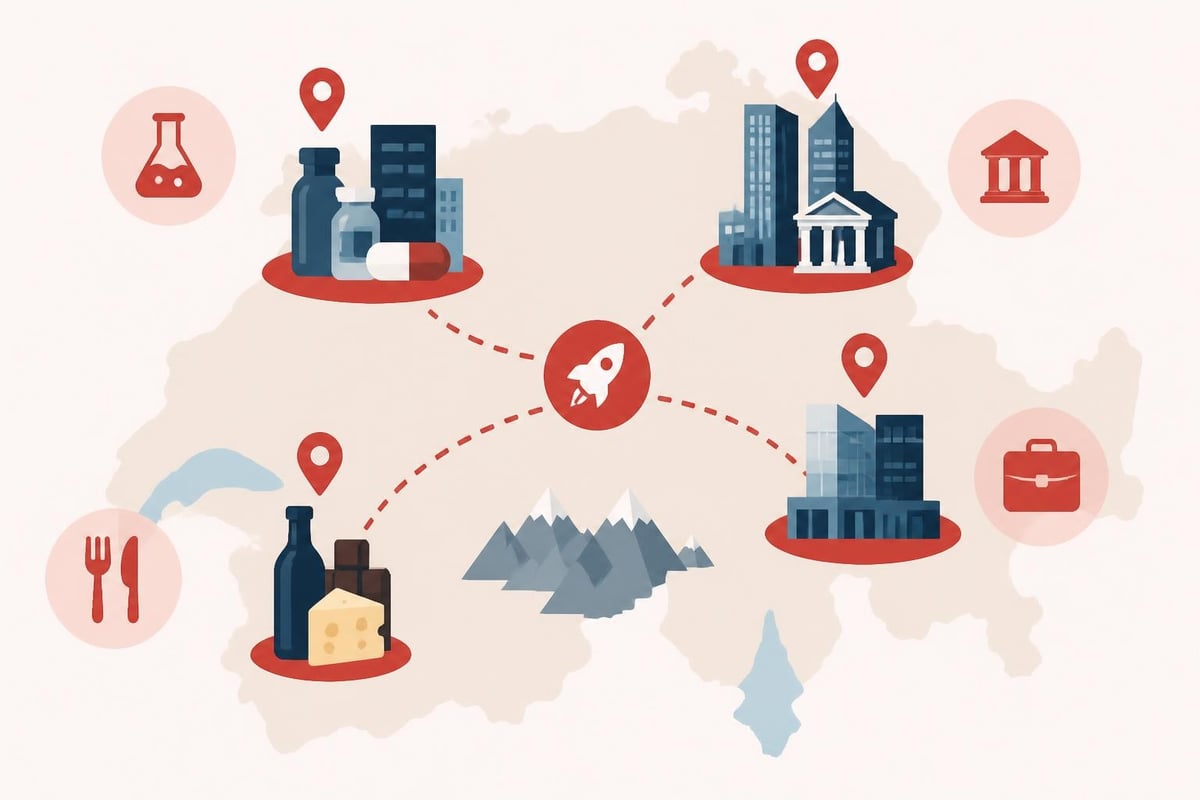
The geographical distribution of the largest companies in Switzerland reveals interesting patterns. Zurich dominates as the financial capital, hosting UBS, Zurich Insurance, and numerous financial services firms. Basel serves as the pharmaceutical hub with Roche and Novartis. Meanwhile, Zug has emerged as a corporate favorite for tax efficiency and blockchain innovation.
According to analysis of Swiss company formations, the canton of Zug hosts numerous corporate headquarters despite its small size, thanks to favorable tax policies and business-friendly regulations. This concentration creates ecosystem effects that benefit startups in these regions.
| Region | Primary Industries | Major Companies | Startup Advantages |
|---|---|---|---|
| Zurich | Finance, Insurance | UBS, Zurich Insurance | Capital access, talent pool |
| Basel | Pharmaceuticals | Roche, Novartis | R&D partnerships, biotech expertise |
| Zug | Corporate HQ, Crypto | Glencore, Crypto firms | Tax efficiency, blockchain ecosystem |
| Vevey | Food & Beverage | Nestlé | Food innovation, consumer insights |
For entrepreneurs selecting where to establish their business, understanding these regional strengths proves crucial. The presence of major corporations influences everything from available talent to investor networks to potential partnership opportunities.
Market Capitalization Versus Revenue Leaders
An important distinction exists between the largest companies in Switzerland by market capitalization and those ranking by revenue. While pharmaceutical companies dominate market cap rankings due to their growth potential and intellectual property value, trading companies like Glencore and Vitol generate enormous revenues with lower market valuations.
Switzerland's largest companies by revenue for 2024/2025 show Glencore, the commodities trading and mining giant, generating revenues exceeding CHF 220 billion annually. Despite this massive revenue figure, Glencore's market capitalization sits around CHF 50-60 billion, reflecting the capital-intensive, lower-margin nature of commodities trading.
Understanding Valuation Differences
This discrepancy teaches entrepreneurs important lessons about business model selection:
- High-margin recurring revenue businesses command premium valuations
- Asset-heavy operations generate large revenues but lower valuations
- Intellectual property and patents create defensible value
- Growth potential matters more than current revenue for tech startups
When developing entrepreneurial models, founders should consider which metrics investors will prioritize in their sector.
Corporate Venture Capital and Startup Acquisition Activity
The largest companies in Switzerland have become increasingly active in the startup ecosystem through corporate venture capital arms and acquisition strategies. This trend accelerated after 2020 as digital transformation became imperative across all sectors.
Novartis operates Novartis Venture Fund, one of the most active healthcare investors globally. Roche has made strategic acquisitions of promising biotech firms, often paying premium valuations for innovative treatment platforms. Nestlé acquired personalized nutrition startup Persona Nutrition and invested in various food tech ventures through its corporate venture arm.
Strategic Benefits for Startups
Working with corporate venture capital from major Swiss companies offers distinct advantages:
- Strategic resources beyond capital, including distribution, manufacturing, and regulatory expertise
- Validation from respected corporate partners enhancing credibility
- Market access to existing customer bases and channels
- Technical expertise and research facilities for product development
However, entrepreneurs should carefully consider potential downsides, including loss of independence and restricted exit options. Resources like founders agreements become even more critical when negotiating with corporate investors.
International Competitiveness and Global Reach
Switzerland's largest companies maintain remarkable global competitiveness despite the country's high cost structure. They've achieved this through focus on innovation, quality, and specialized niches where Swiss expertise commands premium pricing.
The SIX Swiss Exchange rankings as of August 2026 show these companies continuing to outperform many international peers. This success stems from several factors:
- R&D investment consistently exceeding 5-7% of revenue for pharmaceutical leaders
- Global talent attraction through competitive compensation and quality of life
- Political stability and predictable regulatory environment
- Strong intellectual property protection and enforcement
For Swiss entrepreneurs, this creates both opportunities and challenges. The high bar set by established companies means startups must compete globally from day one rather than relying on local market protection.
Emerging Challengers and Future Landscape
While traditional sectors dominate the current landscape of the largest companies in Switzerland, new challengers are emerging. The fintech sector, particularly cryptocurrency and blockchain companies in Crypto Valley, represents potential future leaders.
Companies like Ethereum (though not incorporated as a traditional company) have their foundation roots in Zug. Traditional companies are also transforming. Recent news about Infosys expanding its Swiss footprint with a new Zurich office demonstrates how international tech giants view Switzerland as an increasingly important innovation hub.
Sectors to Watch
Several sectors show potential for producing Switzerland's next corporate giants:
- Biotech and precision medicine leveraging Switzerland's pharmaceutical expertise
- Cleantech and renewable energy addressing sustainability challenges
- Fintech and blockchain building on Zurich and Zug's financial infrastructure
- AI and machine learning applications across multiple industries
- Quantum computing with support from academic institutions
Entrepreneurs exploring these sectors can find valuable insights through platforms like Swisspreneur's podcast interviews with founders building in these emerging areas.
Networking and Professional Connection Strategies
For entrepreneurs looking to connect with decision-makers at the largest companies in Switzerland, strategic networking proves essential. Traditional business cards are giving way to more sophisticated solutions. Modern tools like digital business cards from Spreadly enable entrepreneurs to share comprehensive professional information instantly through QR codes, NFC technology, or simple links, making it easier to connect at corporate events, conferences, or chance encounters.
These digital solutions offer particular advantages when networking with corporate executives:
- Always current contact information that updates automatically across all shared instances
- Rich media capabilities including pitch decks, product demos, and company videos
- Lead capture functionality to gather contact details from interested corporate partners
- Professional branding that reflects startup sophistication and innovation
Building relationships with corporate development teams, innovation managers, and venture arms requires consistent engagement through industry events, targeted outreach, and demonstrated value creation.
Legal Structures and Corporate Governance
Understanding how the largest companies in Switzerland are structured provides insights for entrepreneurs planning their own corporate formation. Most major Swiss corporations operate as Aktiengesellschaft (AG), the Swiss equivalent of a corporation or public limited company.
This structure offers several advantages that have made it the preferred choice for companies planning significant growth:
- Limited liability protecting shareholders from company debts
- Capital raising flexibility through share issuance
- International recognition facilitating cross-border operations
- Governance clarity through established board and shareholder structures
For startups with global ambitions, establishing as an AG from the beginning can facilitate future partnerships with major corporations and cross-border expansion. Resources on good service businesses to start often emphasize the importance of appropriate legal structure selection.
Talent Pipelines and Employment Ecosystems
The largest companies in Switzerland collectively employ hundreds of thousands of people, creating vast talent networks that feed the startup ecosystem. Professionals who've worked at Roche, Nestlé, UBS, or Novartis bring invaluable corporate experience, industry connections, and functional expertise when they transition to startups.
This talent flow operates in both directions. Startups increasingly attract corporate professionals seeking more entrepreneurial environments, while major corporations recruit startup veterans who bring innovation mindsets and agility.
Key talent considerations for startups:
- Compensation expectations may be higher for ex-corporate employees
- Corporate methodologies can improve startup operational discipline
- Network access to potential partners and customers
- Cultural integration requires attention when mixing corporate and startup backgrounds
Finding the right co-founder and founder balance often means combining startup experience with corporate domain expertise.
Supply Chain and Partnership Ecosystems
The largest companies in Switzerland create extensive supply chain networks that present opportunities for B2B startups. A pharmaceutical company might source specialized equipment, software solutions, laboratory services, and logistics support from hundreds of vendors.
Becoming a supplier to major corporations requires meeting stringent quality standards, compliance requirements, and often lengthy evaluation processes. However, the rewards include:
- Recurring revenue through long-term contracts
- Reference value for selling to other enterprise clients
- Product feedback from sophisticated users
- Scale opportunities as corporate needs grow
For startups in manufacturing or industrial sectors, penetrating these supply chains can provide stable foundation for growth.
Sustainability and ESG Leadership
Switzerland's largest companies have increasingly prioritized environmental, social, and governance (ESG) initiatives, creating opportunities for sustainability-focused startups. Nestlé has committed to net-zero emissions by 2050. Roche has implemented comprehensive water conservation programs. UBS has redirected billions toward sustainable investment products.
These commitments translate into procurement preferences, investment priorities, and partnership opportunities for startups offering solutions in:
- Carbon reduction technologies and services
- Circular economy platforms and materials
- Supply chain transparency and traceability systems
- Renewable energy integration and optimization
Entrepreneurs positioning their ventures around sustainability themes can access both corporate partnerships and dedicated ESG investment funds increasingly common among major Swiss corporations.
Understanding the landscape of Switzerland's largest companies provides entrepreneurs with crucial context for building successful ventures in one of the world's most competitive business environments. These corporate giants shape everything from talent availability to partnership opportunities to potential exit strategies. Whether you're developing a B2B solution targeting pharmaceutical companies, building a fintech platform for banking innovation, or creating consumer products for potential acquisition by companies like Nestlé, studying these market leaders reveals patterns and opportunities. Swisspreneur connects founders with the resources, networks, and insights needed to navigate Switzerland's unique entrepreneurial landscape, offering masterclasses, podcast conversations with successful founders, and investment opportunities to help your startup thrive alongside these corporate titans.