

Company Switzerland: Complete 2026 Formation Guide
Switzerland continues to rank among the world's most attractive jurisdictions for entrepreneurs looking to establish and scale their ventures. With its stable political environment, robust infrastructure, and favorable business climate, forming a company switzerland has become a strategic choice for founders across Europe and beyond. The country's reputation for innovation, combined with streamlined registration processes and competitive tax frameworks, creates an ecosystem where startups can thrive. Understanding the nuances of Swiss company formation in 2026 requires navigating legal requirements, making informed structural decisions, and positioning your venture for long-term success in one of the world's most competitive markets.
Understanding Swiss Company Structures
When establishing a company switzerland, entrepreneurs face several structural options, each with distinct advantages and requirements. The choice between a limited liability company (GmbH/Sàrl) and a corporation (AG/SA) fundamentally shapes your venture's legal framework, capital requirements, and operational flexibility.
The limited company (SA) structure remains the preferred choice for growth-oriented startups seeking external investment. This corporate form requires minimum share capital of CHF 100,000, with at least CHF 50,000 paid in at formation. The AG/SA structure offers:
- Complete separation between personal and corporate liability
- Transferable shares that facilitate investor entry and exit
- Professional credibility with institutional partners and clients
- Flexible governance structures supporting board composition
- Scalability for international expansion and multi-stakeholder arrangements
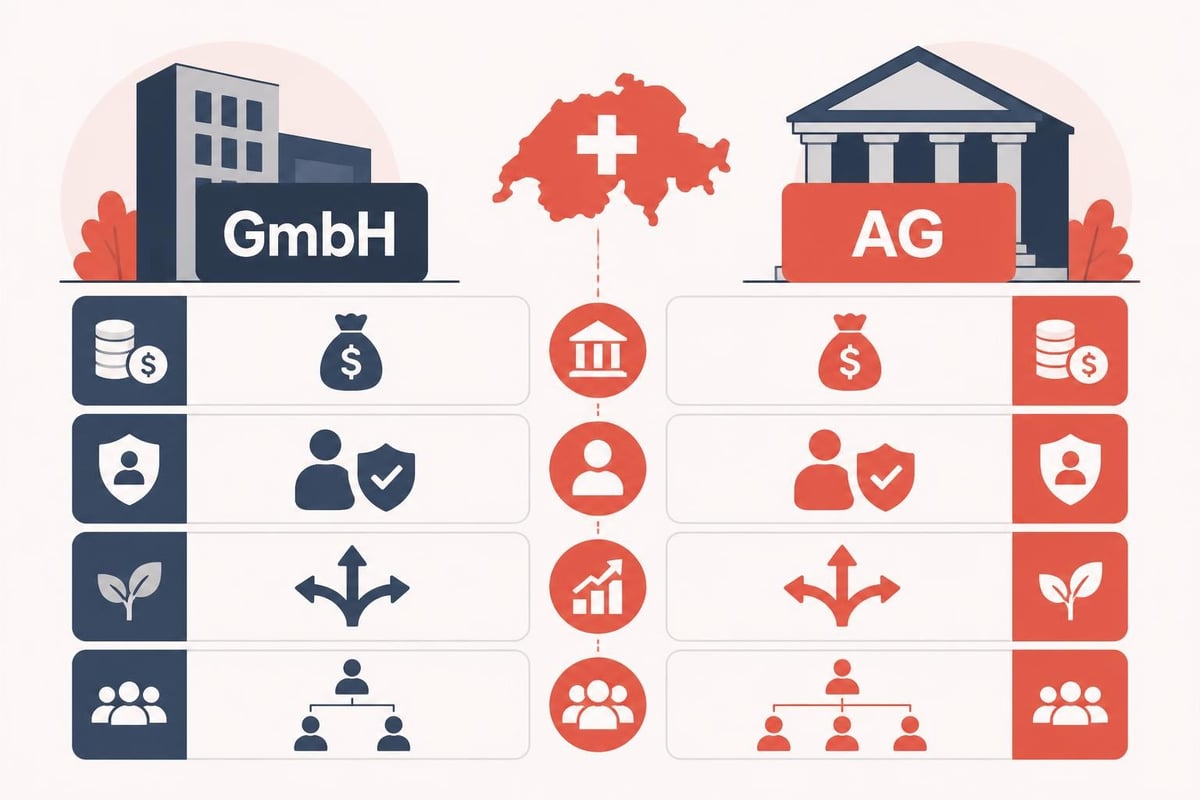
The GmbH/Sàrl alternative requires only CHF 20,000 in share capital, making it accessible for bootstrapped ventures and small business owners. However, this structure typically proves less attractive to venture capitalists and institutional investors due to transfer restrictions and administrative complexity.
Capital and Ownership Considerations
Swiss company formation in 2026 demands careful planning around capitalization and ownership distribution. The share capital you establish at formation creates the foundation for future fundraising rounds and determines your flexibility in bringing on co-founders or investors.
Many founders initially contribute only the minimum required capital, preserving cash for operational expenses. This approach works well for early-stage ventures, but entrepreneurs should consider how subsequent capital increases will be structured as they grow their startup.
| Capital Strategy | Initial Investment | Flexibility | Best For |
|---|---|---|---|
| Minimum Capital | CHF 50,000 paid | High future dilution risk | Bootstrapped ventures |
| Standard Capital | CHF 100,000 paid | Balanced approach | VC-backed startups |
| Overcapitalized | >CHF 100,000 paid | Reduced future dilution | Well-funded teams |
Ownership allocation requires equally strategic thinking. Establishing clear equity splits among co-founders prevents future disputes and signals professionalism to investors. The founders agreement should address vesting schedules, exit scenarios, and decision-making authority before registration.
Legal Requirements and Documentation
Forming a company switzerland in 2026 involves meeting specific statutory requirements that have evolved under recent corporate law reforms. The articles of association serve as your company's constitutional document, and their contents are strictly regulated.
Under regulations effective since January 2023, the articles of association must include mandatory provisions covering corporate name, registered office, business purpose, share capital structure, and shareholder communication methods. These foundational elements cannot be omitted or substantially modified from statutory requirements.
Critical documentation for company formation includes:
- Notarized articles of association drafted in accordance with Swiss Code of Obligations
- Shareholder declarations confirming capital contributions and ownership percentages
- Board member appointments with documented acceptance of duties
- Proof of capital deposit from a recognized Swiss banking institution
- Beneficial ownership disclosure meeting transparency requirements
The notarization process requires all founding shareholders to appear before a Swiss notary public, either in person or through appointed representatives with authenticated powers of attorney. This step cannot be circumvented, though some cantons now offer streamlined digital processes that reduce time requirements.
Registration and Timeline
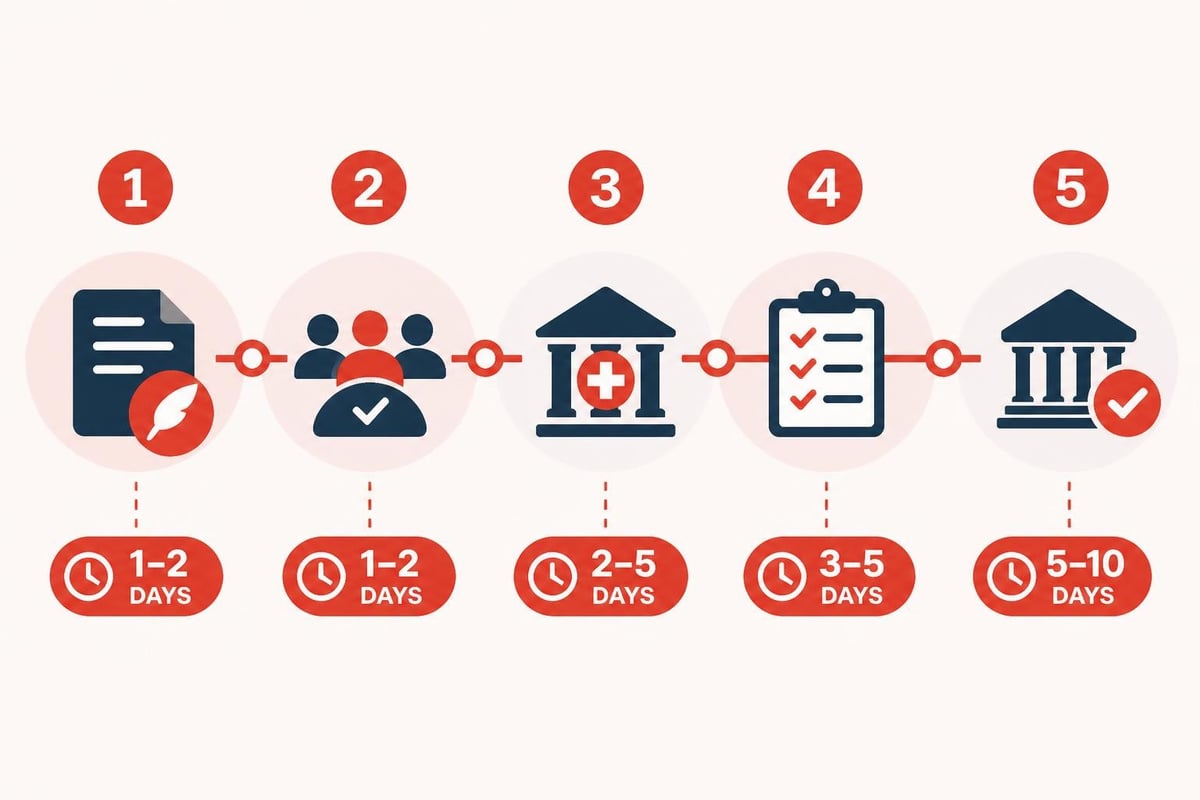
The commercial register entry finalizes your company switzerland formation, granting legal personality and enabling business operations. Canton-specific registration offices process applications, with timelines varying from same-day approval in efficient cantons to several weeks in others.
Most formations follow this sequence:
- Draft and finalize articles of association (1-2 weeks)
- Schedule notary appointment and execute documents (1 week)
- Deposit minimum share capital in escrow account (1-2 days)
- Submit commercial register application (1 day)
- Receive registration confirmation and UID number (1-3 weeks)
Entrepreneurs should anticipate 4-8 weeks total from initial planning to completed registration, though expedited processing is available in some jurisdictions for additional fees.
Tax Optimization and Cantonal Differences
Switzerland's federalist structure creates significant tax variations across its 26 cantons, making location selection a crucial strategic decision when forming a company switzerland. Corporate income tax rates combine federal, cantonal, and municipal components, resulting in effective rates ranging from approximately 11% to 21% depending on jurisdiction.
Recent analysis of cantonal tax burdens reveals competitive dynamics among regions seeking to attract entrepreneurial activity. Cantons like Zug, Lucerne, and Nidwalden maintain notably lower effective rates, while urban centers like Zurich and Geneva compensate with superior infrastructure and talent pools.
Top considerations for cantonal selection:
- Effective tax rate for profitable operations
- Talent availability in your industry
- Proximity to customers and partners
- Quality of life for team members
- Startup ecosystem maturity
Beyond corporate income tax, founders must account for value-added tax (VAT) registration requirements, which become mandatory once annual revenue exceeds CHF 100,000. Strategic VAT planning can provide cash flow advantages during early growth phases.
Holding Company Structures
Sophisticated entrepreneurs often establish holding company structures when forming multiple ventures or planning international expansion. A Swiss holding company switzerland benefits from participation exemptions that can eliminate taxation on qualifying dividend income and capital gains from subsidiary holdings.
This structure proves particularly valuable for portfolio entrepreneurs building multiple ventures simultaneously or founders planning eventual exits through strategic acquisitions. The holding company can consolidate ownership, simplify governance, and optimize group-level tax efficiency.
| Structure Type | Tax Treatment | Complexity | Ideal Use Case |
|---|---|---|---|
| Single Operating Entity | Standard corporate rate | Low | Single focused venture |
| Operational + Holding | Participation exemption | Medium | Multiple ventures |
| International Holding | Treaty benefits | High | Cross-border operations |
Compliance and Transparency Requirements
The regulatory landscape for a company switzerland has evolved significantly with new transparency measures taking effect in 2026. The revised Anti-Money Laundering Act and Transparency Act introduce enhanced beneficial ownership disclosure requirements, creating a federal register of economic beneficiaries for all Swiss legal entities.
Companies must now identify and register individuals who ultimately control 25% or more of voting rights or capital, or who exercise control through other means. This information flows to a centralized federal database accessible to competent authorities, marking a departure from Switzerland's historically private corporate ownership traditions.
Ongoing compliance obligations include:
- Annual financial statement preparation following Swiss GAAP standards
- Shareholder meeting documentation and minute-keeping
- Board meeting records demonstrating governance oversight
- Beneficial ownership register updates within specified timeframes
- Tax return filing at federal, cantonal, and municipal levels
- VAT reporting and remittance on prescribed schedules
These requirements demand systematic record-keeping and often justify engaging professional accounting and legal advisors familiar with Swiss corporate law. The cost of compliance should factor into your financial projections when planning to establish a company switzerland.
Corporate Governance Best Practices
Strong governance foundations distinguish professionally-managed startups from amateur operations. Even early-stage companies benefit from establishing board rhythms, documenting decisions, and maintaining clear accountability structures.
The board of directors carries legal responsibility for company oversight and strategic direction. Directors must act with care and loyalty, avoiding conflicts of interest and ensuring the company meets all statutory obligations. Swiss law holds board members personally liable for breaches of duty, creating strong incentives for diligent governance.
Many successful Swiss startups adopt governance practices including:
- Quarterly board meetings with documented agendas and resolutions
- Annual strategy reviews and budget approvals
- Defined authority levels for management versus board decisions
- Conflict of interest policies and disclosure procedures
- Regular legal and financial compliance reviews
These practices signal maturity to investors and partners while protecting founders from personal liability exposure.
Practical Formation Strategies
Experienced entrepreneurs approach company switzerland formation with strategies that balance speed, cost, and long-term flexibility. The formation process involves multiple professional service providers, each contributing specialized expertise.

Key service providers typically include:
- Corporate lawyer for articles drafting and structural advice
- Notary public for document authentication and commercial register filing
- Accountant for tax registration and bookkeeping setup
- Bank relationship manager for corporate account opening and capital deposit
- Registered address provider if operating virtually or internationally
Founders can significantly reduce formation costs by preparing thoroughly before engaging professionals. Clarifying ownership splits, business purpose, and governance preferences enables lawyers to draft documents efficiently rather than facilitating extended negotiation processes.
Cost Considerations
Total formation costs for a company switzerland typically range from CHF 3,000 to CHF 8,000 depending on complexity and professional fee structures. This investment breaks down across several components:
| Cost Category | Typical Range | Variables Affecting Cost |
|---|---|---|
| Notary fees | CHF 1,000 - 2,000 | Canton, share capital amount |
| Legal drafting | CHF 1,500 - 4,000 | Complexity, lawyer rates |
| Commercial register | CHF 600 - 800 | Canton-specific fees |
| Initial accounting | CHF 500 - 1,500 | Setup complexity |
| Banking setup | CHF 0 - 500 | Institution requirements |
These one-time costs should be viewed as investments in proper legal foundation rather than expenses to minimize. Cutting corners during formation often creates expensive complications during fundraising or exit processes.
International Competitiveness and Global Context
Switzerland's position as a leading entrepreneurial hub reflects decades of consistent policy supporting innovation and business formation. The country regularly ranks among the top jurisdictions globally for competitiveness, with particular strengths in government efficiency, business infrastructure, and economic performance according to international assessments.
The political stability and rule of law that characterize Switzerland create predictability for long-term business planning. When forming a company switzerland, entrepreneurs gain access to a jurisdiction with minimal corruption, efficient public services, and respect for property rights that stands out even among developed economies.
Switzerland's competitive advantages include:
- Highly skilled multilingual workforce across German, French, and Italian regions
- World-class research institutions and university partnerships
- Strategic location at the heart of Europe with excellent transport links
- Strong intellectual property protection and enforcement
- Dense network of bilateral tax treaties minimizing withholding taxes
- Stable currency and sophisticated financial services sector
These structural advantages explain why Switzerland attracts disproportionate venture capital investment relative to its population. The country's startup ecosystem has matured significantly over the past decade, with successful exits creating experienced founders and angel investors who recycle capital and expertise into new ventures.
Access to Capital and Resources
Founders establishing a company switzerland benefit from multiple funding pathways as their ventures mature. The ecosystem includes angel investors, family offices, venture capital firms, corporate venture arms, and government grant programs supporting innovation.
The Swisspreneur platform connects entrepreneurs with these resources through syndicate investment opportunities, enabling qualified founders to access capital from experienced investors who understand the Swiss market dynamics. This infrastructure reduces the friction traditionally associated with early-stage fundraising.
Beyond capital, the Swiss entrepreneurial community offers rich learning opportunities through regular events, masterclasses, and peer networks. Successful founders often emphasize that these relationships and knowledge-sharing channels provide value exceeding pure financial investment, particularly for first-time entrepreneurs navigating unfamiliar challenges.
Banking and Financial Infrastructure
Opening a corporate bank account represents a critical step when forming a company switzerland, as the deposited share capital must remain blocked until commercial register entry is completed. Swiss banks maintain rigorous know-your-customer requirements that sometimes surprise foreign founders accustomed to simpler processes.
Documentation typically required for corporate banking includes:
- Certified copy of commercial register entry (or confirmation of pending registration)
- Articles of association with notary authentication
- Board resolution authorizing account opening and designating signatories
- Personal identification for all beneficial owners and authorized signers
- Business plan explaining commercial activities and expected transaction volumes
- Source of funds documentation for share capital contributions
The account opening process can take 2-6 weeks depending on the institution and complexity of your ownership structure. Some cantonal banks and digital banking providers offer more streamlined processes than traditional institutions, though founders should verify that their chosen bank meets commercial register requirements for capital deposits.
Financial Planning and Runway
Successful company formation extends beyond legal registration to ensuring adequate financial resources for operations. Many founders underestimate the capital required to build sustainable ventures, focusing excessively on minimizing formation costs while neglecting operational runway.
Strategic financial planning addresses:
- Development timeline from formation to revenue generation
- Team expansion requirements and associated salary commitments
- Infrastructure costs including office, equipment, and software tools
- Marketing and customer acquisition investments needed for growth
- Professional services for ongoing legal, accounting, and advisory needs
- Buffer capital for unexpected challenges or opportunities
Experienced entrepreneurs typically recommend maintaining 12-18 months of operating expenses in accessible capital when launching a company switzerland, providing flexibility to pivot strategies or weather market disruptions without immediate fundraising pressure.
Sector-Specific Considerations
Different industries face varying regulatory requirements when forming a company switzerland, from financial services licensing to data protection compliance. Technology startups encounter relatively minimal sector-specific regulation compared to fintech, medtech, or other heavily regulated domains.
Founders in regulated sectors should engage specialized legal counsel early in the formation process to identify licensing requirements, compliance obligations, and timeline implications. Some activities require regulatory approval before commencing operations, extending the practical timeline from formation to revenue generation.
Industry-specific planning considerations:
- Fintech: FINMA licensing requirements for financial intermediaries
- Medtech: Swissmedic approvals for medical device registration
- Biotech: Laboratory certifications and biosafety protocols
- Food/beverage: Cantonal health authority registrations
- Professional services: Industry association memberships and qualifications
Technology companies building software products or digital services typically face simpler regulatory environments, though data protection compliance under Swiss data protection law requires systematic privacy-by-design approaches.
Intellectual Property Strategy
Protecting intellectual property should integrate with company switzerland formation planning, particularly for technology ventures where IP represents core value. Switzerland offers robust trademark, patent, and design protection through the Swiss Federal Institute of Intellectual Property, plus participation in international treaties simplifying cross-border protection.
Founders should consider:
- Registering trademarks for company and product names
- Filing patent applications for novel technical inventions
- Implementing trade secret protection for proprietary processes
- Securing employee invention assignment agreements
- Establishing IP ownership clarity in shareholders' agreements
These protective measures prove especially critical before fundraising, as investors conduct thorough IP due diligence and discount valuations when ownership questions exist.
Building for Scale from Formation
The most successful entrepreneurs approach company switzerland formation with scaling in mind, making structural decisions that accommodate future growth rather than optimizing for current simplicity. This forward-thinking perspective influences choices around share capital, governance, and operational infrastructure.
Share capital structure deserves particular attention, as the authorized share capital, conditional capital, and capital bands established at formation determine your flexibility for future equity issuances. Companies anticipating multiple fundraising rounds benefit from authorizing larger share capital than immediately issued, enabling board-level decisions for future increases without requiring full shareholder votes.
Similarly, establishing clear governance frameworks early prevents conflicts as teams expand and stakes dilute. Many successful entrepreneurs emphasize that time invested in founder alignment and governance clarity during formation pays dividends throughout the company lifecycle.
The company formation process also provides an opportunity to establish cultural foundations and values that will guide decision-making as the organization grows. Documenting mission, vision, and operating principles creates reference points for hiring, strategic choices, and maintaining cohesion through inevitable challenges.
Forming a company switzerland in 2026 offers entrepreneurs access to one of the world's most competitive business environments, combining legal stability, tax efficiency, and robust infrastructure. Success requires navigating legal requirements strategically, making informed structural decisions, and building foundations that support long-term growth. Whether you're a first-time founder or a serial entrepreneur, Swisspreneur provides the resources, connections, and insights you need to build and scale your venture in Switzerland's thriving startup ecosystem.